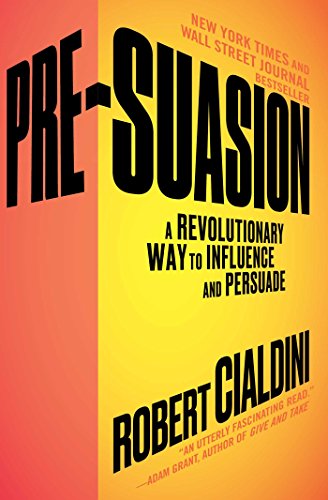
Talk to Pre-Suasion: A Revolutionary Way to Influence and Persuade like its author wrote you back.
Get the ideas that fit your life — not generic summaries.
- Chat with the book
- Audiobook-style main ideas
- Adapts to your life and goals
- Helps you take action
What it argues
Robert Cialdini spent decades studying the principles of persuasion that animate Influence, his 1984 masterwork. Pre-Suasion, published in 2016, is his sequel — not an update of the six principles but a new argument about what happens before a persuasive message arrives. His central claim is that the moment immediately before communication shapes its reception more than the content itself, and that skilled influencers prepare the ground before they plant the seed.
The concept is pre-suasion: the strategic arrangement of attention and context in the moment before a message is received, such that the target is more receptive. Cialdini demonstrates this through attention research. Attention is selective, and what we are attending to at any moment shapes what we associate, value, and believe. A simple manipulation of attention — getting someone to think about warmth, or safety, or high achievement — primes the cognitive landscape that their judgment operates in. The request that follows lands differently.
What it gets right
- 1.
Pre-suasion is the practice of arranging the moment before communication to make the target more receptive. What people attend to immediately before receiving a message shapes their response to it.
- 2.
Attention and causation are linked in human cognition. What is focal in attention tends to be attributed causal significance. Focusing attention on a factor makes it seem more important.
- 3.
Priming works: briefly exposing someone to a concept, image, or word changes subsequent judgments and choices in the direction of the prime. This operates below conscious awareness.
What it covers
Who wrote it
Robert B. Cialdini is Regents' Professor Emeritus of Psychology and Marketing at Arizona State University and the founder of Influence At Work. He is best known for Influence: The Psychology of Persuasion, which has sold over five million copies and is widely regarded as the most important book on persuasion in the social science literature. He spent years infiltrating sales, advertising, public relations, and fundraising organizations to observe the principles of influence in practice. He is also the author of Yes! 50 Scientifically Proven Ways to Be Persuasive, co-authored with Steve Martin and Noah Goldstein.
