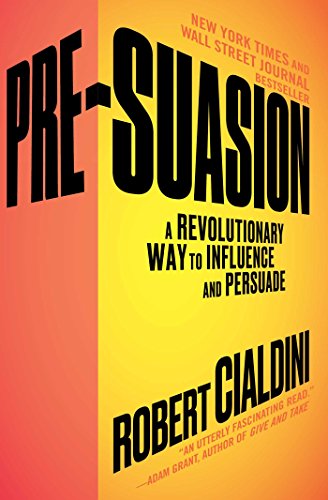
Pre-Suasion: A Revolutionary Way to Influence and Persuade by Robert B. Cialdini is a 2016 psychology book about persuasion, attention, priming. Pre-suasion is the practice of arranging the moment before communication to make the target more receptive. What people attend to immediately before receiving a message shapes their response to it.
Summary
Robert Cialdini spent decades studying the principles of persuasion that animate Influence, his 1984 masterwork. Pre-Suasion, published in 2016, is his sequel — not an update of the six principles but a new argument about what happens before a persuasive message arrives. His central claim is that the moment immediately before communication shapes its reception more than the content itself, and that skilled influencers prepare the ground before they plant the seed.
The concept is pre-suasion: the strategic arrangement of attention and context in the moment before a message is received, such that the target is more receptive. Cialdini demonstrates this through attention research. Attention is selective, and what we are attending to at any moment shapes what we associate, value, and believe. A simple manipulation of attention — getting someone to think about warmth, or safety, or high achievement — primes the cognitive landscape that their judgment operates in. The request that follows lands differently.
The book covers several mechanisms through which pre-suasion operates. Attention is one: what is salient is what is causal, in the sense that focused attention makes us treat attended things as causes of outcomes. Unity is another: Cialdini identifies a seventh principle of influence — shared identity, or the sense of being in the same group — which produces influence at a level deeper than liking or authority. Openers are a third: the first element of a message primes the remainder, and the information that arrives first has disproportionate weight.
Pre-Suasion is not as fundamental a contribution as Influence and is sometimes more illustrative than rigorous. The research base for some of the priming claims has been subject to replication challenges. But the core insight — that the moment before communication matters as much as the communication itself — is robust, and the implications for how messages are crafted, how environments are designed, and how attention is managed are genuinely useful.
Talk to Pre-Suasion: A Revolutionary Way to Influence and Persuade like its author wrote you back.
Get the ideas that fit your life — not generic summaries.
- Chat with the book
- Audiobook-style main ideas
- Adapts to your life and goals
- Helps you take action
Key takeaways
- 1.
Pre-suasion is the practice of arranging the moment before communication to make the target more receptive. What people attend to immediately before receiving a message shapes their response to it.
- 2.
Attention and causation are linked in human cognition. What is focal in attention tends to be attributed causal significance. Focusing attention on a factor makes it seem more important.
- 3.
Priming works: briefly exposing someone to a concept, image, or word changes subsequent judgments and choices in the direction of the prime. This operates below conscious awareness.
- 4.
Unity — shared identity, the sense of 'we' — is a seventh principle of influence beyond the six in Influence. It produces influence at a deeper level than liking or social proof.
- 5.
The opening of any communication primes everything that follows. First impressions and initial frames have outsized weight relative to subsequent information.
- 6.
Openers that establish common ground or shared category membership change how subsequent content is evaluated — not just whether the relationship is warm but whether the information is believed.
- 7.
Ethical use of influence principles requires transparency about the mechanisms. Pre-suasion can be deployed honestly or manipulatively, and Cialdini ends the book with an argument for the long-term costs of manipulative deployment.
Discussion questions
Use these on your own, with a book club, or as chat starters in Superbook. Book club version, ready to copy or print →
- 1.
Cialdini argues that the moment before a message matters as much as the message itself. Can you think of a case where you have experienced this — where the setup shaped how you received information?
- 2.
The attention-causation link means that focusing on a factor makes it seem more causally important. Where do you see this operating in media, politics, or organizational communication?
- 3.
Priming research has had replication problems. How do you weigh those replication challenges against the common-sense observation that context shapes judgment?
- 4.
He proposes a seventh principle of influence: unity, or shared identity. How is belonging to the same group different in its influence from simply liking someone?
- 5.
The book opens frame — what is presented first — shapes the entire subsequent evaluation. Can you think of a negotiation, presentation, or conversation where you have deliberately managed the opening frame?
- 6.
Cialdini ends the book arguing that manipulative use of influence principles damages both relationships and the influence practitioner's long-term capacity. Is that claim convincing?
- 7.
How does pre-suasion relate to what designers, marketers, and architects already do in managing environments and attention flows?
- 8.
The book argues that channeled attention produces focused conviction. What is the ethical line between legitimate persuasion and manufactured conviction?
- 9.
He describes pre-suasion as working on both the audience and the communicator — attending to a reason for a position also strengthens that position in the holder's own mind. What does that imply for how you prepare for important conversations?
- 10.
What is the most valuable pre-suasive move you have observed someone else make, and what made it effective?
- 11.
If you were going to apply one idea from this book to a high-stakes communication in your own life, what would it be?
Themes
Frequently asked questions
-
Do I need to read Influence before Pre-Suasion?
It helps. Pre-Suasion builds on the six principles from Influence and introduces a seventh. Readers who haven't read Influence can follow Pre-Suasion independently, but familiarity with the earlier framework makes the argument richer.
-
What is the difference between influence and pre-suasion?
Influence is the principles that make a message effective once delivered. Pre-suasion is the arrangement of context and attention before delivery that makes the target more receptive. Cialdini argues that the pre-message moment has been neglected relative to the message itself.
-
What is the seventh principle of influence?
Unity — the sense of shared identity, of being in the same group. Cialdini distinguishes this from liking: it is not that we like someone in our group; it is that we experience ourselves as the same kind of thing, with shared stakes and shared identity.
-
Has the priming research in the book been replicated?
Mixed. Some priming effects that Cialdini cites — including social priming experiments involving money and photographs — have had serious replication failures. The core attention and framing effects are more robustly supported.
-
Is this book more useful for practitioners or general readers?
Both. Practitioners in marketing, negotiation, fundraising, and management will find direct applications. General readers will find it useful for recognizing when pre-suasive techniques are being used on them, which is equally valuable.
Similar books
Influence: The Psychology of Persuasion
Robert B. Cialdini
Thinking, Fast and Slow
Daniel Kahneman
Never Split the Difference
Chris Voss
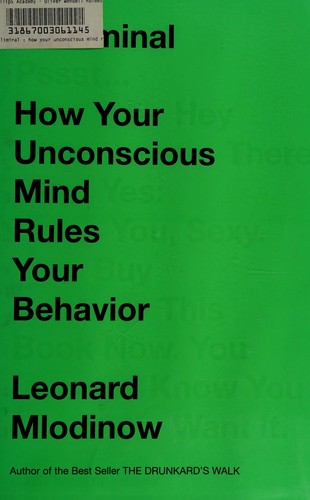
Subliminal: How Your Unconscious Mind Rules Your Behavior
Leonard Mlodinow
