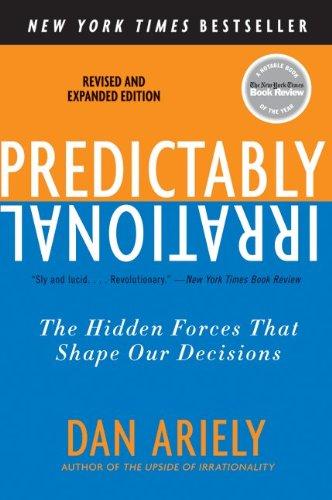
Talk to Predictably Irrational like its author wrote you back.
Get the ideas that fit your life — not generic summaries.
- Chat with the book
- Audiobook-style main ideas
- Adapts to your life and goals
- Helps you take action
What it argues
Predictably Irrational is Dan Ariely's examination of how humans make decisions that are consistently, systematically irrational — not random or arbitrary, but irrational in ways that follow patterns. Where classical economics assumes people weigh costs and benefits rationally, Ariely's experiments show that context, comparison, and emotion hijack decisions in repeatable ways. The book's central point is not that people are dumb but that the conditions under which we decide are reliably exploited, often by marketers and institutions, and can be redesigned by us once we understand the mechanisms.
Each chapter isolates a single phenomenon. Relative pricing explains why we respond to decoy options: a magazine offers a print-only subscription for $125, a web-only subscription for $59, and a print-plus-web bundle for $125. The print-only option exists to make the bundle look like a steal. Ariely ran the experiment with MIT students and found that removing the decoy shifted almost everyone to the cheaper option. The decoy creates a comparison that makes one choice feel obviously right — without it, people have no anchor. This pattern, anchoring, shows up in salary negotiations, restaurant menus, and real estate pricing.
What it gets right
- 1.
Humans are not randomly irrational but predictably irrational — our biases follow consistent patterns that can be studied, mapped, and anticipated.
- 2.
Anchoring shapes all relative judgments. The first number you see — a salary figure, a list price, a suggested donation — creates a reference point that pulls every subsequent estimate toward it.
- 3.
Decoy options are designed to make one choice feel obviously superior. When a pricing tier exists only to make the bundle look like a bargain, that's the decoy at work.
What it covers
Who wrote it
Dan Ariely is a behavioral economist and the James B. Duke Professor of Psychology and Behavioral Economics at Duke University. He founded the Center for Advanced Hindsight and previously taught at MIT and Princeton. His other books include The Upside of Irrationality, The Honest Truth About Dishonesty, and Dollars and Sense. Ariely writes for academic journals and popular outlets and speaks widely on how irrational behavior shapes markets, health, and everyday life. Much of his research is informed by a severe burn injury he suffered as a teenager, which sparked his interest in how people decide under pain and uncertainty.
