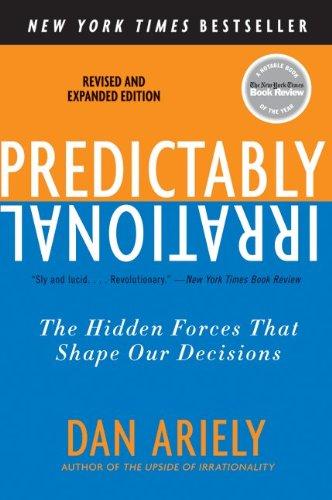
Predictably Irrational by Dan Ariely is a 2008 psychology book about decision-making, behavioral economics, cognitive bias. Humans are not randomly irrational but predictably irrational — our biases follow consistent patterns that can be studied, mapped, and anticipated.
Summary
Predictably Irrational is Dan Ariely's examination of how humans make decisions that are consistently, systematically irrational — not random or arbitrary, but irrational in ways that follow patterns. Where classical economics assumes people weigh costs and benefits rationally, Ariely's experiments show that context, comparison, and emotion hijack decisions in repeatable ways. The book's central point is not that people are dumb but that the conditions under which we decide are reliably exploited, often by marketers and institutions, and can be redesigned by us once we understand the mechanisms.
Each chapter isolates a single phenomenon. Relative pricing explains why we respond to decoy options: a magazine offers a print-only subscription for $125, a web-only subscription for $59, and a print-plus-web bundle for $125. The print-only option exists to make the bundle look like a steal. Ariely ran the experiment with MIT students and found that removing the decoy shifted almost everyone to the cheaper option. The decoy creates a comparison that makes one choice feel obviously right — without it, people have no anchor. This pattern, anchoring, shows up in salary negotiations, restaurant menus, and real estate pricing.
The book also covers the zero price effect: "free" is not just cheap, it triggers a different mental process entirely. People take free items they don't want and pass up deals they'd have otherwise taken the moment a price becomes zero. Social norms and market norms govern separate domains, and mixing them is costly — asking a friend to help you move is fine, but offering them twenty dollars for it is insulting. Ariely's chapter on ownership shows that we overvalue what we own (the endowment effect) to a degree that shapes everything from eBay bidding behavior to political conviction. Expectations shape experience: when told a beer contains balsamic vinegar before tasting it, people rate it lower than when told afterward, even though it's the same beer.
Where the book is weaker is in scope. Most experiments were run on MIT undergraduates in controlled conditions, and Ariely is honest about this in ways that make it readable but leave the generalizability open. Some findings covered here have also faced replication scrutiny since 2008. That said, the core mechanisms — anchoring, the power of free, social versus market norms, the endowment effect — are robust and have held up. For anyone who makes decisions about pricing, product design, negotiation, or their own spending, Ariely's framework for why the irrational choice felt so rational at the time remains one of the clearest available.
Talk to Predictably Irrational like its author wrote you back.
Get the ideas that fit your life — not generic summaries.
- Chat with the book
- Audiobook-style main ideas
- Adapts to your life and goals
- Helps you take action
Key takeaways
- 1.
Humans are not randomly irrational but predictably irrational — our biases follow consistent patterns that can be studied, mapped, and anticipated.
- 2.
Anchoring shapes all relative judgments. The first number you see — a salary figure, a list price, a suggested donation — creates a reference point that pulls every subsequent estimate toward it.
- 3.
Decoy options are designed to make one choice feel obviously superior. When a pricing tier exists only to make the bundle look like a bargain, that's the decoy at work.
- 4.
Free is a different category, not just cheap. The zero price effect means people take items they don't want and reject better deals the moment a price tag appears.
- 5.
Social norms and market norms operate on separate tracks. Mixing them — putting a cash value on a favor, or a friendship frame on a business transaction — tends to damage both relationships.
- 6.
The endowment effect means we overvalue what we own. Once something is ours, loss aversion inflates its perceived worth beyond what we'd have paid to acquire it.
- 7.
Expectations change experience. Knowing a wine costs more, or that a beer has a strange ingredient, physically alters how it tastes — the brain fills in the experience based on prior belief.
- 8.
Procrastination and self-control problems are predictable. Ariely's experiments show that people given the freedom to set their own deadlines perform better than those with no deadlines, and worse than those with imposed ones.
Discussion questions
Use these on your own, with a book club, or as chat starters in Superbook. Book club version, ready to copy or print →
- 1.
Ariely argues irrationality is predictable. In the last month, can you identify a purchase decision where an anchor — a first price you saw — shaped what you eventually paid?
- 2.
The decoy effect is everywhere in pricing. Where have you noticed a tier or option that seemed to exist only to make another choice look like a deal?
- 3.
The zero price effect makes free feel different from cheap. Think of something free you took in the last year that you didn't actually want. Would you have taken it at a penny?
- 4.
Ariely distinguishes social norms from market norms. Has a situation ever shifted between these two registers in your life — and how did it feel when it did?
- 5.
The endowment effect says you overvalue what you own. What's something you're holding onto — a job title, a possession, a position in a debate — partly because it's already yours?
- 6.
Expectations shape experience. Think of something you consumed or experienced while believing it was higher quality than it was. Did the belief change your experience?
- 7.
Ariely's chapter on self-control suggests people benefit from imposed deadlines more than self-set ones. Where in your work or personal life are you operating without a deadline you probably need?
- 8.
The book argues that dishonesty is also predictable — that most people cheat a little when they can rationalize it, rather than a lot. Does that match what you observe in institutions or in yourself?
- 9.
Ariely describes how arousal (in any form — anger, hunger, excitement) shrinks the gap between our stated values and our actual behavior. When have you made a decision in a hot state that your cooler self wouldn't have?
- 10.
Which irrational pattern from the book do you think is most exploited by companies you use regularly? And have you changed behavior as a result of recognizing it?
- 11.
The experiments in this book were mostly run on college students. Do you think the findings apply equally across age groups, cultures, and income levels? What might differ?
- 12.
Ariely ends with the argument that understanding irrationality gives us power to redesign our environment. What's one decision context in your life you could restructure to make the better choice easier?
Themes
Frequently asked questions
-
What is Predictably Irrational about?
It's a behavioral economics book arguing that human decision-making is systematically irrational in ways that follow consistent, exploitable patterns. Ariely draws on experiments to show how anchoring, the zero price effect, social norms, and ownership bias shape choices people believe are rational.
-
Is Predictably Irrational still worth reading?
Yes, though some readers should know that a handful of behavioral economics findings from that era have faced replication challenges since 2008. The core concepts — anchoring, the endowment effect, the power of free, social versus market norms — are well-supported and directly useful.
-
How does Predictably Irrational differ from Thinking, Fast and Slow?
Kahneman's book is broader and more theoretically grounded, covering the full architecture of System 1 and System 2 thinking. Ariely's book is narrower and more accessible, organized around specific experiments and everyday scenarios. Most readers find Ariely easier to start with.
-
Who should read Predictably Irrational?
Anyone involved in pricing, product design, negotiation, or policy who wants to understand why rational-seeming choices often aren't. Also useful for people trying to understand their own financial decisions or why good intentions don't always lead to good outcomes.
-
What's the most useful idea in Predictably Irrational?
The distinction between social norms and market norms. Once you understand that mixing them damages both — that putting a price on a favor or a friendship frame on a transaction creates friction — you start to see it everywhere in professional and personal relationships.
Similar books
Thinking, Fast and Slow
Daniel Kahneman
Influence: The Psychology of Persuasion
Robert B. Cialdini
Nudge: Improving Decisions About Health, Wealth, and Happiness
Richard H. Thaler and Cass R. Sunstein
Blink: The Power of Thinking Without Thinking
Malcolm Gladwell
Predictably Irrational vs.
Deciding between two books? Predictably Irrational vs Thinking, Fast and Slow .
