Psychology · Book club
Presence book club questions
Here are 11 book club questions for Presence by Amy Cuddy, ordered to open easily and end somewhere worth arguing about. Copy them, print them, or bring them up one at a time.
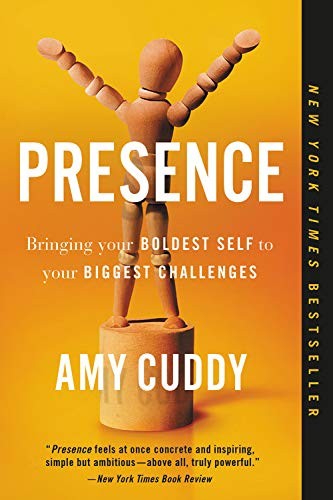
Presence is Amy Cuddy's case that the key to performing well in high-stakes situations is not to fake confidence but to access genuine self-belief — and that the body, surprisingly, is a reliable on-ramp to that state.
Amy Cuddy · 2015 · 5h 15m
Full summary and key takeaways →The 11 questions
- 1.
Cuddy distinguishes between performing confidence and accessing genuine self-belief. What does that distinction feel like in your own experience of high-stakes moments?
- 2.
Have you ever used physical preparation — posture, breathing, movement — before a difficult conversation or presentation? What effect did it have?
- 3.
What are the values or qualities you would want to affirm before an important moment? How often do you actually do that consciously?
- 4.
Imposter syndrome tends to intensify in new environments or at higher levels of responsibility. When have you felt it most strongly, and how did you respond?
- 5.
The book's science on power posing has been challenged since publication. How do you evaluate advice that rests on contested research?
- 6.
Cuddy argues that authenticity is more effective than strategic impression management. Where in your professional life do you feel you're performing a persona rather than showing up as yourself?
- 7.
What physical habits do you have before stressful situations — pacing, contracting, checking your phone — and do any of them actually help?
- 8.
Think of someone you find genuinely present in conversation. What specifically do they do or not do that creates that effect?
- 9.
Reframing anxiety as excitement uses the same physiological arousal differently. Have you ever made that shift deliberately, and what happened?
- 10.
Cuddy's personal story of brain trauma and recovery is central to the book. How does her credibility as a subject of her own research affect how you read her advice?
- 11.
What is one situation in the next month where you want to show up differently? What specific preparation would Cuddy recommend for it?
How to run the discussion
- Pick six to eight, not all of them. An hour of real discussion covers fewer questions than anyone expects, and racing the list is what makes a book club feel like homework.
- Open with what people noticed, not what they concluded. Asking for a verdict first hardens opinions before anyone has heard each other.
- Let the disagreement run. The questions below that split a room are the ones worth the time; the ones everyone answers the same way can be skipped.
- Ask the quiet person a specific question. A direct, narrow question is far easier to answer than an open invitation to contribute.
Themes worth steering toward
If the conversation stalls, these are the threads that usually restart it.
Common questions
What are good book club questions for Presence?
Here are 11 book club questions for Presence by Amy Cuddy, ordered to open easily and end somewhere worth arguing about. The strongest openers ask what each reader noticed rather than what they concluded, and the discussion usually turns on confidence, body language, self-perception.
How long should a book club discussion of Presence last?
Most groups run 60 to 90 minutes of actual discussion. That is roughly six to eight questions, not all of them, so pick the ones that suit your group rather than working down the list in order.
What are the main themes in Presence?
Confidence, Body language, Self-perception, Performance, Authenticity. Those are the threads most likely to divide a room, which makes them the useful places to steer a discussion that has gone quiet.
Picking the next one? See books like Presence or questions for other book club picks.
