Business · Book club
Primal Leadership book club questions
Here are 11 book club questions for Primal Leadership by Daniel Goleman, Richard Boyatzis, and Annie McKee, ordered to open easily and end somewhere worth arguing about. Copy them, print them, or bring them up one at a time.
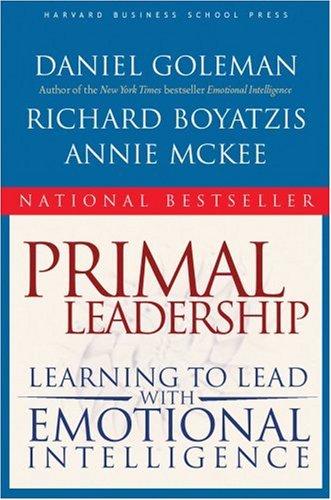
Primal Leadership is the application of emotional intelligence to organizational leadership, written by Daniel Goleman with Richard Boyatzis and Annie McKee.
Daniel Goleman, Richard Boyatzis, and Annie McKee · 2002 · 5h 0m
Full summary and key takeaways →The 11 questions
- 1.
Which of the six leadership styles do you use most naturally? Which do you use least? What's the cost of that imbalance?
- 2.
Think about a specific leader you've worked for whose emotional climate was highly positive. What did they do differently from leaders who created anxiety or flatness?
- 3.
Goleman argues that the pacesetting style suppresses initiative over time despite feeling like high standards. Do you agree? Where have you seen the cost of a pacesetting culture?
- 4.
When was the last time you led a development conversation with a direct report that was genuinely coaching rather than advice-giving or performance management?
- 5.
What's the emotional climate your team operates in on a typical week? How much of that climate do you create versus how much is context you've inherited?
- 6.
The book argues that lasting change requires starting with a vision of who you want to become, not a list of what's wrong. How does this apply to the development conversations you have with your team?
- 7.
What feedback have you received about the emotional climate you create? Did you agree with it? What did you do with it?
- 8.
Which leadership style do you reach for under pressure or stress? Is that the most effective choice for those situations?
- 9.
The commanding style is useful in a genuine crisis and corrosive when used habitually. What counts as a genuine crisis in your work? How often do you invoke it when it's not?
- 10.
Boyatzis's Intentional Change Theory says development must start with a compelling desired self. If you could describe your ideal leader self in specific behavioral terms, what would it look like?
- 11.
What does resonance actually feel like from inside the team — how do you know when a leader is resonant rather than just nice?
How to run the discussion
- Pick six to eight, not all of them. An hour of real discussion covers fewer questions than anyone expects, and racing the list is what makes a book club feel like homework.
- Open with what people noticed, not what they concluded. Asking for a verdict first hardens opinions before anyone has heard each other.
- Let the disagreement run. The questions below that split a room are the ones worth the time; the ones everyone answers the same way can be skipped.
- Ask the quiet person a specific question. A direct, narrow question is far easier to answer than an open invitation to contribute.
Themes worth steering toward
If the conversation stalls, these are the threads that usually restart it.
Common questions
What are good book club questions for Primal Leadership?
Here are 11 book club questions for Primal Leadership by Daniel Goleman, Richard Boyatzis, and Annie McKee, ordered to open easily and end somewhere worth arguing about. The strongest openers ask what each reader noticed rather than what they concluded, and the discussion usually turns on leadership, emotional intelligence, organizational climate.
How long should a book club discussion of Primal Leadership last?
Most groups run 60 to 90 minutes of actual discussion. That is roughly six to eight questions, not all of them, so pick the ones that suit your group rather than working down the list in order.
What are the main themes in Primal Leadership?
Leadership, Emotional intelligence, Organizational climate, Coaching, Self-awareness. Those are the threads most likely to divide a room, which makes them the useful places to steer a discussion that has gone quiet.
Picking the next one? See books like Primal Leadership or questions for other book club picks.
