Economics · Book club
Quality of Earnings book club questions
Here are 11 book club questions for Quality of Earnings by Thornton O'Glove, ordered to open easily and end somewhere worth arguing about. Copy them, print them, or bring them up one at a time.
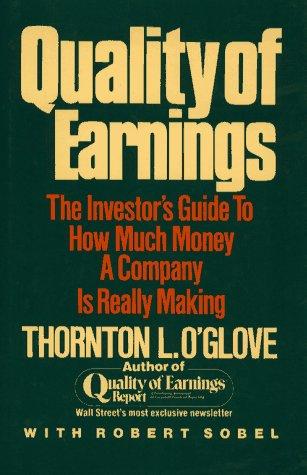
Quality of Earnings, published in 1987, is Thornton O'Glove's guide to reading beyond the headline earnings figures that companies report and understanding whether those earnings are real, recurring, and representative of underlying business performance.
Thornton O'Glove · 1987 · 4h 45m
Full summary and key takeaways →The 11 questions
- 1.
O'Glove argues that the gap between reported earnings and cash flow is the most important signal to watch. Why do most investors focus on earnings rather than cash flow?
- 2.
He describes accounting changes as always warranting investigation. Is that too strong a claim, or is skepticism about accounting policy changes always justified?
- 3.
The book was written in 1987. Which of the earnings manipulation techniques he describes have been addressed by subsequent accounting reforms, and which remain available?
- 4.
O'Glove's analysis requires detailed attention to financial filings that most investors don't do. Is this level of analysis realistic for individual investors, or does it belong primarily to professionals?
- 5.
What does 'quality of earnings' analysis suggest about the reliability of financial analysts' consensus estimates, which are typically based on reported earnings rather than adjusted cash flows?
- 6.
Think of a corporate scandal you know about — Enron, WorldCom, Wirecard, or others. Were the warning signs O'Glove identifies present in the public filings before the collapse became public?
- 7.
The concept of earnings quality implicitly assumes that management is choosing between more and less honest representations of reality. How prevalent is that kind of choice in practice?
- 8.
O'Glove's approach is fundamentally skeptical. At what point does appropriate skepticism about management's presentation become an unreasonable assumption of bad faith?
- 9.
The framework in Quality of Earnings requires significant accounting literacy. What's the minimum level of financial literacy an individual investor needs to apply even a basic version of these ideas?
- 10.
If you were advising someone buying a small private business (not a public company), how would you adapt O'Glove's framework to that context?
- 11.
Analysts who identify earnings manipulation early are often dismissed as being negative while the stock continues to rise. How do you maintain analytical integrity in the face of that social pressure?
How to run the discussion
- Pick six to eight, not all of them. An hour of real discussion covers fewer questions than anyone expects, and racing the list is what makes a book club feel like homework.
- Open with what people noticed, not what they concluded. Asking for a verdict first hardens opinions before anyone has heard each other.
- Let the disagreement run. The questions below that split a room are the ones worth the time; the ones everyone answers the same way can be skipped.
- Ask the quiet person a specific question. A direct, narrow question is far easier to answer than an open invitation to contribute.
Themes worth steering toward
If the conversation stalls, these are the threads that usually restart it.
Common questions
What are good book club questions for Quality of Earnings?
Here are 11 book club questions for Quality of Earnings by Thornton O'Glove, ordered to open easily and end somewhere worth arguing about. The strongest openers ask what each reader noticed rather than what they concluded, and the discussion usually turns on accounting analysis, financial reporting, investing.
How long should a book club discussion of Quality of Earnings last?
Most groups run 60 to 90 minutes of actual discussion. That is roughly six to eight questions, not all of them, so pick the ones that suit your group rather than working down the list in order.
What are the main themes in Quality of Earnings?
Accounting analysis, Financial reporting, Investing, Corporate transparency, Due diligence. Those are the threads most likely to divide a room, which makes them the useful places to steer a discussion that has gone quiet.
Picking the next one? See books like Quality of Earnings or questions for other book club picks.
