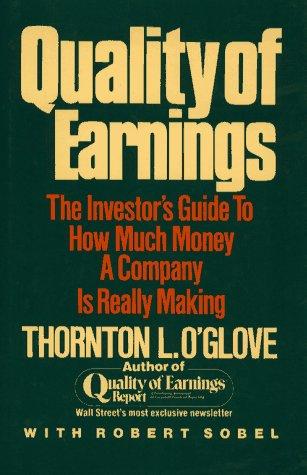
Quality of Earnings by Thornton O'Glove is a 1987 economics book about accounting analysis, financial reporting, investing. Earnings quality is the degree to which reported earnings reflect the actual economic performance of the business. High-quality earnings are cash-backed, recurring, and from core operations.
Summary
Quality of Earnings, published in 1987, is Thornton O'Glove's guide to reading beyond the headline earnings figures that companies report and understanding whether those earnings are real, recurring, and representative of underlying business performance. O'Glove spent decades as a financial analyst and newsletter publisher, and the book distills his approach to detecting the gap between what management wants you to believe about a company's financial health and what the financial statements actually show when read carefully.
The central concept is exactly what the title says: earnings quality. High-quality earnings are backed by cash flow, come from the core business, are not inflated by one-time gains or accounting choices, and are likely to recur. Low-quality earnings may be boosted by accounting adjustments, inventory buildup, delayed expense recognition, or non-recurring items that management has chosen to present as if they were normal. The difference matters enormously for investors: a company reporting strong but low-quality earnings is often in worse shape than one reporting modest but high-quality ones.
O'Glove systematically walks through the major areas where earnings quality degrades: changes in accounting methods (always a red flag worth investigating), shifts in revenue recognition, unusual inventory or receivables growth relative to sales, aggressive capitalization of expenses that should be expensed, and the gap between reported net income and free cash flow. He provides examples from real companies, including some spectacular cases where the red flags were visible in public filings years before the problems became public.
The book predates Sarbanes-Oxley and was written in an era when accounting standards were more permissive than they became after 2002. Some of the specific tricks he describes have been addressed by subsequent rule changes. But the underlying framework — cross-checking the income statement against the cash flow statement, examining changes in accounting policy with suspicion, following the cash rather than the reported earnings — remains the foundation of forensic accounting and value investing analysis. Charlie Munger is among the readers who have cited it as essential.
Talk to Quality of Earnings like its author wrote you back.
Get the ideas that fit your life — not generic summaries.
- Chat with the book
- Audiobook-style main ideas
- Adapts to your life and goals
- Helps you take action
Key takeaways
- 1.
Earnings quality is the degree to which reported earnings reflect the actual economic performance of the business. High-quality earnings are cash-backed, recurring, and from core operations.
- 2.
The cash flow statement is the primary check on the income statement. Persistent divergence between reported net income and operating cash flow is a serious warning sign.
- 3.
Changes in accounting methods always warrant investigation. Companies rarely change their accounting policies to make their performance look worse.
- 4.
Revenue recognition is one of the most abused areas of financial reporting. Aggressive revenue recognition pulls future sales into the current period; conservative recognition pushes current sales into the future.
- 5.
Inventory and receivables growing faster than sales are red flags. They often indicate that channel stuffing, fictitious sales, or demand problems are being papered over with balance sheet adjustments.
- 6.
Non-recurring items require skepticism. A company with a new 'non-recurring' charge every year has recurring charges. Restructuring costs that appear annually are operating costs.
- 7.
Following the footnotes is essential. Material information about accounting choices, contingent liabilities, and related-party transactions is often buried in notes that most readers skip.
Discussion questions
Use these on your own, with a book club, or as chat starters in Superbook. Book club version, ready to copy or print →
- 1.
O'Glove argues that the gap between reported earnings and cash flow is the most important signal to watch. Why do most investors focus on earnings rather than cash flow?
- 2.
He describes accounting changes as always warranting investigation. Is that too strong a claim, or is skepticism about accounting policy changes always justified?
- 3.
The book was written in 1987. Which of the earnings manipulation techniques he describes have been addressed by subsequent accounting reforms, and which remain available?
- 4.
O'Glove's analysis requires detailed attention to financial filings that most investors don't do. Is this level of analysis realistic for individual investors, or does it belong primarily to professionals?
- 5.
What does 'quality of earnings' analysis suggest about the reliability of financial analysts' consensus estimates, which are typically based on reported earnings rather than adjusted cash flows?
- 6.
Think of a corporate scandal you know about — Enron, WorldCom, Wirecard, or others. Were the warning signs O'Glove identifies present in the public filings before the collapse became public?
- 7.
The concept of earnings quality implicitly assumes that management is choosing between more and less honest representations of reality. How prevalent is that kind of choice in practice?
- 8.
O'Glove's approach is fundamentally skeptical. At what point does appropriate skepticism about management's presentation become an unreasonable assumption of bad faith?
- 9.
The framework in Quality of Earnings requires significant accounting literacy. What's the minimum level of financial literacy an individual investor needs to apply even a basic version of these ideas?
- 10.
If you were advising someone buying a small private business (not a public company), how would you adapt O'Glove's framework to that context?
- 11.
Analysts who identify earnings manipulation early are often dismissed as being negative while the stock continues to rise. How do you maintain analytical integrity in the face of that social pressure?
Themes
Frequently asked questions
-
What is Quality of Earnings about?
It's a guide to evaluating whether a company's reported earnings reflect genuine economic performance or have been inflated through accounting choices. O'Glove teaches readers to check the income statement against the cash flow statement, examine accounting policy changes with suspicion, and identify the signs that management is using legitimate accounting flexibility to present the business in an overly favorable light.
-
Is Quality of Earnings worth reading for non-professional investors?
Yes, though it requires patience with accounting concepts. Even readers who can't apply every technique will come away with a healthy skepticism about headline earnings numbers and a basic understanding of why cash flow matters more than net income. The core framework is accessible; the detailed footnote analysis is more specialized.
-
How has the book aged since 1987?
The specific accounting maneuvers described have changed somewhat — Sarbanes-Oxley in 2002 tightened some rules — but the underlying framework holds. Cash flow versus earnings divergence, accounting policy changes, and revenue recognition abuse remain the primary tools of earnings manipulation. The specific examples are dated; the analytical approach is not.
-
What is the most important single idea in the book?
Follow the cash. If a company reports strong net income but weak operating cash flow year after year, something is wrong — either with the accounting, the business model, or both. This single check, applied consistently, will catch most serious earnings quality problems before they become public.
-
Who has recommended Quality of Earnings?
Charlie Munger has cited it as essential reading for investors. It's also appeared on recommended reading lists from various value investors who emphasize fundamental analysis. It is not widely known outside the investing community but has been consistently influential within it.