Science · Book club
Quantum Theory Cannot Hurt You book club questions
Here are 11 book club questions for Quantum Theory Cannot Hurt You by Marcus Chown, ordered to open easily and end somewhere worth arguing about. Copy them, print them, or bring them up one at a time.
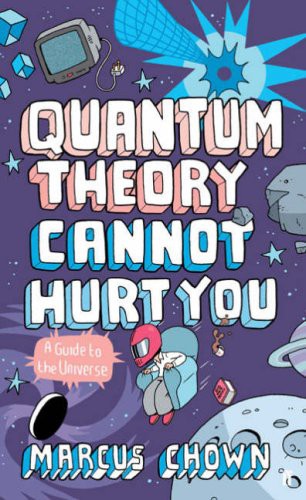
Marcus Chown, a former radio astronomer and longtime science writer, takes two of the most counterintuitive theories in physics — quantum mechanics and special relativity — and presents them in a single short book aimed squarely at readers who find both intimidating.
Marcus Chown · 2007 · 3h 45m
Full summary and key takeaways →The 11 questions
- 1.
Chown argues that quantum mechanics requires abandoning the idea that the world has a definite state independent of observation. How does that strike you?
- 2.
The uncertainty principle is a fact about nature, not a limit of instruments. What other 'measurement problems' might turn out to be features of reality rather than our tools?
- 3.
Chown uses humor to soften counterintuitive ideas. Does that approach help or does it sometimes undermine the seriousness of the physics?
- 4.
Time dilation and length contraction are real physical effects, not optical illusions. Did the relativity sections change how you think about time?
- 5.
Quantum entanglement implies that two particles can be correlated across any distance instantaneously. Why does this not allow faster-than-light communication?
- 6.
Both quantum mechanics and general relativity are extremely accurate theories, but they contradict each other at extreme scales. What does it mean to have two theories that both work but can't both be fundamentally right?
- 7.
Chown writes for readers who are intimidated by physics. Did the humor make the ideas more accessible, or did it sometimes feel like a substitute for explanation?
- 8.
Special relativity says there is no universal 'now' — simultaneity is relative to the observer. What does that imply about events that seem to happen 'at the same time'?
- 9.
Which idea in the book was hardest to hold onto after you finished reading it?
- 10.
Chown is a science writer, not a physicist. Does that affect how much you trust his explanations, or do you think it makes him better at communicating?
- 11.
Physics uses thought experiments — imaginary scenarios — to develop real theories. Do you think that method works in practice, or does it just produce plausible-sounding results?
How to run the discussion
- Pick six to eight, not all of them. An hour of real discussion covers fewer questions than anyone expects, and racing the list is what makes a book club feel like homework.
- Open with what people noticed, not what they concluded. Asking for a verdict first hardens opinions before anyone has heard each other.
- Let the disagreement run. The questions below that split a room are the ones worth the time; the ones everyone answers the same way can be skipped.
- Ask the quiet person a specific question. A direct, narrow question is far easier to answer than an open invitation to contribute.
Themes worth steering toward
If the conversation stalls, these are the threads that usually restart it.
Common questions
What are good book club questions for Quantum Theory Cannot Hurt You?
Here are 11 book club questions for Quantum Theory Cannot Hurt You by Marcus Chown, ordered to open easily and end somewhere worth arguing about. The strongest openers ask what each reader noticed rather than what they concluded, and the discussion usually turns on quantum mechanics, relativity, physics.
How long should a book club discussion of Quantum Theory Cannot Hurt You last?
Most groups run 60 to 90 minutes of actual discussion. That is roughly six to eight questions, not all of them, so pick the ones that suit your group rather than working down the list in order.
What are the main themes in Quantum Theory Cannot Hurt You?
Quantum mechanics, Relativity, Physics, Cosmology, Scientific intuition. Those are the threads most likely to divide a room, which makes them the useful places to steer a discussion that has gone quiet.
Picking the next one? See books like Quantum Theory Cannot Hurt You or questions for other book club picks.
