Economics · Book club
Rational Ritual book club questions
Here are 11 book club questions for Rational Ritual by Michael Chwe, ordered to open easily and end somewhere worth arguing about. Copy them, print them, or bring them up one at a time.
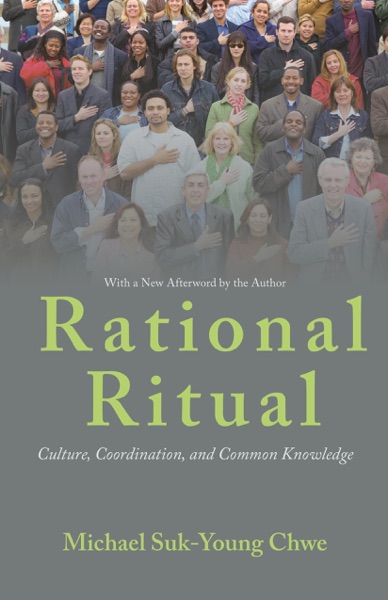
Rational Ritual is a short, elegant book about why certain kinds of social events — rituals, ceremonies, public spectacles, advertising in mass media — serve a function that private communication cannot.
Michael Chwe · 2001 · 2h 40m
Full summary and key takeaways →The 11 questions
- 1.
Chwe argues that Super Bowl ads are priced for common knowledge, not just reach. Does that reframe change how you think about other instances of expensive mass-media advertising?
- 2.
Think of a public ritual in your own life — a wedding, a graduation, a national holiday. What common knowledge was it producing, and what would be lost if it were replaced by private notifications?
- 3.
The book argues that political protests generate common knowledge that private organizing cannot. Does that explain why authoritarian governments restrict public gatherings even when the content seems harmless?
- 4.
How has social media changed the common knowledge problem? Does a viral tweet create common knowledge, or something different?
- 5.
Chwe's framework comes from game theory. Does applying economic reasoning to rituals and ceremonies feel illuminating or reductive to you?
- 6.
The book is short enough to read in an afternoon. Do you find very short, argument-focused academic books more or less convincing than longer ones? What does length signal?
- 7.
What is the common knowledge problem in your own workplace or community? What events or rituals currently solve it, and what gaps remain?
- 8.
Chwe says common knowledge can be used to maintain oppressive orders as well as to coordinate liberation. Can you think of examples where this is true?
- 9.
The argument treats common knowledge as essentially neutral — a tool for coordination that can serve any political end. Is that neutrality convincing?
- 10.
How do you think Zoom meetings and remote work have affected common knowledge in organizations that used to generate it through in-person all-hands or town hall events?
- 11.
If you were designing a new public institution — a policy announcement, a product launch, a community initiative — how would the common knowledge framework change what you would build?
How to run the discussion
- Pick six to eight, not all of them. An hour of real discussion covers fewer questions than anyone expects, and racing the list is what makes a book club feel like homework.
- Open with what people noticed, not what they concluded. Asking for a verdict first hardens opinions before anyone has heard each other.
- Let the disagreement run. The questions below that split a room are the ones worth the time; the ones everyone answers the same way can be skipped.
- Ask the quiet person a specific question. A direct, narrow question is far easier to answer than an open invitation to contribute.
Themes worth steering toward
If the conversation stalls, these are the threads that usually restart it.
Common questions
What are good book club questions for Rational Ritual?
Here are 11 book club questions for Rational Ritual by Michael Chwe, ordered to open easily and end somewhere worth arguing about. The strongest openers ask what each reader noticed rather than what they concluded, and the discussion usually turns on common knowledge, coordination, ritual and ceremony.
How long should a book club discussion of Rational Ritual last?
Most groups run 60 to 90 minutes of actual discussion. That is roughly six to eight questions, not all of them, so pick the ones that suit your group rather than working down the list in order.
What are the main themes in Rational Ritual?
Common knowledge, Coordination, Ritual and ceremony, Game theory, Social behavior. Those are the threads most likely to divide a room, which makes them the useful places to steer a discussion that has gone quiet.
Picking the next one? See books like Rational Ritual or questions for other book club picks.
