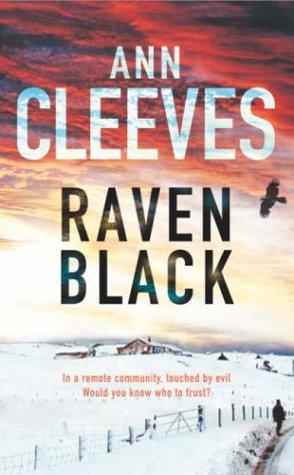
Raven Black by Ann Cleeves is a 2006 mystery book about isolation and community, otherness and scapegoating, guilt and innocence. Magnus Tait is the novel's moral center: a man whose strangeness has made him a social scapegoat, and whose actual guilt is more complicated than the island's ready assumption.
Summary
Raven Black is the first book in Ann Cleeves's Shetland series, set on the Scottish island archipelago at the very edge of British territory. A teenage girl is found murdered on the first day of the new year, in the snow near the isolated croft of Magnus Tait, a man the island has long regarded with vague suspicion. Magnus is immediately arrested. Detective Inspector Jimmy Perez, himself a Shetlander returned from the mainland, is not convinced. The island is small, its past is long, and someone else knows what happened.
The Shetland setting is not decoration but argument. These islands are communities where people know each other across generations, where the past is not past, and where the isolation that can feel protective can also trap. Cleeves uses the landscape — the light that barely arrives in January, the wind, the treeless hills — as a kind of moral pressure. There is nowhere to go and nowhere to hide, and yet secrets persist for decades.
At the center of the novel is the question of what happens to people a community decides to be suspicious of. Magnus Tait is not innocent in every sense — his past contains an episode that has never quite been explained — but the ease with which he becomes the suspect and the investigation's near-capture by that assumption is where the book finds its real interest. Perez's Scottish-island background makes him simultaneously insider and outsider, and Cleeves uses that ambiguity with care.
Raven Black won the CWA Gold Dagger in 2006, which helped launch Cleeves as a major name in British crime fiction. It is a deliberate, atmospheric novel that builds slowly and pays off in the final third. Readers who want Shetland's television intensity in prose form will find the book quieter and more patient; readers who want to understand what the television series is reaching for should start here.
Talk to Raven Black like its author wrote you back.
Get the ideas that fit your life — not generic summaries.
- Chat with the book
- Audiobook-style main ideas
- Adapts to your life and goals
- Helps you take action
Key takeaways
- 1.
Magnus Tait is the novel's moral center: a man whose strangeness has made him a social scapegoat, and whose actual guilt is more complicated than the island's ready assumption.
- 2.
Perez's dual status as local and returned-outsider is Cleeves's main tool for examining what Shetland is — he can see it both from inside and from a distance.
- 3.
The January Shetland landscape does real work in this book: the dark, the cold, and the isolation are not atmosphere dressing but conditions that shape what the community can and cannot admit.
- 4.
The scapegoating mechanism is studied with unusual care: not mob violence but quiet social consensus — the accumulated weight of decades of half-suspicion.
- 5.
Memory in isolated communities is long and selectively preserved. What people remember, and what version they remember, is as important as what happened.
- 6.
Cleeves distributes the investigation's failures honestly: Perez gets things wrong, the institutional pressure to close the case quickly is real, and the novel acknowledges that the wrong person nearly takes the fall.
- 7.
The murder victim is a teenager, and the novel insists on her specificity rather than using her as an abstract catalyst. What she was doing, and why, matters to the resolution.
- 8.
The ending earns its weight because Cleeves has been patient about the Shetland community's particular combination of closeness and concealment.
Discussion questions
Use these on your own, with a book club, or as chat starters in Superbook. Book club version, ready to copy or print →
- 1.
Magnus Tait is regarded with suspicion for decades based on something ambiguous that happened years earlier. What is the community doing when it sustains that kind of low-level suspicion? Is it self-protection or something else?
- 2.
The investigation nearly closes on the wrong person largely because of institutional and social pressure to resolve the case quickly. What does the novel say about what justice actually requires?
- 3.
Perez left Shetland and came back. How does that shape his investigation? Would a detective who had never left understand the island better or worse?
- 4.
The landscape — dark, cold, treeless, windswept — is used almost as a psychological condition rather than just a setting. Where did you feel that most strongly?
- 5.
Shetland is a community where people have long memories and short distances. Is that an advantage or a vulnerability when a crime needs to be solved?
- 6.
The killer's motive involves something that happened years before the novel begins. Does that make the crime feel more or less comprehensible to you?
- 7.
The novel opens on New Year's Day. Does the timing matter to how you read it? What does that particular threshold bring to the story?
- 8.
Cleeves presents the island community sympathetically while also showing clearly how it can produce and protect injustice. How does she manage that balance?
- 9.
Raven Black won the Gold Dagger in 2006. Having read it, do you understand why? Is there anything about it that surprised you given that level of recognition?
- 10.
The title Raven Black refers to the bird that appears at certain key moments. By the end, what do you think the raven represents in the book's economy?
- 11.
How does this compare to the television series in your sense of Shetland? Does one version feel truer to you?
- 12.
Jimmy Perez carries a loneliness that isn't entirely explained in this first book. What do you make of him as a character at this stage?
Themes
Frequently asked questions
-
Is Raven Black the same as the Shetland TV series?
It is the source material for the series, but they diverge significantly. The TV version compresses and relocates some plots, and the character of Perez in the books is somewhat different from Douglas Henshall's portrayal. Both are good; neither spoils the other.
-
Is Raven Black slow?
Yes, by thriller standards. The pacing is deliberate and the landscape is given as much attention as the plot. If you go in knowing it will reward patience rather than propel you forward, it works very well.
-
Do I need to know Shetland to read this?
No, but Cleeves embeds enough detail that readers unfamiliar with the islands get a strong sense of them. The geography and the particular social texture of an island community are established without requiring any background knowledge.
-
Who shouldn't read Raven Black?
Readers who want their mysteries to resolve neatly and without ambiguity will find the emotional texture here unsatisfying. The book ends on justice achieved, but with a residue of sadness about what the community did and did not do.
-
Is the Shetland series best read in order?
In order is better. The books are self-contained as mysteries, but Perez develops across the series and certain personal events in the later books carry more weight if you know his history.