Science · Book club
Reality Is Not What It Seems book club questions
Here are 12 book club questions for Reality Is Not What It Seems by Carlo Rovelli, ordered to open easily and end somewhere worth arguing about. Copy them, print them, or bring them up one at a time.
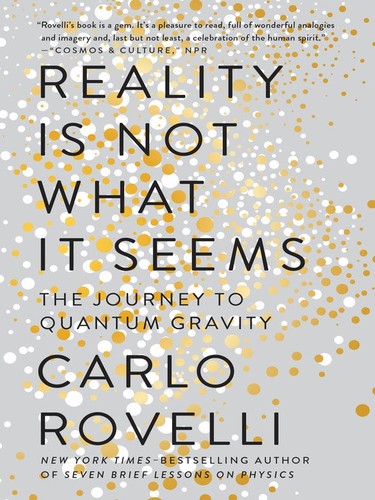
Reality Is Not What It Seems is Rovelli's most ambitious popular book: a history of human understanding of physical reality from the pre-Socratics to loop quantum gravity, the theory of quantum spacetime that Rovelli himself has spent his career developing.
Carlo Rovelli · 2014 · 4h 0m
Full summary and key takeaways →The 12 questions
- 1.
Rovelli traces a through-line from Democritus to loop quantum gravity. Is that historical framing a genuine insight about how science progresses, or a rhetorical device?
- 2.
Loop quantum gravity proposes that space itself is quantized. What would it mean for there to be a minimum length below which distance loses meaning?
- 3.
Rovelli is a developer of loop quantum gravity, not a neutral observer. Does that affect how persuasive you find his account of the debate with string theory?
- 4.
The book argues that time, at the most fundamental level, does not exist. After reading both The Order of Time and this book, how do you understand Rovelli's position on time?
- 5.
Quantum field theory describes particles as excitations of fields rather than as discrete objects. Did that framing change how you think about matter?
- 6.
Rovelli begins with Democritus. What does it tell us about science that an ancient intuition about discrete atomic units keeps proving prophetic at new scales?
- 7.
The unification of general relativity and quantum mechanics is often called the most important open problem in physics. After reading this book, why do you think it has proven so difficult?
- 8.
Rovelli is honest that loop quantum gravity is not yet confirmed by experiment. Does the absence of experimental confirmation change how you evaluate the theory?
- 9.
The book covers a vast sweep of history in roughly 200 pages. What ideas did you wish Rovelli had spent more time on?
- 10.
Rovelli argues that reality is fundamentally relational — that there are no absolute properties, only relations between systems. Is that philosophically satisfying or disturbingly empty?
- 11.
String theory has more adherents among physicists than loop quantum gravity. Is the sociology of physics — which theories get attention and funding — a distortion of scientific truth-seeking?
- 12.
After reading this book, what is your best guess about what space and time actually are at the most fundamental level?
How to run the discussion
- Pick six to eight, not all of them. An hour of real discussion covers fewer questions than anyone expects, and racing the list is what makes a book club feel like homework.
- Open with what people noticed, not what they concluded. Asking for a verdict first hardens opinions before anyone has heard each other.
- Let the disagreement run. The questions below that split a room are the ones worth the time; the ones everyone answers the same way can be skipped.
- Ask the quiet person a specific question. A direct, narrow question is far easier to answer than an open invitation to contribute.
Themes worth steering toward
If the conversation stalls, these are the threads that usually restart it.
Common questions
What are good book club questions for Reality Is Not What It Seems?
Here are 12 book club questions for Reality Is Not What It Seems by Carlo Rovelli, ordered to open easily and end somewhere worth arguing about. The strongest openers ask what each reader noticed rather than what they concluded, and the discussion usually turns on loop quantum gravity, space and time, quantum mechanics.
How long should a book club discussion of Reality Is Not What It Seems last?
Most groups run 60 to 90 minutes of actual discussion. That is roughly six to eight questions, not all of them, so pick the ones that suit your group rather than working down the list in order.
What are the main themes in Reality Is Not What It Seems?
Loop quantum gravity, Space and time, Quantum mechanics, History of physics, Cosmology. Those are the threads most likely to divide a room, which makes them the useful places to steer a discussion that has gone quiet.
Picking the next one? See books like Reality Is Not What It Seems or questions for other book club picks.
