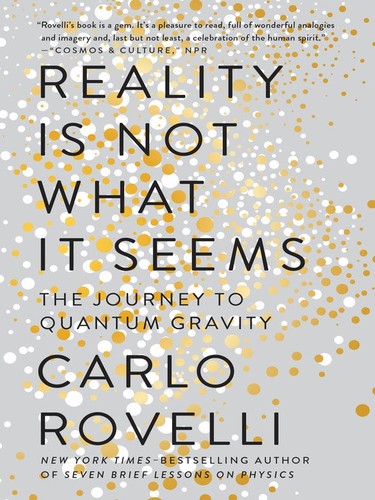
Reality Is Not What It Seems by Carlo Rovelli is a 2014 science book about loop quantum gravity, space and time, quantum mechanics. The history of physics is a history of discovering that the world is more granular than it appears: atoms, quanta, and now, loop quantum gravity suggests, spacetime itself is discrete.
Summary
Reality Is Not What It Seems is Rovelli's most ambitious popular book: a history of human understanding of physical reality from the pre-Socratics to loop quantum gravity, the theory of quantum spacetime that Rovelli himself has spent his career developing. Where Seven Brief Lessons on Physics offers a lyrical overview, this book makes a sustained argument: that the granularity of quantum mechanics and the geometry of general relativity are not two separate theories but aspects of a single picture, and that understanding that picture requires rethinking what space, time, and matter fundamentally are.
Rovelli begins with the ancient Greeks, tracing the atomic hypothesis from Democritus through Newton, Faraday, Maxwell, and into the twentieth century. He is making a point with this history: the idea that reality is composed of discrete granular units keeps returning, in different forms, as our best description of nature. Quantum mechanics is the current expression of that ancient intuition. But even quantum mechanics, in its standard forms, still treats spacetime as a smooth continuous background. Loop quantum gravity proposes that spacetime itself is granular — composed of discrete loops of quantum geometry, with no smaller scale below the Planck length.
The middle sections cover general relativity and quantum field theory with more depth than Rovelli's other popular books, preparing the reader for the loop quantum gravity chapters that follow. Rovelli is honest about what the theory predicts, what it doesn't yet explain, and where it conflicts with alternative approaches like string theory. He makes the case for loop quantum gravity without overclaiming.
The final chapters address the cosmological implications: what a theory of quantum spacetime means for the Big Bang, for black holes, and for the nature of time. Rovelli circles back to time repeatedly — it is his central preoccupation — and here argues that time, along with continuous space, is one of the approximations that dissolves at the Planck scale. The book is more technical than his other popular works and rewards patient reading. For readers who want to understand what is actually at stake in the quest to unify physics, it is the clearest account available.
Talk to Reality Is Not What It Seems like its author wrote you back.
Get the ideas that fit your life — not generic summaries.
- Chat with the book
- Audiobook-style main ideas
- Adapts to your life and goals
- Helps you take action
Key takeaways
- 1.
The history of physics is a history of discovering that the world is more granular than it appears: atoms, quanta, and now, loop quantum gravity suggests, spacetime itself is discrete.
- 2.
General relativity and quantum mechanics are the two pillars of modern physics, but they are mathematically incompatible. Unifying them is the deepest open problem in fundamental physics.
- 3.
Loop quantum gravity proposes that space is not continuous but composed of discrete loops of quantum geometry. Below the Planck length — about 10⁻³⁵ meters — space loses meaning.
- 4.
In loop quantum gravity, time also becomes discrete and relative. The smooth flow of time we experience is an emergent approximation, not a fundamental feature of the theory.
- 5.
Quantum field theory describes particles as excitations of quantum fields that permeate all of space. What we call a particle is a localized vibration in a field, not a tiny ball.
- 6.
Black holes are not permanent features of spacetime. Loop quantum gravity predicts they eventually evaporate via quantum effects, and the information they appear to destroy may be recovered.
- 7.
The ancient atomic hypothesis — that reality is composed of indivisible discrete units — has been vindicated repeatedly. Each layer of reality we probe turns out to be composed of something smaller.
- 8.
String theory and loop quantum gravity represent different approaches to quantum gravity. They make different assumptions and, in some cases, different predictions. Neither is confirmed.
Discussion questions
Use these on your own, with a book club, or as chat starters in Superbook. Book club version, ready to copy or print →
- 1.
Rovelli traces a through-line from Democritus to loop quantum gravity. Is that historical framing a genuine insight about how science progresses, or a rhetorical device?
- 2.
Loop quantum gravity proposes that space itself is quantized. What would it mean for there to be a minimum length below which distance loses meaning?
- 3.
Rovelli is a developer of loop quantum gravity, not a neutral observer. Does that affect how persuasive you find his account of the debate with string theory?
- 4.
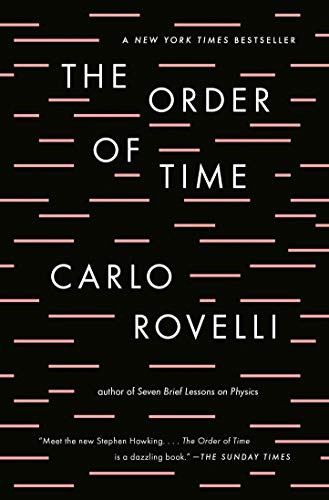
The book argues that time, at the most fundamental level, does not exist. After reading both The Order of Time and this book, how do you understand Rovelli's position on time?
- 5.
Quantum field theory describes particles as excitations of fields rather than as discrete objects. Did that framing change how you think about matter?
- 6.
Rovelli begins with Democritus. What does it tell us about science that an ancient intuition about discrete atomic units keeps proving prophetic at new scales?
- 7.
The unification of general relativity and quantum mechanics is often called the most important open problem in physics. After reading this book, why do you think it has proven so difficult?
- 8.
Rovelli is honest that loop quantum gravity is not yet confirmed by experiment. Does the absence of experimental confirmation change how you evaluate the theory?
- 9.
The book covers a vast sweep of history in roughly 200 pages. What ideas did you wish Rovelli had spent more time on?
- 10.
Rovelli argues that reality is fundamentally relational — that there are no absolute properties, only relations between systems. Is that philosophically satisfying or disturbingly empty?
- 11.
String theory has more adherents among physicists than loop quantum gravity. Is the sociology of physics — which theories get attention and funding — a distortion of scientific truth-seeking?
- 12.
After reading this book, what is your best guess about what space and time actually are at the most fundamental level?
Themes
Frequently asked questions
-
Is Reality Is Not What It Seems Rovelli's most technical popular book?
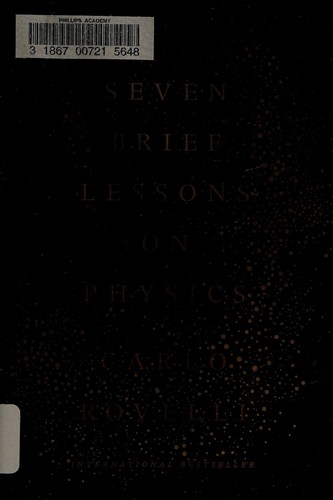
Yes. It goes deeper into quantum field theory and loop quantum gravity than Seven Brief Lessons on Physics or The Order of Time. Readers comfortable with those books will find this a satisfying extension; readers new to Rovelli should start with Seven Brief Lessons.
-
How long does it take to read?
About four hours, though the loop quantum gravity sections in the second half require careful reading and may take longer. The historical first half reads at a brisker pace.
-
What is loop quantum gravity?
A theory that attempts to quantize spacetime itself, proposing that space and time are composed of discrete units below the Planck scale rather than being continuous. It is one of the two leading approaches to quantum gravity, alongside string theory, and remains unconfirmed by experiment.
-
Do I need to read Rovelli's other books first?
No, but Seven Brief Lessons on Physics provides useful background. The present book is self-contained; Rovelli explains the necessary physics before building to loop quantum gravity.
-
How does this book compare to The Elegant Universe by Brian Greene?
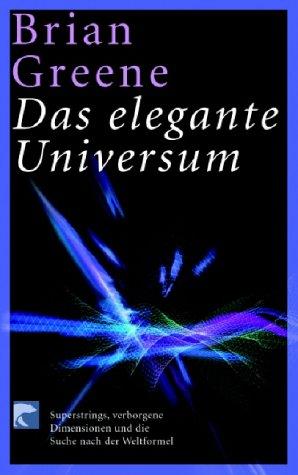
The Elegant Universe covers string theory; this book presents loop quantum gravity as an alternative approach. They make different bets about what a unified theory of physics will look like. Reading both gives a sense of the genuine disagreement among physicists about which direction is more promising.