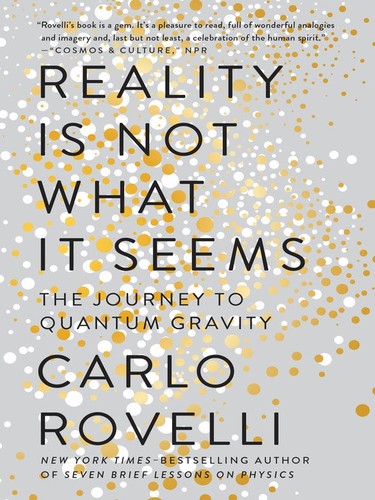
Talk to Reality Is Not What It Seems like its author wrote you back.
Get the ideas that fit your life — not generic summaries.
- Chat with the book
- Audiobook-style main ideas
- Adapts to your life and goals
- Helps you take action
What it argues
Reality Is Not What It Seems is Rovelli's most ambitious popular book: a history of human understanding of physical reality from the pre-Socratics to loop quantum gravity, the theory of quantum spacetime that Rovelli himself has spent his career developing. Where Seven Brief Lessons on Physics offers a lyrical overview, this book makes a sustained argument: that the granularity of quantum mechanics and the geometry of general relativity are not two separate theories but aspects of a single picture, and that understanding that picture requires rethinking what space, time, and matter fundamentally are.
Rovelli begins with the ancient Greeks, tracing the atomic hypothesis from Democritus through Newton, Faraday, Maxwell, and into the twentieth century. He is making a point with this history: the idea that reality is composed of discrete granular units keeps returning, in different forms, as our best description of nature. Quantum mechanics is the current expression of that ancient intuition. But even quantum mechanics, in its standard forms, still treats spacetime as a smooth continuous background. Loop quantum gravity proposes that spacetime itself is granular — composed of discrete loops of quantum geometry, with no smaller scale below the Planck length.
What it gets right
- 1.
The history of physics is a history of discovering that the world is more granular than it appears: atoms, quanta, and now, loop quantum gravity suggests, spacetime itself is discrete.
- 2.
General relativity and quantum mechanics are the two pillars of modern physics, but they are mathematically incompatible. Unifying them is the deepest open problem in fundamental physics.
- 3.
Loop quantum gravity proposes that space is not continuous but composed of discrete loops of quantum geometry. Below the Planck length — about 10⁻³⁵ meters — space loses meaning.
What it covers
Who wrote it
Carlo Rovelli is an Italian theoretical physicist and professor at Aix-Marseille University, co-developer of loop quantum gravity and a leading figure in the attempt to reconcile general relativity with quantum mechanics. He has written several international bestsellers in popular science, including Seven Brief Lessons on Physics and The Order of Time, both translated into dozens of languages. Rovelli is known for combining rigorous physics with philosophical depth and literary quality. His research focuses on the quantum nature of space and time and the interpretation of quantum mechanics.
