Memoir · Book club
Red Notice book club questions
Here are 12 book club questions for Red Notice by Bill Browder, ordered to open easily and end somewhere worth arguing about. Copy them, print them, or bring them up one at a time.
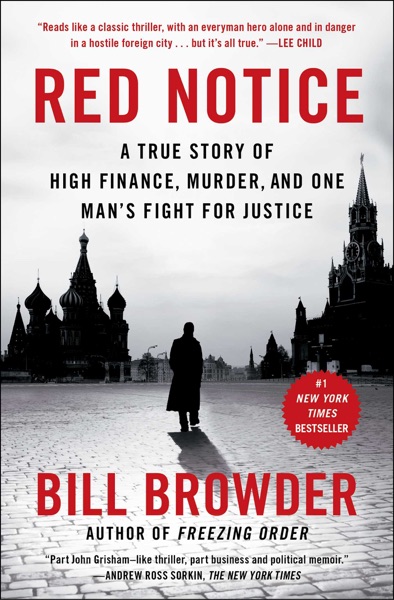
Red Notice is Bill Browder's account of how he became one of the largest foreign investors in Russia after the Soviet collapse, was subsequently expelled by the Kremlin, and then spent years fighting for justice after his lawyer Sergei Magnitsky was arrested, tortured, and killed in a Russian detention facility in 2009.
Bill Browder · 2015 · 7h 0m
Full summary and key takeaways →The 12 questions
- 1.
Browder initially saw corruption exposure as a profit opportunity — higher stock prices rewarded honest governance. How do you evaluate a motive that is simultaneously self-interested and socially beneficial?
- 2.
The officials who stole the $230 million were subsequently promoted. What does that pattern suggest about how kleptocratic systems sustain themselves?
- 3.
Browder admits he felt responsible for Magnitsky's death because he hired him and put him in harm's way. How do you think about that kind of indirect responsibility?
- 4.
The Magnitsky Act was initially opposed by financial institutions and State Department officials. What does that tell us about the relationship between economic engagement and human rights in foreign policy?
- 5.
Russia used Interpol's Red Notice system — designed to track criminals — to pursue Browder internationally. What does that tell you about the vulnerability of international institutions to capture by bad actors?
- 6.
Browder's campaign succeeded in part because he was wealthy enough to fund it himself and well-connected enough to get meetings. What does that say about who can and cannot pursue this kind of accountability work?
- 7.
The book is written from a single, strongly partisan perspective. What parts of the narrative would you want to check against other sources?
- 8.
The Kremlin consistently framed Browder as a criminal. How do you evaluate narratives when both sides have strong incentives to lie?
- 9.
By the end of the book, Browder describes himself as having been changed by the campaign — he is less interested in making money and more interested in the work itself. Do you find that transformation credible?
- 10.
The Magnitsky Act has since been used against human rights abusers in countries beyond Russia. Was it a good precedent, and what are the risks of giving any government a unilateral sanctions tool?
- 11.
Corruption at the scale Browder describes depends on lawyers, banks, and accountants in Western countries processing stolen money. What responsibility do those professionals bear?
- 12.
What would you have done in Browder's position after Magnitsky's death? Is the campaign he chose the right one, or are there other approaches that might have been more effective?
How to run the discussion
- Pick six to eight, not all of them. An hour of real discussion covers fewer questions than anyone expects, and racing the list is what makes a book club feel like homework.
- Open with what people noticed, not what they concluded. Asking for a verdict first hardens opinions before anyone has heard each other.
- Let the disagreement run. The questions below that split a room are the ones worth the time; the ones everyone answers the same way can be skipped.
- Ask the quiet person a specific question. A direct, narrow question is far easier to answer than an open invitation to contribute.
Themes worth steering toward
If the conversation stalls, these are the threads that usually restart it.
Common questions
What are good book club questions for Red Notice?
Here are 12 book club questions for Red Notice by Bill Browder, ordered to open easily and end somewhere worth arguing about. The strongest openers ask what each reader noticed rather than what they concluded, and the discussion usually turns on corruption, justice, oligarchy.
How long should a book club discussion of Red Notice last?
Most groups run 60 to 90 minutes of actual discussion. That is roughly six to eight questions, not all of them, so pick the ones that suit your group rather than working down the list in order.
What are the main themes in Red Notice?
Corruption, Justice, Oligarchy, Activism, Russia. Those are the threads most likely to divide a room, which makes them the useful places to steer a discussion that has gone quiet.
Picking the next one? See books like Red Notice or questions for other book club picks.
