Science fiction · Book club
Red Rising book club questions
Here are 12 book club questions for Red Rising by Pierce Brown, ordered to open easily and end somewhere worth arguing about. Copy them, print them, or bring them up one at a time.
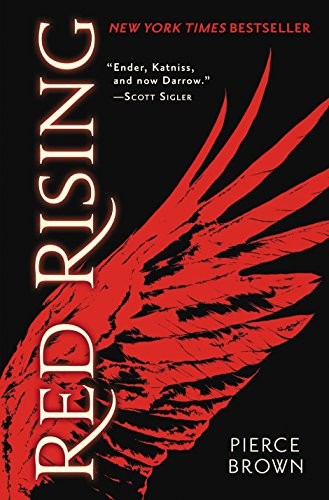
Red Rising is set on Mars in a far-future humanity stratified by color-coded caste: Golds rule, Reds mine the deep rock, and everyone in between occupies a precisely ordered place.
Pierce Brown · 2014 · 8h 45m
Full summary and key takeaways →The 12 questions
- 1.
Darrow has to become Gold convincingly enough to fool the people around him. At what point in the novel did you start to worry that the performance was changing him?
- 2.
The Golds believe they are superior by nature. The novel shows this belief is maintained by circular logic and controlled information. Do you see parallels to real-world class ideology?
- 3.
The Institute game is designed to produce leaders by having them compete brutally. Does the novel suggest this system selects for the right traits, or the wrong ones?
- 4.
Darrow is given a mission by a resistance movement that manipulates and deceives him. How does that complicate his agency? Is he a revolutionary or a tool?
- 5.
The color-caste system is extremely rigid — each color has a culture, a function, and a worldview. Did you find the world-building convincing as a stable social order, or implausibly elaborate?
- 6.
Brown's influences are explicitly classical (Caesar, Alexander) and modern (Ender's Game, Hunger Games). Where did you feel those influences most strongly, and did they feel like debts or building blocks?
- 7.
The Institute section is the majority of the novel. Did the game-within-a-game structure sustain your interest, or did it start to feel repetitive?
- 8.
The sacrifice that opens the novel — Darrow's personal loss — is what drives him forward. Did you find his motivation believable throughout, or does the novel lose track of it in the action?
- 9.
The Golds have genuine virtues — courage, intelligence, loyalty — alongside their cruelty. Does the novel need them to have virtues to make its satire work?
- 10.
Red Rising is written in first-person present tense, which gives it an immediate, propulsive quality. Did the narrative voice work for you, or did it feel like a style choice that wore thin?
- 11.
By the end of the novel, Darrow has done things that are hard to justify even given his mission. Does the novel hold him accountable for those, or does the end-justifies-means logic dominate?
- 12.
If you've read The Hunger Games, how would you compare Katniss and Darrow as protagonists in structurally similar situations?
How to run the discussion
- Pick six to eight, not all of them. An hour of real discussion covers fewer questions than anyone expects, and racing the list is what makes a book club feel like homework.
- Open with what people noticed, not what they concluded. Asking for a verdict first hardens opinions before anyone has heard each other.
- Let the disagreement run. The questions below that split a room are the ones worth the time; the ones everyone answers the same way can be skipped.
- Ask the quiet person a specific question. A direct, narrow question is far easier to answer than an open invitation to contribute.
Themes worth steering toward
If the conversation stalls, these are the threads that usually restart it.
Common questions
What are good book club questions for Red Rising?
Here are 12 book club questions for Red Rising by Pierce Brown, ordered to open easily and end somewhere worth arguing about. The strongest openers ask what each reader noticed rather than what they concluded, and the discussion usually turns on class and caste, revolution, identity and performance.
How long should a book club discussion of Red Rising last?
Most groups run 60 to 90 minutes of actual discussion. That is roughly six to eight questions, not all of them, so pick the ones that suit your group rather than working down the list in order.
What are the main themes in Red Rising?
Class and caste, Revolution, Identity and performance, Survival, Loyalty. Those are the threads most likely to divide a room, which makes them the useful places to steer a discussion that has gone quiet.
Picking the next one? See books like Red Rising or questions for other book club picks.
