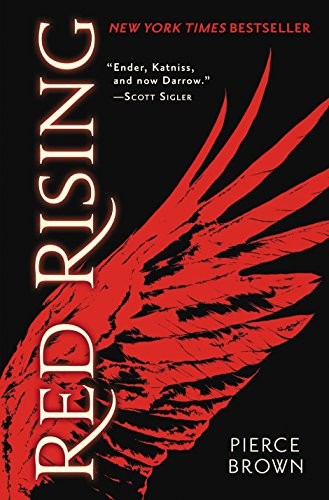
Red Rising by Pierce Brown is a 2014 science fiction book about class and caste, revolution, identity and performance. The caste system's genius is that most of its members internalize it — the Colors police themselves and each other, which is how the Gold elite sustains power with minimal direct enforcement.
Summary
Red Rising is set on Mars in a far-future humanity stratified by color-coded caste: Golds rule, Reds mine the deep rock, and everyone in between occupies a precisely ordered place. Darrow is a Red miner who discovers that everything his people have been told — that their mining work is necessary before the surface of Mars can be colonized — is a lie. The surface has been inhabited by higher-caste people for generations. Reds are slaves who don't know they're slaves. Darrow is recruited by a resistance movement, surgically remade to pass as a Gold, and inserted into the brutal competitive process by which Gold elites sort themselves: a years-long war game in the highlands called the Institute.
The Institute section, which constitutes most of the novel, operates as a brutal crucible. Darrow must not only survive but rise to lead, and the novel is genuinely interested in what leadership requires — not just tactics and strength, but reading people, building loyalty, understanding the psychology of submission and alliance. Brown draws on Ender's Game, The Hunger Games, and classical military history (Caesar, Alexander), but the execution has enough specific texture and intellectual content to stand on its own. The cast system is elaborated with care: each color has its own culture, prejudices, and assigned place, and the novel's critique of caste ideology is embedded in how the characters think rather than delivered as explicit argument.
Brown's prose is kinetic and first-person present tense — immediate, action-forward, occasionally breathless. The novel is designed to be consumed; readers report finishing it in a day or two. The plotting is efficient and the reveals are well-timed. The social satire has genuine teeth: the Golds' ideology is a parody of meritocratic mythology (they believe they rule because they are superior; the evidence for this is circular), and Darrow's infiltration exposes how that ideology sustains itself through performance and social reproduction.
Red Rising works best as propulsive science fiction with something to say about class and legitimacy. It works less well if you're scrutinizing the world-building for internal consistency or expecting the kind of psychological depth you'd find in literary fiction. The sequels, Golden Son and Morning Star, expand the world significantly; most readers who enjoy the first book continue straight through the trilogy.
Talk to Red Rising like its author wrote you back.
Get the ideas that fit your life — not generic summaries.
- Chat with the book
- Audiobook-style main ideas
- Adapts to your life and goals
- Helps you take action
Key takeaways
- 1.
The caste system's genius is that most of its members internalize it — the Colors police themselves and each other, which is how the Gold elite sustains power with minimal direct enforcement.
- 2.
Darrow's transformation is not just physical — he has to perform Goldness so convincingly that he risks becoming what he pretended to be.
- 3.
The Institute war game is a socialization mechanism: it doesn't just select leaders, it teaches them to naturalize hierarchy and command.
- 4.
The novel's meritocratic mythology — Golds rule because they are superior — is a direct parody of real-world class ideology, and the satire is embedded rather than preached.
- 5.
Leadership in the novel requires understanding people better than they understand themselves; Darrow wins by reading motivation, not just by being stronger.
- 6.
The resistance movement that recruits Darrow is not morally clean — they are using him, and the novel is honest about the cost of that use.
- 7.
Violence in the novel is consequence-laden; Brown doesn't aestheticize it, and the aftermath of the Institute leaves real marks.
- 8.
The series grows in scope across the trilogy: what begins as a personal revenge story becomes a planetary revolution, and the moral stakes expand accordingly.
Discussion questions
Use these on your own, with a book club, or as chat starters in Superbook. Book club version, ready to copy or print →
- 1.
Darrow has to become Gold convincingly enough to fool the people around him. At what point in the novel did you start to worry that the performance was changing him?
- 2.
The Golds believe they are superior by nature. The novel shows this belief is maintained by circular logic and controlled information. Do you see parallels to real-world class ideology?
- 3.
The Institute game is designed to produce leaders by having them compete brutally. Does the novel suggest this system selects for the right traits, or the wrong ones?
- 4.
Darrow is given a mission by a resistance movement that manipulates and deceives him. How does that complicate his agency? Is he a revolutionary or a tool?
- 5.
The color-caste system is extremely rigid — each color has a culture, a function, and a worldview. Did you find the world-building convincing as a stable social order, or implausibly elaborate?
- 6.
Brown's influences are explicitly classical (Caesar, Alexander) and modern (Ender's Game, Hunger Games). Where did you feel those influences most strongly, and did they feel like debts or building blocks?
- 7.
The Institute section is the majority of the novel. Did the game-within-a-game structure sustain your interest, or did it start to feel repetitive?
- 8.
The sacrifice that opens the novel — Darrow's personal loss — is what drives him forward. Did you find his motivation believable throughout, or does the novel lose track of it in the action?
- 9.
The Golds have genuine virtues — courage, intelligence, loyalty — alongside their cruelty. Does the novel need them to have virtues to make its satire work?
- 10.
Red Rising is written in first-person present tense, which gives it an immediate, propulsive quality. Did the narrative voice work for you, or did it feel like a style choice that wore thin?
- 11.
By the end of the novel, Darrow has done things that are hard to justify even given his mission. Does the novel hold him accountable for those, or does the end-justifies-means logic dominate?
- 12.
If you've read The Hunger Games, how would you compare Katniss and Darrow as protagonists in structurally similar situations?
Themes
Frequently asked questions
-
Is Red Rising similar to The Hunger Games?
Structurally yes — young protagonist from an oppressed group is inserted into a brutal competitive system run by the elite. The tone and execution differ: Red Rising is more politically elaborated, more focused on leadership strategy, and more interested in the mechanics of how caste ideology operates. It is aimed at older readers, though it has a similarly broad audience.
-
Do I need to read the sequels?
Red Rising works as a self-contained story with a satisfying arc. The sequels, Golden Son and Morning Star, complete the original trilogy and many readers find them necessary for full satisfaction. The series has continued beyond the original trilogy.
-
Is the world-building complicated?
The color-caste system has a lot of Colors with distinct cultures and roles. Brown introduces them quickly and the novel moves fast enough that readers usually absorb the system through context rather than pause to map it. It becomes clearer as the novel progresses.
-
Is Red Rising worth reading if I mostly read literary fiction?
If you're comfortable with propulsive genre fiction and interested in class satire, yes. If you need careful prose and psychological depth over plot momentum, you may find it thin. It's strong genre fiction, not literature in disguise.
-
Who shouldn't read Red Rising?
Readers who want careful world-building consistency and slow-burn character study. The novel is built for speed and momentum. It rewards the reader who surrenders to the plot rather than the one who pauses to interrogate the architecture.