Biography · Book club
Reminiscences of a Stock Operator book club questions
Here are 12 book club questions for Reminiscences of a Stock Operator by Edwin Lefèvre, ordered to open easily and end somewhere worth arguing about. Copy them, print them, or bring them up one at a time.
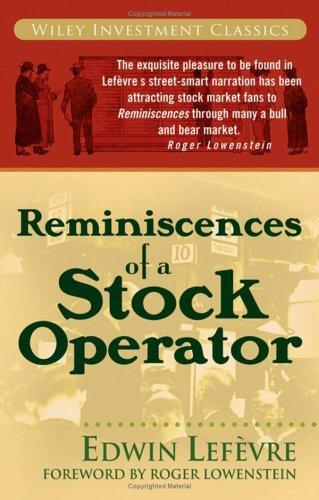
Reminiscences of a Stock Operator is a fictionalized biography of Jesse Livermore, the most famous speculator of the early twentieth century, told through the voice of "Larry Livingston." First published in 1923 as a series in the Saturday Evening Post, the book follows Livermore from his teenage years trading in bucket shops — illegal off-exchange betting parlors where customers wagered on price movements — through his multiple fortunes and bankruptcies on Wall Street.
Edwin Lefèvre · 1923 · 5h 0m
Full summary and key takeaways →The 12 questions
- 1.
Livermore made and lost fortunes multiple times. What does that cycle say about the relationship between trading skill and financial stability?
- 2.
He describes bucket shops as his training ground. What would the modern equivalent be for someone who wanted to develop pattern recognition before risking serious capital?
- 3.
The book's most quoted line is that the big money is made by sitting. What makes sitting so psychologically difficult for most market participants?
- 4.
Livermore was a brilliant tape reader who died bankrupt. What does his story suggest about the separability of market skill and life skill?
- 5.
His short positions before the 1907 and 1929 crashes made him fortunes. How do you distinguish a correct contrarian bet from wishful thinking dressed as analysis?
- 6.
The pools and manipulations Livermore describes are illegal today. Does that change the book's relevance, or do the human behaviors he's describing operate in cleaner markets too?
- 7.
Livermore repeatedly broke his own rules — holding losing positions, trading on tips — and paid for it each time. Why do experienced people keep breaking rules they know are right?
- 8.
The book has no happy ending. Does knowing Livermore died bankrupt change how you read his market wisdom?
- 9.
Which specific observation from Livingston has the most direct application to investing or decision-making in your own life?
- 10.
Lefèvre wrote the book with Livermore's cooperation. How does that affect your confidence in its accuracy? What might Livermore have left out?
- 11.
What does Livermore's story suggest about whether the skills that produce success in markets tend to cluster with psychological traits that also produce self-destruction?
- 12.
The book was written in 1923 and is still widely read by traders. What specifically has not changed about markets in the intervening century?
How to run the discussion
- Pick six to eight, not all of them. An hour of real discussion covers fewer questions than anyone expects, and racing the list is what makes a book club feel like homework.
- Open with what people noticed, not what they concluded. Asking for a verdict first hardens opinions before anyone has heard each other.
- Let the disagreement run. The questions below that split a room are the ones worth the time; the ones everyone answers the same way can be skipped.
- Ask the quiet person a specific question. A direct, narrow question is far easier to answer than an open invitation to contribute.
Themes worth steering toward
If the conversation stalls, these are the threads that usually restart it.
Common questions
What are good book club questions for Reminiscences of a Stock Operator?
Here are 12 book club questions for Reminiscences of a Stock Operator by Edwin Lefèvre, ordered to open easily and end somewhere worth arguing about. The strongest openers ask what each reader noticed rather than what they concluded, and the discussion usually turns on trading psychology, speculation, markets.
How long should a book club discussion of Reminiscences of a Stock Operator last?
Most groups run 60 to 90 minutes of actual discussion. That is roughly six to eight questions, not all of them, so pick the ones that suit your group rather than working down the list in order.
What are the main themes in Reminiscences of a Stock Operator?
Trading psychology, Speculation, Markets, Human nature, Risk and reward. Those are the threads most likely to divide a room, which makes them the useful places to steer a discussion that has gone quiet.
Picking the next one? See books like Reminiscences of a Stock Operator or questions for other book club picks.
