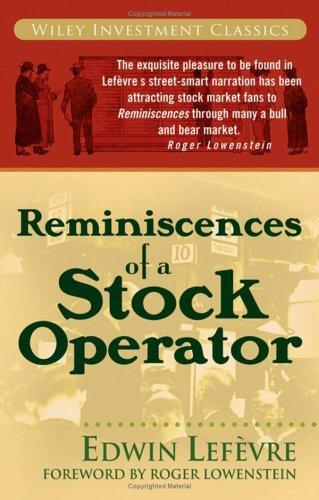
Reminiscences of a Stock Operator by Edwin Lefèvre is a 1923 biography book about trading psychology, speculation, markets. The big money is made not by frequent trading but by holding a strong position through a major move. Sitting and waiting is harder than it sounds.
Summary
Reminiscences of a Stock Operator is a fictionalized biography of Jesse Livermore, the most famous speculator of the early twentieth century, told through the voice of "Larry Livingston." First published in 1923 as a series in the Saturday Evening Post, the book follows Livermore from his teenage years trading in bucket shops — illegal off-exchange betting parlors where customers wagered on price movements — through his multiple fortunes and bankruptcies on Wall Street. Edwin Lefèvre, a financial journalist, wrote it in close collaboration with Livermore himself.
The book's enduring appeal is not its historical narrative but the observations Livingston makes about markets and human nature along the way. These emerge organically from the story rather than as numbered lessons. Among the most quoted: the market is never wrong but opinions often are; the big money is made by sitting, not trading; a man must believe in himself and his judgment if he expects to make a living from speculation; and that the speculator's chief enemy is himself, specifically the twin impulses of impatience and wishful thinking.
Livermore was a technical trader before the term existed, reading the tape for patterns in price and volume that told him which way the big operators were moving stocks. The book describes his method in some detail — pyramiding into winning positions, cutting losses quickly, reading sentiment by watching who was buying and selling in size. His greatest trades came from identifying major trend changes early: he shorted the market before the crash of 1907 and again before 1929.
The book has obvious limitations. It was written in another era, and the mechanics of the market it describes — bucket shops, pools, manipulation — are either illegal or unrecognizable today. Livermore himself died a suicide in 1940, bankrupt for the third time. Readers looking for a trading system won't find one here. What they find instead is a portrait of the speculative temperament: its strengths, its pathologies, and its tendency to produce intermittent brilliance followed by spectacular self-destruction.
Talk to Reminiscences of a Stock Operator like its author wrote you back.
Get the ideas that fit your life — not generic summaries.
- Chat with the book
- Audiobook-style main ideas
- Adapts to your life and goals
- Helps you take action
Key takeaways
- 1.
The big money is made not by frequent trading but by holding a strong position through a major move. Sitting and waiting is harder than it sounds.
- 2.
Livermore cut losses quickly and let winners run — a principle nearly every professional trader endorses and nearly every retail investor reverses.
- 3.
Price and volume patterns precede fundamental explanations. By the time the news explains a move, the move is usually over.
- 4.
Speculation is a business that requires as much discipline as any other. Treating it as gambling — chasing action — is the surest path to ruin.
- 5.
The market punishes impatience. Entering too early, exiting too early, or trading when there's no clear edge are all forms of the same underlying mistake.
- 6.
Livermore's repeated bankruptcies illustrate that winning temperament in markets can coexist with destructive behavior off the tape. The skills don't transfer.
- 7.
Reading the tape — watching how prices move in relation to volume — remains a core skill. The mechanics change but the underlying logic of identifying who is in control does not.
- 8.
The crowd is usually right during a trend and wrong at the turns. Identifying the turn requires going against the prevailing opinion at the exact moment it feels most dangerous.
Discussion questions
Use these on your own, with a book club, or as chat starters in Superbook. Book club version, ready to copy or print →
- 1.
Livermore made and lost fortunes multiple times. What does that cycle say about the relationship between trading skill and financial stability?
- 2.
He describes bucket shops as his training ground. What would the modern equivalent be for someone who wanted to develop pattern recognition before risking serious capital?
- 3.
The book's most quoted line is that the big money is made by sitting. What makes sitting so psychologically difficult for most market participants?
- 4.
Livermore was a brilliant tape reader who died bankrupt. What does his story suggest about the separability of market skill and life skill?
- 5.
His short positions before the 1907 and 1929 crashes made him fortunes. How do you distinguish a correct contrarian bet from wishful thinking dressed as analysis?
- 6.
The pools and manipulations Livermore describes are illegal today. Does that change the book's relevance, or do the human behaviors he's describing operate in cleaner markets too?
- 7.
Livermore repeatedly broke his own rules — holding losing positions, trading on tips — and paid for it each time. Why do experienced people keep breaking rules they know are right?
- 8.
The book has no happy ending. Does knowing Livermore died bankrupt change how you read his market wisdom?
- 9.
Which specific observation from Livingston has the most direct application to investing or decision-making in your own life?
- 10.
Lefèvre wrote the book with Livermore's cooperation. How does that affect your confidence in its accuracy? What might Livermore have left out?
- 11.
What does Livermore's story suggest about whether the skills that produce success in markets tend to cluster with psychological traits that also produce self-destruction?
- 12.
The book was written in 1923 and is still widely read by traders. What specifically has not changed about markets in the intervening century?
Themes
Frequently asked questions
-
Is Reminiscences of a Stock Operator still relevant today?
For human psychology and temperament, yes. The mechanics of the market Livermore traded — bucket shops, floor specialists, pools — are either illegal or archaic. But the observations about patience, cutting losses, holding winners, and fighting your own emotions are as applicable to modern markets as they were in 1923.
-
Is the book fiction or non-fiction?
It's a fictionalized autobiography. Jesse Livermore is thinly disguised as Larry Livingston, and the events are drawn from Livermore's actual life. Lefèvre wrote it in the first person after extensive interviews with Livermore. The 1994 annotated edition by Jack Schwager maps the fictional names back to real people and events.
-
How long does it take to read?
Around four to five hours. The prose is from 1923 and feels slightly archaic, but Lefèvre was a professional journalist and the style is clear rather than ornate. Most readers find the momentum of the story carries them through.
-
What is the most important trading lesson in the book?
Probably the importance of sitting. Livermore consistently lost money through impatience — entering before the right moment, exiting profitable positions too early, or trading when there was no clear setup. His biggest profits came from identifying a major move early and holding through it.
-
Who should read this book?
Anyone interested in markets, trading psychology, or financial history. Traders will recognize themselves in Livermore's self-defeating patterns. Non-traders will find the book useful as a study in decision-making under uncertainty and the psychology of conviction versus doubt.
Similar books

What I Learned Losing a Million Dollars
Jim Paul
Thinking in Bets: Making Smarter Decisions When You Don't Have All the Facts
Annie Duke
The Psychology of Money
Morgan Housel
Thinking, Fast and Slow
Daniel Kahneman
