Science fiction · Book club
Rendezvous with Rama book club questions
Here are 12 book club questions for Rendezvous with Rama by Arthur C. Clarke, ordered to open easily and end somewhere worth arguing about. Copy them, print them, or bring them up one at a time.
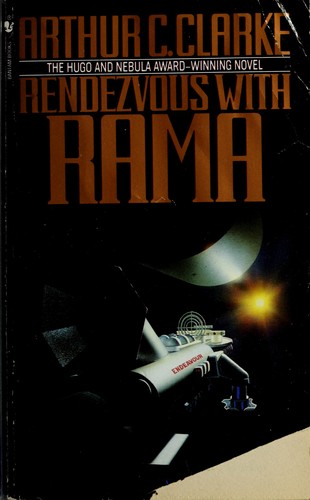
In 2130, an object enters the solar system on a trajectory that makes clear it is not a natural body.
Arthur C. Clarke · 1973 · 4h 20m
Full summary and key takeaways →The 12 questions
- 1.
The Ramans never communicate with, acknowledge, or seem to notice the human crew. Is that more disturbing or less disturbing than an alien encounter that goes badly?
- 2.
Clarke's characters are deliberately thin — functional rather than complex. Does that serve the novel's purposes, or does it make it harder to care about the exploration?
- 3.
The Committee debates destroying Rama out of precaution. Which side of that debate do you find more defensible? What would your government actually do?
- 4.
Rama appears to be an ark or a transport vessel. What does it tell us about the civilization that built it that they built it this way?
- 5.
Clarke doesn't explain the Ramans. Three sequels, written with Gentry Lee, do explain them. Having read this book, do you want the explanation?
- 6.
The sense of wonder in Rendezvous with Rama depends on not knowing. Is that a sustainable literary strategy, or does the book demand a sequel to feel complete?
- 7.
Norton's crew responds to Rama with curiosity and professionalism rather than fear. Is that realistic? Is it what you would want to be true of the people representing humanity in this situation?
- 8.
Clarke published this in 1973. What does the novel assume about the future of space exploration that looks correct or incorrect from a 2020s perspective?
- 9.
The Simps — biological maintenance machines — are more unsettling to some readers than the empty cities. Why might something purposeful and small be stranger than something vast and silent?
- 10.
The last line reveals that the Ramans 'always do things in threes.' Does that recontextualize the whole novel, or does it just open a door the original book was wise to leave closed?
- 11.
Rendezvous with Rama won four major awards in the same year. What does that consensus say about what science fiction readers and writers valued in 1974?
- 12.
Is this a novel about humanity's smallness, humanity's curiosity, or both? Does Clarke seem optimistic or pessimistic about what humans would actually do?
How to run the discussion
- Pick six to eight, not all of them. An hour of real discussion covers fewer questions than anyone expects, and racing the list is what makes a book club feel like homework.
- Open with what people noticed, not what they concluded. Asking for a verdict first hardens opinions before anyone has heard each other.
- Let the disagreement run. The questions below that split a room are the ones worth the time; the ones everyone answers the same way can be skipped.
- Ask the quiet person a specific question. A direct, narrow question is far easier to answer than an open invitation to contribute.
Themes worth steering toward
If the conversation stalls, these are the threads that usually restart it.
Common questions
What are good book club questions for Rendezvous with Rama?
Here are 12 book club questions for Rendezvous with Rama by Arthur C. Clarke, ordered to open easily and end somewhere worth arguing about. The strongest openers ask what each reader noticed rather than what they concluded, and the discussion usually turns on the alien and unknowable, human curiosity, scale and humility.
How long should a book club discussion of Rendezvous with Rama last?
Most groups run 60 to 90 minutes of actual discussion. That is roughly six to eight questions, not all of them, so pick the ones that suit your group rather than working down the list in order.
What are the main themes in Rendezvous with Rama?
The alien and unknowable, Human curiosity, Scale and humility, Exploration, Indifference of the cosmos. Those are the threads most likely to divide a room, which makes them the useful places to steer a discussion that has gone quiet.
Picking the next one? See books like Rendezvous with Rama or questions for other book club picks.
