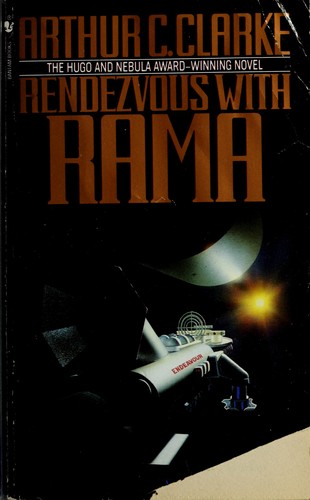
Rendezvous with Rama by Arthur C. Clarke is a 1973 science fiction book about the alien and unknowable, human curiosity, scale and humility. The Ramans' indifference to human presence is the novel's most unsettling proposition: they did not come to meet us, did not notice us, and did not need to. First contact as a non-event.
Summary
In 2130, an object enters the solar system on a trajectory that makes clear it is not a natural body. It is named Rama. Commander Norton and the crew of the Endeavour are dispatched to intercept and investigate before Rama swings around the sun and vanishes. What they find is a cylindrical alien spacecraft fifty kilometers long — a sealed world rotating to generate internal gravity, with an architecture that is geometrically perfect and utterly purposeless to human understanding. They have weeks inside before Rama leaves.
Rendezvous with Rama is a novel of exploration and sustained wonder. It is less interested in plot in the conventional sense than in the experience of encountering something genuinely alien — a structure built by minds that do not share human assumptions about scale, aesthetics, utility, or communication. Clarke writes with a scientist's precision: the physics of Rama's rotation, the ecology of the cylindrical sea, the Ramans' apparent indifference to the visitors who have boarded their craft. None of it is explained. All of it is described with care.
The characters are functional rather than deep — they are largely vessels for the reader's curiosity. Clarke's gift here is not for interiority but for making the reader feel the disorientation and privilege of walking through a structure whose purpose is opaque. The Committee of the United Planets, debating whether to destroy Rama out of fear, provides a frame for what humanity would actually do with first contact. The answer is not flattering.
Rama won the Hugo, Nebula, Locus, and British Science Fiction awards in 1974. It is often cited as the purest expression of the sense-of-wonder tradition in science fiction. Three sequels were written with Gentry Lee, though Clarke had little involvement and they are generally considered inferior. The original stands completely alone and requires no sequels — it ends exactly where it should, with the mystery intact.
Talk to Rendezvous with Rama like its author wrote you back.
Get the ideas that fit your life — not generic summaries.
- Chat with the book
- Audiobook-style main ideas
- Adapts to your life and goals
- Helps you take action
Key takeaways
- 1.
The Ramans' indifference to human presence is the novel's most unsettling proposition: they did not come to meet us, did not notice us, and did not need to. First contact as a non-event.
- 2.
Clarke's scientific precision creates the wonder rather than undermining it. The physics of Rama — rotation, gravity gradient, the cylindrical sea — are thought through, and the thinking-through makes the scale feel real.
- 3.
The Committee's debate about whether to destroy Rama with a nuclear weapon is the most honest part of the novel: that is probably what governments would do.
- 4.
Rama is never explained. Clarke resists the temptation to provide an origin story, a purpose, or a message. The mystery is the point.
- 5.
The novel is about exploration as a state of mind — the particular disposition required to enter an unknown space and observe carefully rather than impose meaning.
- 6.
The Simps — biological machines that maintain Rama — are the closest thing to Raman life the crew encounters, and their mechanical purposefulness makes them more alien than a monster would be.
- 7.
Scale is used deliberately throughout: the cylindrical landscape, the sea, the cities. Clarke makes you feel small in a specific way that is different from merely being told the object is large.
- 8.
The last line of the novel reframes everything that came before. Clarke holds it back perfectly, and it changes the nature of what Rama was doing in the solar system.
Discussion questions
Use these on your own, with a book club, or as chat starters in Superbook. Book club version, ready to copy or print →
- 1.
The Ramans never communicate with, acknowledge, or seem to notice the human crew. Is that more disturbing or less disturbing than an alien encounter that goes badly?
- 2.
Clarke's characters are deliberately thin — functional rather than complex. Does that serve the novel's purposes, or does it make it harder to care about the exploration?
- 3.
The Committee debates destroying Rama out of precaution. Which side of that debate do you find more defensible? What would your government actually do?
- 4.
Rama appears to be an ark or a transport vessel. What does it tell us about the civilization that built it that they built it this way?
- 5.
Clarke doesn't explain the Ramans. Three sequels, written with Gentry Lee, do explain them. Having read this book, do you want the explanation?
- 6.
The sense of wonder in Rendezvous with Rama depends on not knowing. Is that a sustainable literary strategy, or does the book demand a sequel to feel complete?
- 7.
Norton's crew responds to Rama with curiosity and professionalism rather than fear. Is that realistic? Is it what you would want to be true of the people representing humanity in this situation?
- 8.
Clarke published this in 1973. What does the novel assume about the future of space exploration that looks correct or incorrect from a 2020s perspective?
- 9.
The Simps — biological maintenance machines — are more unsettling to some readers than the empty cities. Why might something purposeful and small be stranger than something vast and silent?
- 10.
The last line reveals that the Ramans 'always do things in threes.' Does that recontextualize the whole novel, or does it just open a door the original book was wise to leave closed?
- 11.
Rendezvous with Rama won four major awards in the same year. What does that consensus say about what science fiction readers and writers valued in 1974?
- 12.
Is this a novel about humanity's smallness, humanity's curiosity, or both? Does Clarke seem optimistic or pessimistic about what humans would actually do?
Themes
Frequently asked questions
-
Is Rendezvous with Rama worth reading?
Yes, if you value the sense of wonder over character drama. It is the purest expression of what science fiction can do when it commits fully to making the universe feel large and indifferent. If you want plot twists and deep characters, look elsewhere.
-
Do I need to read the sequels?
No. The three sequels (Rama II, The Garden of Rama, Rama Revealed) were written with Gentry Lee and are largely considered inferior to the original. Clarke had minimal involvement. The original is complete as it stands.
-
Is Rendezvous with Rama hard science fiction?
Yes, in the Clarke tradition — rigorous about physics and engineering, speculative about biology and civilization. The rotating cylinder's gravity mechanics, the cylindrical sea, and Rama's trajectory are all worked out carefully.
-
Is there an adaptation?
A film adaptation has been in development for decades, at various points attached to David Fincher, Morgan Freeman, and others. As of 2024 it has not been produced. The novel's emphasis on wonder and environment over character drama makes adaptation genuinely difficult.
-
Who shouldn't read it?
Readers who need character depth and interpersonal conflict. The crew of the Endeavour are competent and pleasant but not complex. The novel is about the place, not the people. If that trade-off doesn't work for you, Clarke has better character-driven options.