Talk to Rendezvous with Rama like its author wrote you back.
Get the ideas that fit your life — not generic summaries.
- Chat with the book
- Audiobook-style main ideas
- Adapts to your life and goals
- Helps you take action
What it argues
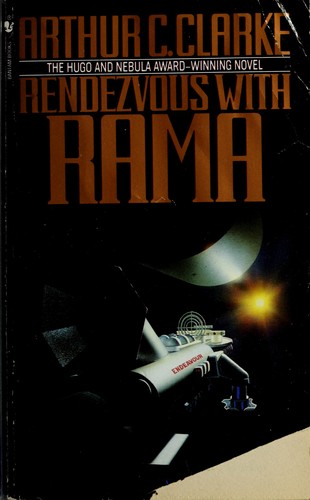
In 2130, an object enters the solar system on a trajectory that makes clear it is not a natural body. It is named Rama. Commander Norton and the crew of the Endeavour are dispatched to intercept and investigate before Rama swings around the sun and vanishes. What they find is a cylindrical alien spacecraft fifty kilometers long — a sealed world rotating to generate internal gravity, with an architecture that is geometrically perfect and utterly purposeless to human understanding. They have weeks inside before Rama leaves.
Rendezvous with Rama is a novel of exploration and sustained wonder. It is less interested in plot in the conventional sense than in the experience of encountering something genuinely alien — a structure built by minds that do not share human assumptions about scale, aesthetics, utility, or communication. Clarke writes with a scientist's precision: the physics of Rama's rotation, the ecology of the cylindrical sea, the Ramans' apparent indifference to the visitors who have boarded their craft. None of it is explained. All of it is described with care.
What it gets right
- 1.
The Ramans' indifference to human presence is the novel's most unsettling proposition: they did not come to meet us, did not notice us, and did not need to. First contact as a non-event.
- 2.
Clarke's scientific precision creates the wonder rather than undermining it. The physics of Rama — rotation, gravity gradient, the cylindrical sea — are thought through, and the thinking-through makes the scale feel real.
- 3.
The Committee's debate about whether to destroy Rama with a nuclear weapon is the most honest part of the novel: that is probably what governments would do.
What it covers
Who wrote it
Arthur C. Clarke was a British science fiction author, science writer, and futurist whose work defined the optimistic, science-grounded wing of twentieth-century science fiction. His novel 2001: A Space Odyssey, developed in parallel with Stanley Kubrick's film, remains one of the genre's most famous works. He authored more than a hundred books and is credited with proposing the geostationary satellite communications concept. He won multiple Hugo and Nebula awards and received a knighthood in 1998. He lived for decades in Sri Lanka and died in 2008.
