Talk to Rendezvous with Rama like its author wrote you back.
Get the ideas that fit your life — not generic summaries.
- Chat with the book
- Audiobook-style main ideas
- Adapts to your life and goals
- Helps you take action
Rendezvous with Rama, in detail
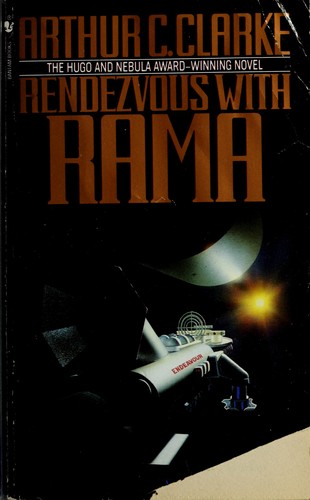
In 2130, an object enters the solar system on a trajectory that makes clear it is not a natural body. It is named Rama. Commander Norton and the crew of the Endeavour are dispatched to intercept and investigate before Rama swings around the sun and vanishes. What they find is a cylindrical alien spacecraft fifty kilometers long — a sealed world rotating to generate internal gravity, with an architecture that is geometrically perfect and utterly purposeless to human understanding. They have weeks inside before Rama leaves.
Rendezvous with Rama is a novel of exploration and sustained wonder. It is less interested in plot in the conventional sense than in the experience of encountering something genuinely alien — a structure built by minds that do not share human assumptions about scale, aesthetics, utility, or communication. Clarke writes with a scientist's precision: the physics of Rama's rotation, the ecology of the cylindrical sea, the Ramans' apparent indifference to the visitors who have boarded their craft. None of it is explained. All of it is described with care.
The characters are functional rather than deep — they are largely vessels for the reader's curiosity. Clarke's gift here is not for interiority but for making the reader feel the disorientation and privilege of walking through a structure whose purpose is opaque. The Committee of the United Planets, debating whether to destroy Rama out of fear, provides a frame for what humanity would actually do with first contact. The answer is not flattering.
Rama won the Hugo, Nebula, Locus, and British Science Fiction awards in 1974. It is often cited as the purest expression of the sense-of-wonder tradition in science fiction. Three sequels were written with Gentry Lee, though Clarke had little involvement and they are generally considered inferior. The original stands completely alone and requires no sequels — it ends exactly where it should, with the mystery intact.
The big ideas
- 1.
The Ramans' indifference to human presence is the novel's most unsettling proposition: they did not come to meet us, did not notice us, and did not need to. First contact as a non-event.
- 2.
Clarke's scientific precision creates the wonder rather than undermining it. The physics of Rama — rotation, gravity gradient, the cylindrical sea — are thought through, and the thinking-through makes the scale feel real.
- 3.
The Committee's debate about whether to destroy Rama with a nuclear weapon is the most honest part of the novel: that is probably what governments would do.
