History · Book club
Rubicon: The Last Years of the Roman Republic book club questions
Here are 12 book club questions for Rubicon: The Last Years of the Roman Republic by Tom Holland, ordered to open easily and end somewhere worth arguing about. Copy them, print them, or bring them up one at a time.
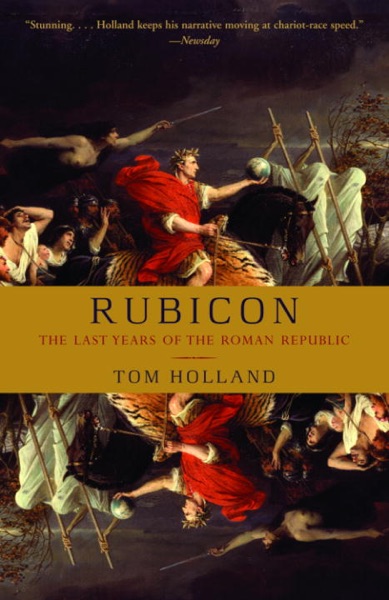
Rubicon tells the story of the Roman Republic's last century — from the Gracchi in the 130s BCE through the assassination of Julius Caesar in 44 BCE and the civil wars that followed — with the narrative energy of a thriller and the sourcing of serious scholarship.
Tom Holland · 2003 · 8h 45m
Full summary and key takeaways →The 12 questions
- 1.
Holland shows that each violation of republican norms made the next one easier. Where do you see similar normalization of norm-breaking in contemporary political systems?
- 2.
The army reforms that created soldiers loyal to their generals rather than the state were driven by practical military needs. How do you weigh short-term effectiveness against long-term institutional risk?
- 3.
Cicero believed deeply in republican institutions but couldn't match his opponents' willingness to use force. Is that kind of principled commitment admirable, delusional, or both?
- 4.
Holland argues the Republic was hollowed out gradually rather than destroyed in a moment. Which moment do you think was actually decisive, and could anything have been done differently?
- 5.
Empire gave Roman commanders resources that dwarfed the state. What are the modern equivalents of that concentration of wealth and power outside democratic control?
- 6.
Caesar is often presented as a genius reformer rather than a destroyer of democracy. Does Holland's account complicate or support that rehabilitation?
- 7.
The Senate kept functioning through decades of violence and unconstitutional acts. Why did an institution that had lost effective authority continue to matter symbolically?
- 8.
What does Rubicon suggest about the durability of republican government? Are there conditions under which republican systems are inherently fragile?
- 9.
Pompey, Crassus, and Caesar formed the First Triumvirate to share power outside the formal system. How does that compare to informal power-sharing arrangements in modern democracies?
- 10.
Holland writes popular history for general readers. Does accessibility require simplifying complexity, or can narrative and scholarship coexist? How does this book balance them?
- 11.
The book ends with Caesar's assassination and the civil wars that followed. What does the aftermath tell us about whether the assassins understood what they were doing?
- 12.
If you were advising a Roman senator in 100 BCE on how to preserve the Republic, what changes would you recommend, and what would be politically possible?
How to run the discussion
- Pick six to eight, not all of them. An hour of real discussion covers fewer questions than anyone expects, and racing the list is what makes a book club feel like homework.
- Open with what people noticed, not what they concluded. Asking for a verdict first hardens opinions before anyone has heard each other.
- Let the disagreement run. The questions below that split a room are the ones worth the time; the ones everyone answers the same way can be skipped.
- Ask the quiet person a specific question. A direct, narrow question is far easier to answer than an open invitation to contribute.
Themes worth steering toward
If the conversation stalls, these are the threads that usually restart it.
Common questions
What are good book club questions for Rubicon: The Last Years of the Roman Republic?
Here are 12 book club questions for Rubicon: The Last Years of the Roman Republic by Tom Holland, ordered to open easily and end somewhere worth arguing about. The strongest openers ask what each reader noticed rather than what they concluded, and the discussion usually turns on republican collapse, political ambition, roman republic.
How long should a book club discussion of Rubicon: The Last Years of the Roman Republic last?
Most groups run 60 to 90 minutes of actual discussion. That is roughly six to eight questions, not all of them, so pick the ones that suit your group rather than working down the list in order.
What are the main themes in Rubicon: The Last Years of the Roman Republic?
Republican collapse, Political ambition, Roman Republic, Civil war, Power and corruption. Those are the threads most likely to divide a room, which makes them the useful places to steer a discussion that has gone quiet.
Picking the next one? See books like Rubicon: The Last Years of the Roman Republic or questions for other book club picks.
