History · Book club
Sapiens: A Brief History of Humankind book club questions
Here are 12 book club questions for Sapiens: A Brief History of Humankind by Yuval Noah Harari, ordered to open easily and end somewhere worth arguing about. Copy them, print them, or bring them up one at a time.
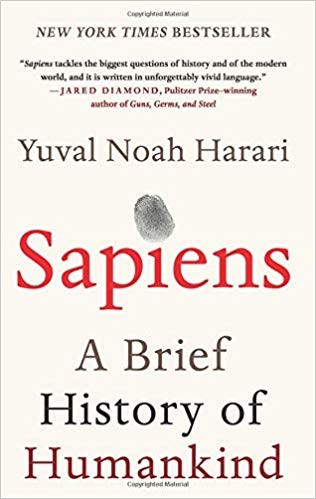
Sapiens traces the full arc of human history from the emergence of Homo sapiens in Africa roughly 70,000 years ago to the present.
Yuval Noah Harari · 2014 · 8h 45m
Full summary and key takeaways →The 12 questions
- 1.
Harari argues that shared fictions — money, laws, corporations — are what make civilization possible. Which of the fictions you live inside is hardest to see as a fiction?
- 2.
His take on the Agricultural Revolution is that it was bad for most individuals while being good for populations. Can you think of modern equivalents — systems that benefit the aggregate at the expense of the individual?
- 3.
Harari claims Homo sapiens drove most large mammals to extinction during the prehistoric period. Does attributing this to humans 70,000 years ago change how you think about current environmental destruction?
- 4.
The book treats religion, money, and nationalism as functionally similar: shared stories that enable cooperation. Is there a meaningful moral difference between them, or only a practical one?
- 5.
If the Agricultural Revolution made average people worse off, what does that tell you about how collective decisions get made? Can you identify a contemporary equivalent?
- 6.
Harari is skeptical that economic growth has made humans happier. What evidence from your own life supports or challenges that view?
- 7.
The book covers 70,000 years in under 500 pages. What gets lost in that kind of compression, and does the loss matter for the argument Harari is making?
- 8.
Sapiens links the Scientific Revolution specifically to European culture and institutions. Is that argument convincing, or does it leave too much out?
- 9.
Harari draws a connection between capitalism and the belief that tomorrow will be better than today. Where did you get that belief, and do you actually hold it?
- 10.
The book ends with humans on the verge of redesigning life itself. Harari asks whether we know what we want to become. What would your answer be?
- 11.
Which of the three revolutions — Cognitive, Agricultural, Scientific — do you think had the largest net negative effect on human experience? Why?
- 12.
Harari suggests the most important things in history are not the facts themselves but the stories people told about them. Do you find that view persuasive, or does it undervalue material causation?
How to run the discussion
- Pick six to eight, not all of them. An hour of real discussion covers fewer questions than anyone expects, and racing the list is what makes a book club feel like homework.
- Open with what people noticed, not what they concluded. Asking for a verdict first hardens opinions before anyone has heard each other.
- Let the disagreement run. The questions below that split a room are the ones worth the time; the ones everyone answers the same way can be skipped.
- Ask the quiet person a specific question. A direct, narrow question is far easier to answer than an open invitation to contribute.
Themes worth steering toward
If the conversation stalls, these are the threads that usually restart it.
Common questions
What are good book club questions for Sapiens: A Brief History of Humankind?
Here are 12 book club questions for Sapiens: A Brief History of Humankind by Yuval Noah Harari, ordered to open easily and end somewhere worth arguing about. The strongest openers ask what each reader noticed rather than what they concluded, and the discussion usually turns on history, evolution, cognition.
How long should a book club discussion of Sapiens: A Brief History of Humankind last?
Most groups run 60 to 90 minutes of actual discussion. That is roughly six to eight questions, not all of them, so pick the ones that suit your group rather than working down the list in order.
What are the main themes in Sapiens: A Brief History of Humankind?
History, Evolution, Cognition, Civilization, Myth-making, Power. Those are the threads most likely to divide a room, which makes them the useful places to steer a discussion that has gone quiet.
Picking the next one? See books like Sapiens: A Brief History of Humankind or questions for other book club picks.
