History · Book club
Say Nothing: A True Story of Murder and Memory in Northern Ireland book club questions
Here are 12 book club questions for Say Nothing: A True Story of Murder and Memory in Northern Ireland by Patrick Radden Keefe, ordered to open easily and end somewhere worth arguing about. Copy them, print them, or bring them up one at a time.
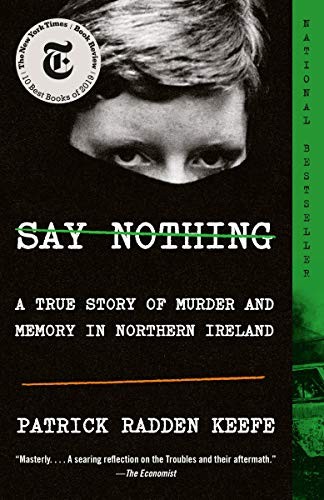
Say Nothing opens with a scene that sets its register precisely: Jean McConville, a widowed mother of ten, is dragged from her Belfast flat by a gang of masked strangers in December 1972 and never seen alive again.
Patrick Radden Keefe · 2018 · 7h 15m
Full summary and key takeaways →The 12 questions
- 1.
Keefe shows that Jean McConville's children spent decades searching for answers that the IRA's culture of silence withheld. What do victims' families owe, and what do perpetrators' communities owe them?
- 2.
The Boston College researchers believed their promise of confidentiality would hold. Was the project ethically defensible, given the foreseeable legal risks? What would you have done?
- 3.
Dolours Price believed she was fighting a just war. At what point, if any, do you think she stopped believing that — and what evidence in the book supports your reading?
- 4.
The peace process required participants to set aside justice for stability. Can you think of historical or contemporary situations where the same tradeoff was made, and do you think it was the right call?
- 5.
Gerry Adams maintained his denial of IRA membership long after it strained credibility. What does the book suggest about the relationship between political utility and personal honesty?
- 6.
Several characters in the book experienced the Troubles as inherited — born into Catholic or Protestant communities, shaped by family loyalties before they could choose. How much moral weight does that inherited context carry?
- 7.
Brendan Hughes gave his testimony to the oral history project knowing it would embarrass former comrades. Do you see his decision as an act of integrity, grievance, or something else?
- 8.
Jean McConville's children describe different ways of handling the absence of answers — some pursued justice, others tried to move on. Which approach do you understand better, and why?
- 9.
Keefe writes that the peace required a kind of collective forgetting. Is there a version of the Northern Ireland settlement you think would have been more honest without unraveling the peace?
- 10.
The book ends without full resolution. Several perpetrators died before testifying; others maintained silence. How did that open ending sit with you as a reader?
- 11.
Keefe is American writing about Irish history. Did you find that external perspective a strength — more distance, less grievance — or a limitation, missing things an insider would have caught?
- 12.
The title comes from the culture of omerta inside the IRA: say nothing, no matter what. How does that code function throughout the book, and who in the narrative eventually breaks it?
How to run the discussion
- Pick six to eight, not all of them. An hour of real discussion covers fewer questions than anyone expects, and racing the list is what makes a book club feel like homework.
- Open with what people noticed, not what they concluded. Asking for a verdict first hardens opinions before anyone has heard each other.
- Let the disagreement run. The questions below that split a room are the ones worth the time; the ones everyone answers the same way can be skipped.
- Ask the quiet person a specific question. A direct, narrow question is far easier to answer than an open invitation to contribute.
Themes worth steering toward
If the conversation stalls, these are the threads that usually restart it.
Common questions
What are good book club questions for Say Nothing: A True Story of Murder and Memory in Northern Ireland?
Here are 12 book club questions for Say Nothing: A True Story of Murder and Memory in Northern Ireland by Patrick Radden Keefe, ordered to open easily and end somewhere worth arguing about. The strongest openers ask what each reader noticed rather than what they concluded, and the discussion usually turns on political violence, memory, identity.
How long should a book club discussion of Say Nothing: A True Story of Murder and Memory in Northern Ireland last?
Most groups run 60 to 90 minutes of actual discussion. That is roughly six to eight questions, not all of them, so pick the ones that suit your group rather than working down the list in order.
What are the main themes in Say Nothing: A True Story of Murder and Memory in Northern Ireland?
Political violence, Memory, Identity, Conflict, Justice, Trauma. Those are the threads most likely to divide a room, which makes them the useful places to steer a discussion that has gone quiet.
Picking the next one? See books like Say Nothing: A True Story of Murder and Memory in Northern Ireland or questions for other book club picks.
