Science · Book club
Scale book club questions
Here are 12 book club questions for Scale by Geoffrey West, ordered to open easily and end somewhere worth arguing about. Copy them, print them, or bring them up one at a time.
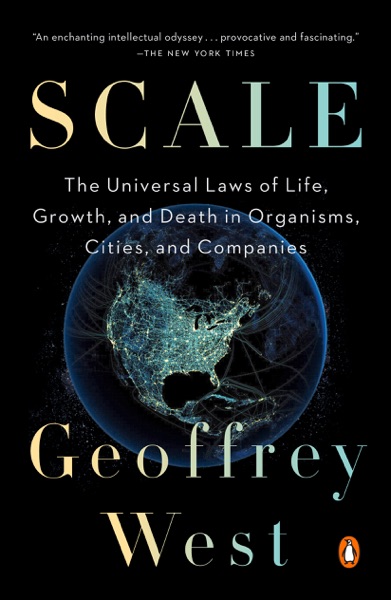
Geoffrey West is a theoretical physicist who spent decades at Los Alamos and the Santa Fe Institute studying whether there are mathematical laws underlying all complex systems — organisms, cities, companies — and finding that the answer appears to be yes.
Geoffrey West · 2017 · 8h 45m
Full summary and key takeaways →The 12 questions
- 1.
West argues that the 3/4 scaling law for metabolism is not a biological accident but a consequence of network geometry. Does that kind of mathematical universality change how you think about the nature of life?
- 2.
Cities scale super-linearly for both good outputs (innovation, wages) and bad ones (crime, disease). What does it mean that these are linked, and what does it imply about how we manage cities?
- 3.
The finding that companies die but cities almost never do is counterintuitive. What is it about corporate structure versus city structure that produces this difference?
- 4.
West is explicit that exponential growth on a finite planet eventually fails. How do you personally sit with that conclusion, and do you find his innovation-treadmill escape route convincing?
- 5.
The book implies that your lifespan, sleep needs, and cancer risk are partly determined by your body size according to mathematical laws. How do you feel about the determinism implied by that?
- 6.
West says larger cities produce more per capita through the same mechanism that accelerates their pace of life. Have you felt the pace difference between cities of different sizes? What drives it?
- 7.
He found that companies stagnate because they become increasingly risk-averse as they scale. What specific organizational habits cause that, and is it inevitable?
- 8.
The Santa Fe Institute where West works focuses on complex adaptive systems. What other systems in your daily life might obey hidden mathematical regularities you haven't noticed?
- 9.
West's framework generates predictions that can be tested against data. He describes this as what makes it science rather than metaphor. Is there a distinction in complex systems you think he's eliding?
- 10.
The super-linear scaling of innovation in cities suggests that urbanization creates compounding returns. What are the implications for rural communities and the people who choose to live in them?
- 11.
If companies scale like organisms and die, what does that suggest about organizational strategies for longevity — should large companies try to behave more like cities?
- 12.
The book's conclusion about sustainability is sobering rather than optimistic. Does West's honesty make you more or less confident in the analysis?
How to run the discussion
- Pick six to eight, not all of them. An hour of real discussion covers fewer questions than anyone expects, and racing the list is what makes a book club feel like homework.
- Open with what people noticed, not what they concluded. Asking for a verdict first hardens opinions before anyone has heard each other.
- Let the disagreement run. The questions below that split a room are the ones worth the time; the ones everyone answers the same way can be skipped.
- Ask the quiet person a specific question. A direct, narrow question is far easier to answer than an open invitation to contribute.
Themes worth steering toward
If the conversation stalls, these are the threads that usually restart it.
Common questions
What are good book club questions for Scale?
Here are 12 book club questions for Scale by Geoffrey West, ordered to open easily and end somewhere worth arguing about. The strongest openers ask what each reader noticed rather than what they concluded, and the discussion usually turns on complexity, cities, biology.
How long should a book club discussion of Scale last?
Most groups run 60 to 90 minutes of actual discussion. That is roughly six to eight questions, not all of them, so pick the ones that suit your group rather than working down the list in order.
What are the main themes in Scale?
Complexity, Cities, Biology, Growth, Networks. Those are the threads most likely to divide a room, which makes them the useful places to steer a discussion that has gone quiet.
Picking the next one? See books like Scale or questions for other book club picks.
