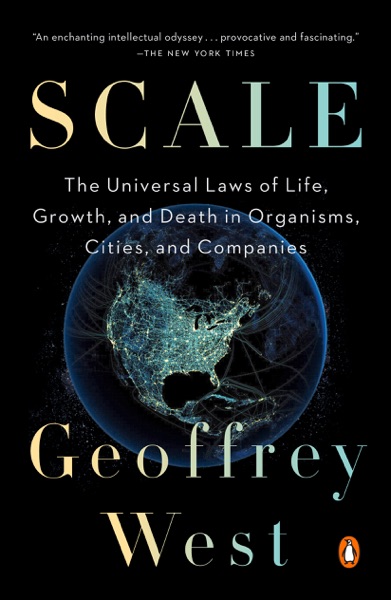
Scale by Geoffrey West is a 2017 science book about complexity, cities, biology. Biological scaling follows a 3/4 power law: metabolic rate, lifespan, and most physiological traits scale predictably with body mass across all mammals.
Summary
Geoffrey West is a theoretical physicist who spent decades at Los Alamos and the Santa Fe Institute studying whether there are mathematical laws underlying all complex systems — organisms, cities, companies — and finding that the answer appears to be yes. Scale is his attempt to explain those laws to a general audience and draw out their implications for how we understand growth, sustainability, and the future of human civilization.
The central discovery is scaling. When you plot metabolic rate against body mass for mammals across twelve orders of magnitude — from a shrew to a whale — you get a power law. Specifically, metabolic rate scales as the 3/4 power of body mass. This means that larger animals are more efficient per unit of mass, but they also live longer, have slower hearts, and take more time to mature. West and his collaborators discovered that this 3/4 scaling is not accidental but follows from the fractal geometry of the distribution networks — circulatory, respiratory, neural — that deliver resources to cells. The same mathematics, it turns out, describes how trees, rivers, and even companies scale.
Cities are where the book gets most interesting. Cities obey different scaling laws than organisms. Where organisms scale sub-linearly (bigger is more efficient), cities scale super-linearly for innovation-related outputs. Double the size of a city and you get roughly a 15 percent increase in patents, wages, crime, disease, and coffee shops — per person. Cities accelerate life rather than slowing it. West argues this is why cities are essentially immortal — they keep reinventing themselves — while companies, which scale more like organisms, inevitably stagnate and die.
The last third of the book turns to the sustainability question. Exponential growth on a finite planet is mathematically unsustainable, and West is frank about this. The only way out, he argues, is a series of major innovations that keep resetting the growth curve — which means the pace of innovation itself must accelerate to stay ahead of collapse. This is not a comfortable conclusion, and West does not pretend it is. The book ends not with a solution but with an honest account of the problem.
Talk to Scale like its author wrote you back.
Get the ideas that fit your life — not generic summaries.
- Chat with the book
- Audiobook-style main ideas
- Adapts to your life and goals
- Helps you take action
Key takeaways
- 1.
Biological scaling follows a 3/4 power law: metabolic rate, lifespan, and most physiological traits scale predictably with body mass across all mammals.
- 2.
These laws emerge not from biology specifically but from the mathematics of efficient distribution networks, which explains why they appear in rivers, trees, and other systems.
- 3.
Cities scale super-linearly for social outputs. Doubling city size produces about 15 percent more innovation, wages, and — symmetrically — crime and disease per capita.
- 4.
Companies scale sub-linearly, more like organisms than cities. As they grow, metabolism slows and death becomes increasingly likely. Most companies die; almost no cities do.
- 5.
Exponential growth on a finite planet eventually collides with resource limits. The only escape is a series of ever-faster innovation cycles that keep resetting the curve.
- 6.
The pace of life in cities scales super-linearly with population: people walk faster, do more, and create more in larger cities, at a quantifiable rate.
- 7.
The same mathematical principles that govern metabolic scaling also apply to sleep time, cancer risk, and the fractal branching of circulatory systems.
- 8.
West's framework predicts that sustained growth requires increasingly frequent innovations — a treadmill that must speed up over time to avoid collapse.
Discussion questions
Use these on your own, with a book club, or as chat starters in Superbook. Book club version, ready to copy or print →
- 1.
West argues that the 3/4 scaling law for metabolism is not a biological accident but a consequence of network geometry. Does that kind of mathematical universality change how you think about the nature of life?
- 2.
Cities scale super-linearly for both good outputs (innovation, wages) and bad ones (crime, disease). What does it mean that these are linked, and what does it imply about how we manage cities?
- 3.
The finding that companies die but cities almost never do is counterintuitive. What is it about corporate structure versus city structure that produces this difference?
- 4.
West is explicit that exponential growth on a finite planet eventually fails. How do you personally sit with that conclusion, and do you find his innovation-treadmill escape route convincing?
- 5.
The book implies that your lifespan, sleep needs, and cancer risk are partly determined by your body size according to mathematical laws. How do you feel about the determinism implied by that?
- 6.
West says larger cities produce more per capita through the same mechanism that accelerates their pace of life. Have you felt the pace difference between cities of different sizes? What drives it?
- 7.
He found that companies stagnate because they become increasingly risk-averse as they scale. What specific organizational habits cause that, and is it inevitable?
- 8.
The Santa Fe Institute where West works focuses on complex adaptive systems. What other systems in your daily life might obey hidden mathematical regularities you haven't noticed?
- 9.
West's framework generates predictions that can be tested against data. He describes this as what makes it science rather than metaphor. Is there a distinction in complex systems you think he's eliding?
- 10.
The super-linear scaling of innovation in cities suggests that urbanization creates compounding returns. What are the implications for rural communities and the people who choose to live in them?
- 11.
If companies scale like organisms and die, what does that suggest about organizational strategies for longevity — should large companies try to behave more like cities?
- 12.
The book's conclusion about sustainability is sobering rather than optimistic. Does West's honesty make you more or less confident in the analysis?
Themes
Frequently asked questions
-
Do you need a science background to read Scale?
No. West writes for a general audience and the mathematical content is mostly visual and conceptual. The arguments are accessible without calculus. Readers with more quantitative backgrounds may want more technical depth, which they'll need to find in the academic papers.
-
What is the most surprising finding in Scale?
Probably the super-linear scaling of cities: that doubling a city's population produces more than double the innovation, wages, and crime per capita. The fact that this applies symmetrically to social goods and social harms is both elegant and uncomfortable.
-
Is Scale optimistic or pessimistic about the future?
Honestly mixed. West shows that the growth we depend on requires accelerating innovation cycles to avoid collapse. He doesn't pretend there's an easy way out. The tone is that of a scientist presenting findings, not an advocate making a case for hope.
-
How long is Scale?
Around 480 pages, approximately eight to nine hours at average reading pace. The early chapters on biology are denser; the city and company chapters are more narrative. Some readers find the final sustainability sections the most gripping.
-
What's the book's weakness?
West occasionally overstates the universality of his findings. Not all complex systems obey clean power laws, and the empirical fits are sometimes less tidy than the prose implies. Readers should hold the framework as illuminating rather than definitive.