Psychology · Book club
Scarcity: Why Having Too Little Means So Much book club questions
Here are 12 book club questions for Scarcity: Why Having Too Little Means So Much by Sendhil Mullainathan and Eldar Shafir, ordered to open easily and end somewhere worth arguing about. Copy them, print them, or bring them up one at a time.
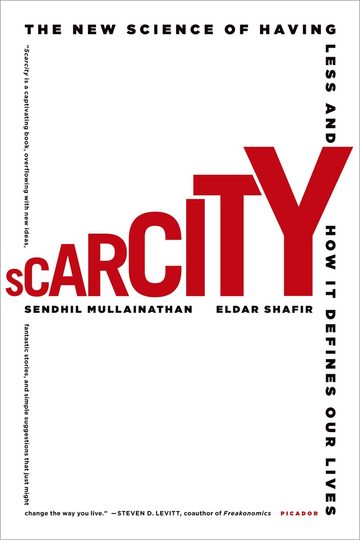
Scarcity is Sendhil Mullainathan and Eldar Shafir's argument that the experience of having too little — of any resource — produces a predictable cognitive syndrome with consequences that extend far beyond the original deficit.
Sendhil Mullainathan and Eldar Shafir · 2013 · 5h 0m
Full summary and key takeaways →The 12 questions
- 1.
The authors argue that scarcity of any kind — money, time, social connection — produces the same cognitive syndrome. Which type of scarcity do you personally experience most acutely?
- 2.
The tunneling concept says that scarcity focuses you on the scarce resource at the cost of everything else. What important things are outside your tunnel right now?
- 3.
The sugarcane farmer study is the most striking single piece of evidence in the book. What does it change about how you think about the relationship between poverty and decision quality?
- 4.
Slack — unused capacity — is what protects you from scarcity spirals. How much slack do you have in your time, finances, and attention? Is it enough?
- 5.
The borrowing trap says scarcity leads to decisions that perpetuate scarcity. Where in your own life do you see that pattern?
- 6.
They argue poverty is partly a design problem — systems that assume unlimited bandwidth impose disproportionate costs on people with less. What systems in your life assume more bandwidth than most people have?
- 7.
Time scarcity affects knowledge workers as well as the poor. Does framing 'always busy' as a form of cognitive impairment change how you think about your own work patterns?
- 8.
The book is careful not to oversimplify policy implications. Do you think it goes far enough in drawing practical conclusions, or is the restraint appropriate given the research?
- 9.
They distinguish between how scarcity feels (focused, urgent) and what it costs (impaired bandwidth, tunneling). Have you ever confused the feeling of urgency with good performance?
- 10.
Where do you see organizations, governments, or institutions designing as if people have unlimited cognitive bandwidth? What would a bandwidth-aware design look like instead?
- 11.
The authors extend their framework beyond poverty to explain why busy professionals, dieters, and lonely people show similar cognitive patterns. Does unifying those experiences feel insightful or like it risks trivializing poverty?
- 12.
What is one concrete change in your environment or schedule that would increase your cognitive slack?
How to run the discussion
- Pick six to eight, not all of them. An hour of real discussion covers fewer questions than anyone expects, and racing the list is what makes a book club feel like homework.
- Open with what people noticed, not what they concluded. Asking for a verdict first hardens opinions before anyone has heard each other.
- Let the disagreement run. The questions below that split a room are the ones worth the time; the ones everyone answers the same way can be skipped.
- Ask the quiet person a specific question. A direct, narrow question is far easier to answer than an open invitation to contribute.
Themes worth steering toward
If the conversation stalls, these are the threads that usually restart it.
Common questions
What are good book club questions for Scarcity: Why Having Too Little Means So Much?
Here are 12 book club questions for Scarcity: Why Having Too Little Means So Much by Sendhil Mullainathan and Eldar Shafir, ordered to open easily and end somewhere worth arguing about. The strongest openers ask what each reader noticed rather than what they concluded, and the discussion usually turns on scarcity mindset, cognitive bandwidth, poverty.
How long should a book club discussion of Scarcity: Why Having Too Little Means So Much last?
Most groups run 60 to 90 minutes of actual discussion. That is roughly six to eight questions, not all of them, so pick the ones that suit your group rather than working down the list in order.
What are the main themes in Scarcity: Why Having Too Little Means So Much?
Scarcity mindset, Cognitive bandwidth, Poverty, Decision-making, Behavioral economics. Those are the threads most likely to divide a room, which makes them the useful places to steer a discussion that has gone quiet.
Picking the next one? See books like Scarcity: Why Having Too Little Means So Much or questions for other book club picks.
