Sculpting in Time by Andrei Tarkovsky is a 1986 philosophy book about cinema, time, art and truth. Film's unique capacity is to sculpt time: to preserve and reshape the pressure of actual duration, not just the appearance of the world.
Summary
Sculpting in Time is Andrei Tarkovsky's account of his own filmmaking philosophy, assembled from lectures and writings over the final decade of his life and published in Russian in 1986, the year he died. It is one of the most serious books about cinema ever written — not as craft manual or critical theory, but as a sustained attempt to answer the question of what film is for and why it matters.
Tarkovsky's central metaphor gives the book its title. He argues that filmmaking is analogous to sculpture: the filmmaker works with actual time as raw material, selecting and shaping what to preserve. Unlike painting, which transforms the world into image, film preserves the pressure of time itself — a falling leaf, water dripping from a roof, a face held longer than narrative efficiency demands. When a shot holds beyond the beat that story-logic requires, Tarkovsky argues, something else becomes available: the texture of lived experience, the rhythm of thought, the proximity to something the viewer cannot quite name but recognizes.
The book is also a passionate polemic. Tarkovsky is contemptuous of commercial cinema's manipulation of emotion through montage, of films that use images instrumentally to construct an argument rather than allowing images to exist on their own terms. He is equally critical of the art cinema tradition that uses obscurity as a mark of seriousness. His touchstones are a cinema of direct, unhurried observation — Bresson, Bergman — and a spiritual conception of art as the artist's effort to communicate the inexpressible.
Readers who come expecting accessible film criticism will find the book difficult. Tarkovsky writes from within a deeply held, occasionally dogmatic, Russian Orthodox conception of beauty and sacrifice that he never brackets or relativizes. The chapter on his own films — Andrei Rublev, Solaris, The Mirror, Stalker — is rich, but it assumes familiarity with the work. For viewers already serious about cinema, or anyone asking why some images linger for decades while technically superior films vanish, Sculpting in Time offers an account you won't find elsewhere.
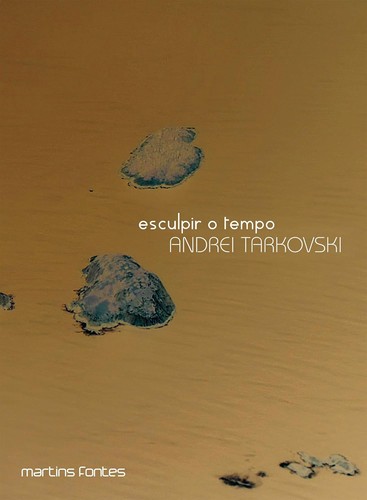
Talk to Sculpting in Time like its author wrote you back.
Get the ideas that fit your life — not generic summaries.
- Chat with the book
- Audiobook-style main ideas
- Adapts to your life and goals
- Helps you take action
Key takeaways
- 1.
Film's unique capacity is to sculpt time: to preserve and reshape the pressure of actual duration, not just the appearance of the world.
- 2.
The hold of a shot beyond narrative necessity is not waste — it is the moment when cinema can communicate something that cannot be argued, only experienced.
- 3.
Tarkovsky distrusts montage-as-argument. When images are cut to build a logic, they stop being images and become symbols, losing their direct weight.
- 4.
Art's purpose, for Tarkovsky, is not entertainment or persuasion but something closer to prayer: a mode of reaching for the inexpressible and failing productively.
- 5.
The audience is not a passive receiver but an active participant who brings their own time and memory to what they see, completing the work.
- 6.
Commercial cinema's manipulation of emotion is a kind of fraud — producing feeling without depth, using images as levers rather than as things in themselves.
- 7.
The director's task is to find the rhythm of a film — its inner tempo — which may be quite different from the pace that story logic would dictate.
- 8.
Great cinema, for Tarkovsky, shares qualities with music: it organizes time, creates atmosphere, and aims not to explain but to transform the viewer.
Discussion questions
Use these on your own, with a book club, or as chat starters in Superbook. Book club version, ready to copy or print →
- 1.
Tarkovsky argues that holding a shot longer than story logic requires opens access to something beyond narrative. Can you think of a film moment where you experienced exactly that — where the duration itself was the point?
- 2.
He distrusts montage editing that builds arguments through image juxtaposition. Is there a meaningful difference between a film that moves you and one that manipulates you? How do you tell the difference?
- 3.
The book's conception of art is explicitly spiritual — art reaches toward the inexpressible. Does that framework resonate with you, or does it feel exclusionary? What is lost and what is gained by framing art that way?
- 4.
Tarkovsky says the director must find the inner rhythm of a film before making decisions about pace or structure. Have you noticed 'inner rhythm' as a quality in films you love? What is it?
- 5.
He is harshly critical of commercial cinema for manipulating audiences. Is manipulation always a failure, or is some emotional engineering legitimate?
- 6.
The book assumes familiarity with Tarkovsky's films. If you've seen Stalker, Solaris, or The Mirror, does reading his own account of what he was trying to do change how you see the work?
- 7.
Tarkovsky argues that a film's meaning cannot be paraphrased without loss — that the film is the meaning. Do you agree? Is there a work of art you feel this is true of?
- 8.
He draws a direct line from his filmmaking ethics to Russian Orthodox spirituality. To what extent is his aesthetics separable from that religious framework?
- 9.
The book was written in the 1980s, and cinema has changed enormously. Do Tarkovsky's categories — especially his distinction between image and symbol — still apply to contemporary film and video?
- 10.
Tarkovsky places enormous weight on slowness as a value. What do you think we lose as viewers by watching more content faster? Is his argument just nostalgia, or does it identify something real?
- 11.
What film have you seen that most fits Tarkovsky's ideal of cinema? What made it different from films that merely told a story well?
Themes
Frequently asked questions
-
Do I need to have seen Tarkovsky's films to read this book?
It helps considerably. The later chapters discuss his own films in depth and assume you know them. That said, the philosophical sections — especially on time and image — stand on their own and are worth reading even without the films as background.
-
What is Tarkovsky's main argument in Sculpting in Time?
That film uniquely preserves and reshapes time rather than space, and that the highest use of this capacity is not to tell stories efficiently but to create spaces of direct observation where viewers can encounter something beyond narrative — something closer to what he calls spiritual experience.
-
Is this an accessible book or a difficult one?
Genuinely difficult if you come to it cold. Tarkovsky is a systematic thinker but also dogmatic about his categories; he writes from within a worldview that he doesn't pause to explain. Readers who already watch films slowly and seriously will find it rewarding. Casual readers will struggle.
-
How does it compare to other books on filmmaking?
It is not a how-to book and barely touches technique. As a statement of what cinema is for — as a philosophical and spiritual argument rather than a craft guide — there's nothing quite like it. Robert Bresson's Notes on the Cinematograph is the closest equivalent.
-
How long does it take to read?
Around four to five hours for the main text, though many readers pause to watch or re-watch the films he discusses. It rewards slow reading more than most books about cinema.
Similar books
Creativity, Inc.: Overcoming the Unseen Forces That Stand in the Way of True Inspiration
Ed Catmull and Amy Wallace
Daily Rituals: How Artists Work
Mason Currey
The Creative Habit
Twyla Tharp
The Act of Creation
Arthur Koestler
