Philosophy · Book club
Sculpting in Time book club questions
Here are 11 book club questions for Sculpting in Time by Andrei Tarkovsky, ordered to open easily and end somewhere worth arguing about. Copy them, print them, or bring them up one at a time.
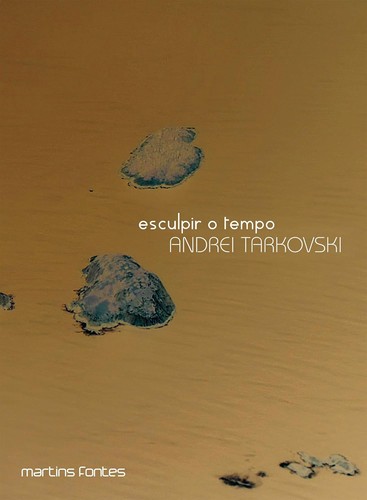
Sculpting in Time is Andrei Tarkovsky's account of his own filmmaking philosophy, assembled from lectures and writings over the final decade of his life and published in Russian in 1986, the year he died.
Andrei Tarkovsky · 1986 · 4h 45m
Full summary and key takeaways →The 11 questions
- 1.
Tarkovsky argues that holding a shot longer than story logic requires opens access to something beyond narrative. Can you think of a film moment where you experienced exactly that — where the duration itself was the point?
- 2.
He distrusts montage editing that builds arguments through image juxtaposition. Is there a meaningful difference between a film that moves you and one that manipulates you? How do you tell the difference?
- 3.
The book's conception of art is explicitly spiritual — art reaches toward the inexpressible. Does that framework resonate with you, or does it feel exclusionary? What is lost and what is gained by framing art that way?
- 4.
Tarkovsky says the director must find the inner rhythm of a film before making decisions about pace or structure. Have you noticed 'inner rhythm' as a quality in films you love? What is it?
- 5.
He is harshly critical of commercial cinema for manipulating audiences. Is manipulation always a failure, or is some emotional engineering legitimate?
- 6.
The book assumes familiarity with Tarkovsky's films. If you've seen Stalker, Solaris, or The Mirror, does reading his own account of what he was trying to do change how you see the work?
- 7.
Tarkovsky argues that a film's meaning cannot be paraphrased without loss — that the film is the meaning. Do you agree? Is there a work of art you feel this is true of?
- 8.
He draws a direct line from his filmmaking ethics to Russian Orthodox spirituality. To what extent is his aesthetics separable from that religious framework?
- 9.
The book was written in the 1980s, and cinema has changed enormously. Do Tarkovsky's categories — especially his distinction between image and symbol — still apply to contemporary film and video?
- 10.
Tarkovsky places enormous weight on slowness as a value. What do you think we lose as viewers by watching more content faster? Is his argument just nostalgia, or does it identify something real?
- 11.
What film have you seen that most fits Tarkovsky's ideal of cinema? What made it different from films that merely told a story well?
How to run the discussion
- Pick six to eight, not all of them. An hour of real discussion covers fewer questions than anyone expects, and racing the list is what makes a book club feel like homework.
- Open with what people noticed, not what they concluded. Asking for a verdict first hardens opinions before anyone has heard each other.
- Let the disagreement run. The questions below that split a room are the ones worth the time; the ones everyone answers the same way can be skipped.
- Ask the quiet person a specific question. A direct, narrow question is far easier to answer than an open invitation to contribute.
Themes worth steering toward
If the conversation stalls, these are the threads that usually restart it.
Common questions
What are good book club questions for Sculpting in Time?
Here are 11 book club questions for Sculpting in Time by Andrei Tarkovsky, ordered to open easily and end somewhere worth arguing about. The strongest openers ask what each reader noticed rather than what they concluded, and the discussion usually turns on cinema, time, art and truth.
How long should a book club discussion of Sculpting in Time last?
Most groups run 60 to 90 minutes of actual discussion. That is roughly six to eight questions, not all of them, so pick the ones that suit your group rather than working down the list in order.
What are the main themes in Sculpting in Time?
Cinema, Time, Art and truth, Creativity, Spiritual life. Those are the threads most likely to divide a room, which makes them the useful places to steer a discussion that has gone quiet.
Picking the next one? See books like Sculpting in Time or questions for other book club picks.
