History · Book club
Seabiscuit: An American Legend book club questions
Here are 12 book club questions for Seabiscuit: An American Legend by Laura Hillenbrand, ordered to open easily and end somewhere worth arguing about. Copy them, print them, or bring them up one at a time.
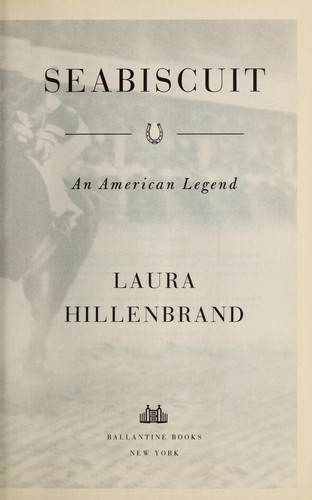
Seabiscuit is the story of the undersized, knobby-kneed racehorse who became the most celebrated American athlete of the late 1930s — drawing larger newspaper audiences than Franklin Roosevelt or Joe DiMaggio at his peak.
Laura Hillenbrand · 2001 · 7h 0m
Full summary and key takeaways →The 12 questions
- 1.
Hillenbrand argues that Seabiscuit's appeal was inseparable from the Depression. What do you think people were really seeing when they watched this horse, and what did they need from the story?
- 2.
Tom Smith is the most enigmatic figure in the book — intuitive, uncommunicative, effective. What kind of expertise does he represent, and how does it differ from conventional knowledge?
- 3.
Red Pollard's half-blindness and excess weight should have ended his riding career. What does his persistence tell us about how people override evidence about their own limitations?
- 4.
Charles Howard approached horse ownership with a car dealer's marketing instincts. Does framing a sport through marketing and narrative make the underlying thing less authentic, or is that always how public spectacle works?
- 5.
Hillenbrand wrote this book from her apartment while seriously ill. Does knowing that change how you read the book, and should it?
- 6.
The book covers multiple near-fatal injuries — to both Seabiscuit and Pollard — and subsequent recoveries. What does Hillenbrand's treatment of those episodes say about how we construct narratives of resilience?
- 7.
The War Admiral match race was framed as a class conflict — the establishment champion versus the people's horse. How accurate is that framing, and who benefits when sport gets read as class allegory?
- 8.
Hillenbrand is careful to distinguish mythology from evidence throughout the book. What myths about Seabiscuit does she explicitly correct, and does the true story lose anything in the process?
- 9.
The match race was set up through a prolonged negotiation between the two horses' camps. What do the logistics of elite sporting events tell us about power, leverage, and the economics of spectacle?
- 10.
How has horse racing changed since the 1930s — in public profile, in ethics, in the role of the individual horse as a media figure? What does that change say about American sports culture?
- 11.
The final race is almost too narratively satisfying — the injured horse, the injured jockey, the improbable win. How do you evaluate a true story that fits a classical narrative arc this precisely?
- 12.
Seabiscuit inspired enormous public devotion during his lifetime and faded from cultural memory afterward. What determines whether a sporting hero stays culturally significant over time?
How to run the discussion
- Pick six to eight, not all of them. An hour of real discussion covers fewer questions than anyone expects, and racing the list is what makes a book club feel like homework.
- Open with what people noticed, not what they concluded. Asking for a verdict first hardens opinions before anyone has heard each other.
- Let the disagreement run. The questions below that split a room are the ones worth the time; the ones everyone answers the same way can be skipped.
- Ask the quiet person a specific question. A direct, narrow question is far easier to answer than an open invitation to contribute.
Themes worth steering toward
If the conversation stalls, these are the threads that usually restart it.
Common questions
What are good book club questions for Seabiscuit: An American Legend?
Here are 12 book club questions for Seabiscuit: An American Legend by Laura Hillenbrand, ordered to open easily and end somewhere worth arguing about. The strongest openers ask what each reader noticed rather than what they concluded, and the discussion usually turns on perseverance, depression-era america, sport.
How long should a book club discussion of Seabiscuit: An American Legend last?
Most groups run 60 to 90 minutes of actual discussion. That is roughly six to eight questions, not all of them, so pick the ones that suit your group rather than working down the list in order.
What are the main themes in Seabiscuit: An American Legend?
Perseverance, Depression-era America, Sport, Redemption, Media and celebrity. Those are the threads most likely to divide a room, which makes them the useful places to steer a discussion that has gone quiet.
Picking the next one? See books like Seabiscuit: An American Legend or questions for other book club picks.
