Biography · Book club
Seeing Is Forgetting the Name of the Thing One Sees book club questions
Here are 11 book club questions for Seeing Is Forgetting the Name of the Thing One Sees by Lawrence Weschler, ordered to open easily and end somewhere worth arguing about. Copy them, print them, or bring them up one at a time.
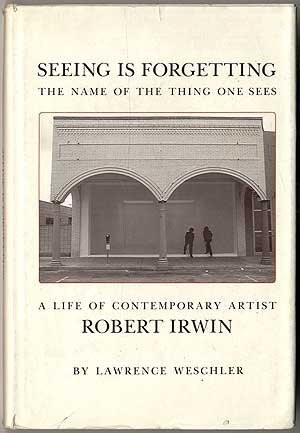
Seeing Is Forgetting the Name of the Thing One Sees is Lawrence Weschler's extended portrait of Robert Irwin, the California artist who began his career as an abstract expressionist painter and progressively dismantled every element of conventional art-making — frame, canvas, pigment, discrete object — until he was working with pure perception itself.
Lawrence Weschler · 1982 · 3h 45m
Full summary and key takeaways →The 11 questions
- 1.
Irwin progressively eliminated every conventional element of art-making until he reached perception itself. Is there a logic to that progression, or does it look like a sequence of refusals without a destination?
- 2.
The title argues that naming a thing interferes with seeing it. Can you think of contexts in your own experience — professional or personal — where what you already know gets in the way of what you could see?
- 3.
Irwin's late work is often invisible until you are actually standing in it. Is there a distinction between art that rewards sustained attention and art that merely requires it?
- 4.
Weschler's book is as much a portrait of obsessive creative inquiry as a biography. What does it suggest about what a life in art requires, and whether that life is compatible with other things?
- 5.
The dot paintings and the discs are objects that work hard to dissolve their own objecthood. What does Irwin seem to think objects are for in the history of art, and why does he want to escape them?
- 6.
Irwin's evolution was driven partly by the absence of a satisfying answer to his previous work. How does creative dissatisfaction function differently from ordinary dissatisfaction?
- 7.
The book was expanded in later editions as Irwin's work continued. What is gained or lost by a biography that grows alongside its subject rather than looking back from a fixed endpoint?
- 8.
Site-specific installation resists collection and sale in the conventional sense. What does Irwin's commitment to that form say about his relationship to the art market?
- 9.
Weschler is clearly sympathetic to Irwin. Does that sympathy help or limit the portrait? What questions does it seem to skip?
- 10.
The idea of 'seeing is forgetting the name of the thing one sees' applies beyond art. Where in your daily life do you most rely on category and name rather than direct perception?
- 11.
Irwin's work requires institutional support — museums, galleries, site owners — even as it questions the conventions of the institution. How does that tension show up in the book?
How to run the discussion
- Pick six to eight, not all of them. An hour of real discussion covers fewer questions than anyone expects, and racing the list is what makes a book club feel like homework.
- Open with what people noticed, not what they concluded. Asking for a verdict first hardens opinions before anyone has heard each other.
- Let the disagreement run. The questions below that split a room are the ones worth the time; the ones everyone answers the same way can be skipped.
- Ask the quiet person a specific question. A direct, narrow question is far easier to answer than an open invitation to contribute.
Themes worth steering toward
If the conversation stalls, these are the threads that usually restart it.
Common questions
What are good book club questions for Seeing Is Forgetting the Name of the Thing One Sees?
Here are 11 book club questions for Seeing Is Forgetting the Name of the Thing One Sees by Lawrence Weschler, ordered to open easily and end somewhere worth arguing about. The strongest openers ask what each reader noticed rather than what they concluded, and the discussion usually turns on perception, art practice, conceptual art.
How long should a book club discussion of Seeing Is Forgetting the Name of the Thing One Sees last?
Most groups run 60 to 90 minutes of actual discussion. That is roughly six to eight questions, not all of them, so pick the ones that suit your group rather than working down the list in order.
What are the main themes in Seeing Is Forgetting the Name of the Thing One Sees?
Perception, Art practice, Conceptual art, Attention, Process. Those are the threads most likely to divide a room, which makes them the useful places to steer a discussion that has gone quiet.
Picking the next one? See books like Seeing Is Forgetting the Name of the Thing One Sees or questions for other book club picks.
