Business · Book club
Setting the Table book club questions
Here are 12 book club questions for Setting the Table by Danny Meyer, ordered to open easily and end somewhere worth arguing about. Copy them, print them, or bring them up one at a time.
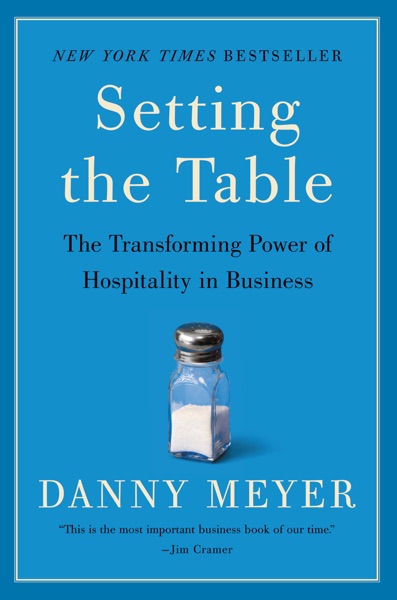
Setting the Table is Danny Meyer's account of building Union Square Hospitality Group, the company behind Union Square Cafe, Gramercy Tavern, Shake Shack, and more than a dozen other New York restaurants.
Danny Meyer · 2006 · 5h 45m
Full summary and key takeaways →The 12 questions
- 1.
Meyer distinguishes hospitality from service. Think of a business outside restaurants that gets hospitality right. What specifically do they do that feels like genuine care rather than protocol?
- 2.
He ranks employees above guests in his stakeholder hierarchy. What does that ordering mean in practice, and can you think of cases where it has limits?
- 3.
Meyer describes looking for '51 percenters.' How do you screen for emotional intelligence in interviews? Can you think of examples where you got that judgment right or wrong?
- 4.
What is your own business or workplace's implicit stakeholder priority order? How does it compare to Meyer's explicit version?
- 5.
Meyer talks extensively about the importance of recovering from mistakes. Think of a service failure you experienced — as a customer or as the provider. What would have made the recovery feel genuinely hospitable?
- 6.
He argues that culture becomes harder to sustain as organizations grow. What mechanisms have you seen work — or fail — for preserving culture at scale?
- 7.
Union Square Cafe survived its landlord doubling the rent and the restaurant choosing to move. What does that kind of institutional loyalty from guests require, and what investments built it?
- 8.
Meyer describes opening several restaurants that failed or underperformed. What patterns does he identify in those failures, and do they match your experience with organizational missteps?
- 9.
Is 'hospitality' as Meyer defines it transferable to industries beyond direct consumer service — say, software, manufacturing, or healthcare?
- 10.
Meyer talks about the importance of genuine eye contact and personal attention. In an age of digital interfaces, what is the equivalent of that kind of personal recognition?
- 11.
He describes himself as a 'constant gardener' — someone who tends relationships continuously rather than episodically. How do you maintain key relationships in your own work?
- 12.
Shake Shack grew from a hot dog cart to a global chain. What, if anything, does Meyer's hospitality culture look like at that scale? Can it survive?
How to run the discussion
- Pick six to eight, not all of them. An hour of real discussion covers fewer questions than anyone expects, and racing the list is what makes a book club feel like homework.
- Open with what people noticed, not what they concluded. Asking for a verdict first hardens opinions before anyone has heard each other.
- Let the disagreement run. The questions below that split a room are the ones worth the time; the ones everyone answers the same way can be skipped.
- Ask the quiet person a specific question. A direct, narrow question is far easier to answer than an open invitation to contribute.
Themes worth steering toward
If the conversation stalls, these are the threads that usually restart it.
Common questions
What are good book club questions for Setting the Table?
Here are 12 book club questions for Setting the Table by Danny Meyer, ordered to open easily and end somewhere worth arguing about. The strongest openers ask what each reader noticed rather than what they concluded, and the discussion usually turns on hospitality, service culture, leadership.
How long should a book club discussion of Setting the Table last?
Most groups run 60 to 90 minutes of actual discussion. That is roughly six to eight questions, not all of them, so pick the ones that suit your group rather than working down the list in order.
What are the main themes in Setting the Table?
Hospitality, Service culture, Leadership, Customer relationships, Restaurant business. Those are the threads most likely to divide a room, which makes them the useful places to steer a discussion that has gone quiet.
Picking the next one? See books like Setting the Table or questions for other book club picks.
