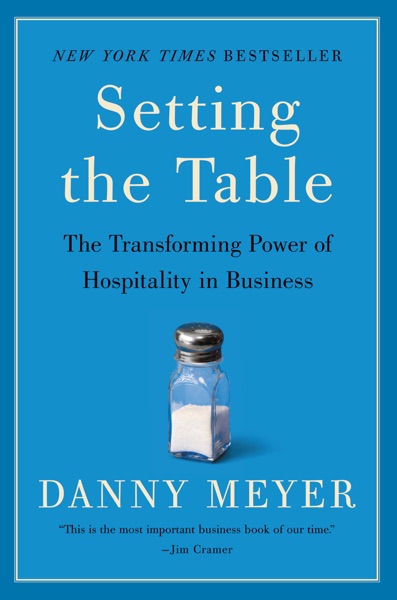
Setting the Table by Danny Meyer is a 2006 business book about hospitality, service culture, leadership. Hospitality is making guests feel genuinely welcomed and seen. Service is technical execution. Meyer argues that hospitality — the emotional component — is the harder and more valuable thing to get right.
Summary
Setting the Table is Danny Meyer's account of building Union Square Hospitality Group, the company behind Union Square Cafe, Gramercy Tavern, Shake Shack, and more than a dozen other New York restaurants. Meyer opened Union Square Cafe in 1985 at age 27 with no formal culinary training, and the book follows his evolution from a first-time restaurateur into one of the most successful operators in the American restaurant industry.
The organizing idea is what Meyer calls "enlightened hospitality," a term he deliberately distinguishes from mere service. Service, in his framing, is the technical act of delivering what a guest ordered correctly and on time. Hospitality is making the guest feel genuinely seen, welcomed, and cared for. The difference is the difference between a transaction and a relationship. Meyer argues that businesses that master the emotional component of hospitality — not just the mechanical one — build durable loyalty that transcends price and competition.
Meyer is notably specific about the internal culture that makes hospitality possible. He ranks his stakeholders in a deliberate order: employees first, guests second, community third, suppliers fourth, investors fifth. This isn't anti-investor; it's an argument that if you take exceptional care of the people doing the work, they will take exceptional care of guests, and financial results follow. Meyer spends considerable time on hiring — what he calls looking for "51 percenters," people whose natural warmth and emotional intelligence outweigh their technical skills, because technical skills can be taught and emotional intelligence largely cannot.
The book is candid about failures alongside successes. Meyer describes restaurants that didn't work, partnerships that fell apart, and the humbling learning curve of a first-time restaurateur. He's also honest about the tension between growth and culture — as Union Square Hospitality Group expanded, maintaining the warmth of a small operation became harder, and he describes the deliberate structures he built to try to preserve it. Setting the Table is most useful for anyone running a team or business where customer experience is the core product, but the hospitality framework applies beyond restaurants.
Talk to Setting the Table like its author wrote you back.
Get the ideas that fit your life — not generic summaries.
- Chat with the book
- Audiobook-style main ideas
- Adapts to your life and goals
- Helps you take action
Key takeaways
- 1.
Hospitality is making guests feel genuinely welcomed and seen. Service is technical execution. Meyer argues that hospitality — the emotional component — is the harder and more valuable thing to get right.
- 2.
Meyer's stakeholder priority order: employees first, guests second, community third, suppliers fourth, investors fifth. Happy employees produce the hospitality that produces financial results.
- 3.
Hire for emotional intelligence over technical skill. Meyer looks for '51 percenters' — people whose natural warmth slightly outweighs their competence, because warmth is harder to teach.
- 4.
The restaurant industry's hardest problem is not the food. It's building a culture that sustains excellence when the founder isn't in the room.
- 5.
Mistakes are inevitable in hospitality. What distinguishes great restaurants is how they recover from errors — with genuine care and urgency, not defensive protocol.
- 6.
Context matters in hospitality. The same guest with a business dinner, a birthday celebration, and a quick lunch needs different things. Paying attention to context is the whole game.
- 7.
Growth strains culture. As Union Square Hospitality Group expanded, Meyer had to build deliberate structures — training, leadership development, shared language — to preserve the warmth of smaller operations.
- 8.
Community relationship is part of the business model. Meyer's restaurants became institutions partly because they invested in the neighborhoods around them, not just in the dining rooms.
Discussion questions
Use these on your own, with a book club, or as chat starters in Superbook. Book club version, ready to copy or print →
- 1.
Meyer distinguishes hospitality from service. Think of a business outside restaurants that gets hospitality right. What specifically do they do that feels like genuine care rather than protocol?
- 2.
He ranks employees above guests in his stakeholder hierarchy. What does that ordering mean in practice, and can you think of cases where it has limits?
- 3.
Meyer describes looking for '51 percenters.' How do you screen for emotional intelligence in interviews? Can you think of examples where you got that judgment right or wrong?
- 4.
What is your own business or workplace's implicit stakeholder priority order? How does it compare to Meyer's explicit version?
- 5.
Meyer talks extensively about the importance of recovering from mistakes. Think of a service failure you experienced — as a customer or as the provider. What would have made the recovery feel genuinely hospitable?
- 6.
He argues that culture becomes harder to sustain as organizations grow. What mechanisms have you seen work — or fail — for preserving culture at scale?
- 7.
Union Square Cafe survived its landlord doubling the rent and the restaurant choosing to move. What does that kind of institutional loyalty from guests require, and what investments built it?
- 8.
Meyer describes opening several restaurants that failed or underperformed. What patterns does he identify in those failures, and do they match your experience with organizational missteps?
- 9.
Is 'hospitality' as Meyer defines it transferable to industries beyond direct consumer service — say, software, manufacturing, or healthcare?
- 10.
Meyer talks about the importance of genuine eye contact and personal attention. In an age of digital interfaces, what is the equivalent of that kind of personal recognition?
- 11.
He describes himself as a 'constant gardener' — someone who tends relationships continuously rather than episodically. How do you maintain key relationships in your own work?
- 12.
Shake Shack grew from a hot dog cart to a global chain. What, if anything, does Meyer's hospitality culture look like at that scale? Can it survive?
Themes
Frequently asked questions
-
What is Setting the Table about?
It's Danny Meyer's account of building Union Square Hospitality Group from his first restaurant in 1985 through two decades of growth. The book's central argument is about 'enlightened hospitality' — the idea that making employees and guests feel genuinely cared for is the foundation of lasting business success.
-
Is Setting the Table only for people in the restaurant business?
No. The hospitality framework applies broadly to any business where customer experience and team culture matter. Readers in retail, healthcare, software, and professional services have found it useful. The restaurant examples are vivid but the underlying management ideas transfer.
-
What is Danny Meyer's most actionable idea in Setting the Table?
The '51 percenter' hiring principle: prioritize emotional intelligence and warmth over technical skill when choosing people for roles that involve serving others, because the emotional dimension is harder to teach. This changes how you think about job requirements and interviews.
-
How long is Setting the Table?
Roughly five to six hours at average reading pace. The book is about 320 pages, mixing memoir with management philosophy. It reads smoothly and the restaurant stories make the abstract points concrete.
-
Does Meyer address the hard parts of the restaurant business?
Yes, more than most business memoirs do. He describes restaurants that didn't work, partnerships that went wrong, the physical and financial difficulty of the industry, and the strain of growth on culture. The candor is part of why the book holds up.
Similar books
Good to Great
Jim Collins
The Culture Code
Daniel Coyle

Kitchen Confidential: Adventures in the Culinary Underbelly
Anthony Bourdain
The Hard Thing About Hard Things
Ben Horowitz
