Literary fiction · Book club
Slaughterhouse-Five book club questions
Here are 12 book club questions for Slaughterhouse-Five by Kurt Vonnegut, ordered to open easily and end somewhere worth arguing about. Copy them, print them, or bring them up one at a time.
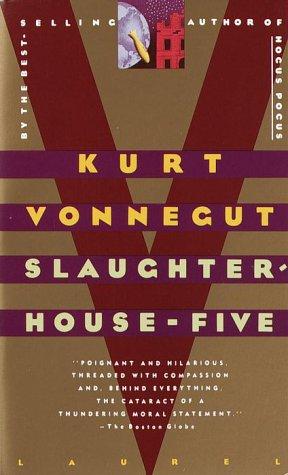
Billy Pilgrim has become unstuck in time.
Kurt Vonnegut · 1969 · 3h 15m
Full summary and key takeaways →The 12 questions
- 1.
The Tralfamadorian view of time removes free will and makes all outcomes fixed. Does Billy Pilgrim use this as a genuine philosophy or as a mechanism to avoid guilt about surviving when others didn't?
- 2.
Vonnegut tells us in chapter one that he's been trying to write this book for years and that it's a failure. Does knowing that change how you read what follows?
- 3.
'So it goes' after every death — including deaths of thousands. When did you first feel the phrase doing something to you emotionally? When did it stop working, if it did?
- 4.
The firebombing of Dresden is described briefly. Why does Vonnegut keep circling it rather than putting it at the center? What does that structure reproduce?
- 5.
Edgar Derby — decent, optimistic, shot for stealing a teapot — is telegraphed from early in the novel. Does knowing his fate affect how you read his earlier scenes?
- 6.
Montana Wildhack is the obvious male fantasy character in the novel. Is she a problem in the book, or is the fantasy itself being examined?
- 7.
Billy Pilgrim is never quite sympathetic — he's passive, weak, and his alien kidnapping is probably delusion. Does the novel need you to like him?
- 8.
Compared to Catch-22's relentless comedy, Slaughterhouse-Five uses humor more sparingly and the grief is more visible. Which approach to representing war feels more honest to you?
- 9.
The novel was published in 1969 during Vietnam. How much of it is about World War II and how much is it talking about something happening in real time?
- 10.
Vonnegut was actually there, in that basement, when Dresden burned. How does knowing that change what you make of Billy Pilgrim's passivity?
- 11.
The book ends 'Poo-tee-weet?' — a bird call, the only appropriate response to what has happened. Is that resolution, or a refusal of resolution?
- 12.
If you had to describe the book to someone who had never heard of it in two sentences, what would you say? And is that description actually true to what reading it feels like?
How to run the discussion
- Pick six to eight, not all of them. An hour of real discussion covers fewer questions than anyone expects, and racing the list is what makes a book club feel like homework.
- Open with what people noticed, not what they concluded. Asking for a verdict first hardens opinions before anyone has heard each other.
- Let the disagreement run. The questions below that split a room are the ones worth the time; the ones everyone answers the same way can be skipped.
- Ask the quiet person a specific question. A direct, narrow question is far easier to answer than an open invitation to contribute.
Themes worth steering toward
If the conversation stalls, these are the threads that usually restart it.
Common questions
What are good book club questions for Slaughterhouse-Five?
Here are 12 book club questions for Slaughterhouse-Five by Kurt Vonnegut, ordered to open easily and end somewhere worth arguing about. The strongest openers ask what each reader noticed rather than what they concluded, and the discussion usually turns on war and trauma, free will and fatalism, time and memory.
How long should a book club discussion of Slaughterhouse-Five last?
Most groups run 60 to 90 minutes of actual discussion. That is roughly six to eight questions, not all of them, so pick the ones that suit your group rather than working down the list in order.
What are the main themes in Slaughterhouse-Five?
War and trauma, Free will and fatalism, Time and memory, Survival and guilt, American mythology. Those are the threads most likely to divide a room, which makes them the useful places to steer a discussion that has gone quiet.
Picking the next one? See books like Slaughterhouse-Five or questions for other book club picks.
