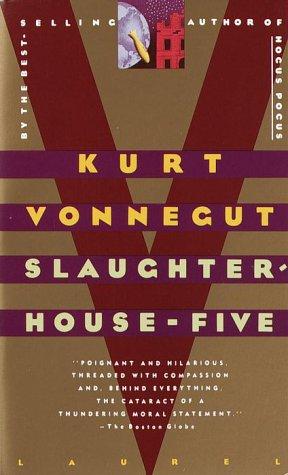
Slaughterhouse-Five by Kurt Vonnegut is a 1969 literary fiction book about war and trauma, free will and fatalism, time and memory. The Tralfamadorian philosophy — all moments exist simultaneously, death is just a bad moment — is Vonnegut presenting a coping mechanism honestly: it helps, and it is also a way of avoiding responsibility and grief.
Summary
Billy Pilgrim has become unstuck in time. A former American prisoner of war who survived the firebombing of Dresden in a slaughterhouse basement, Billy now jumps involuntarily between moments in his life — his boring optometry practice in upstate New York, his capture during the Battle of the Bulge, his years as a living exhibit on the planet Tralfamadore, his daughter's wedding. And then he travels back to Dresden. Slaughterhouse-Five, published in 1969, is Vonnegut's attempt to write about a war atrocity he survived and couldn't process through conventional narrative means. It's among the strangest and most effective antiwar novels ever written.
The book is overtly about the limits of story when applied to catastrophe. The first chapter is Vonnegut himself explaining that he tried for years to write about Dresden the normal way and couldn't — and so he invented Billy Pilgrim, who processes the unprocessable through time travel and alien abduction. The Tralfamadorians' view of time — all moments exist simultaneously, and death simply means the person is having a bad moment in one of them, so it goes — is both a coping mechanism and a satire of fatalism. Billy's "So it goes" after every death in the novel is devastatingly funny and devastatingly sad at once.
Vonnegut's prose is conversational, flat, and deeply controlled. The short declarative sentences and chapter breaks feel almost childlike. They aren't. The simplicity is a way of reporting the unspeakable plainly, without inflation, which turns out to be more affecting than any conventional tragic register. The novel is also very funny, and it shouldn't be, and Vonnegut knows it shouldn't be, and the comedy and the horror refuse to separate.
Slaughterhouse-Five is short, unusual, and emotionally demanding in ways that aren't immediately obvious. Readers who want narrative tension or character development in the traditional sense will find it thin. What the book actually offers is something closer to a sustained mood — the texture of a survivor's mind, full of gaps and dark humor and the reflex to say "so it goes" because there's nothing else adequate to say. It has aged into one of the defining American novels, partly because the question of what to do with catastrophe — how to represent it, how to live with it — hasn't gotten easier.
Talk to Slaughterhouse-Five like its author wrote you back.
Get the ideas that fit your life — not generic summaries.
- Chat with the book
- Audiobook-style main ideas
- Adapts to your life and goals
- Helps you take action
Key takeaways
- 1.
The Tralfamadorian philosophy — all moments exist simultaneously, death is just a bad moment — is Vonnegut presenting a coping mechanism honestly: it helps, and it is also a way of avoiding responsibility and grief.
- 2.
'So it goes' appears after every death in the novel. The repetition does something to the reader that commentary can't: it performs the numbing that war produces.
- 3.
The firebombing of Dresden killed more civilians than Hiroshima and was barely discussed in postwar America. Vonnegut understood that the shape of memory is political.
- 4.
Billy Pilgrim may be traumatized rather than literally unstuck in time. The novel holds both readings without resolving them.
- 5.
Vonnegut opens by telling you the book you're about to read failed to say what he wanted to say about Dresden. This admission is one of the most honest things in American fiction.
- 6.
The Tralfamadorian novel — which shows only beautiful moments, in no order — is a parody of escapist fiction. It's also what parts of Slaughterhouse-Five actually are.
- 7.
Montana Wildhack, Billy's partner on Tralfamadore, is a fantasy that functions as both wish fulfillment and trauma response — a safe place that is also, like all safe places in the novel, a cage.
- 8.
Edgar Derby's execution for looting a teapot amid the rubble of Dresden is the novel's absurdist peak: one man shot for theft in the context of a city burned to the ground.
Discussion questions
Use these on your own, with a book club, or as chat starters in Superbook. Book club version, ready to copy or print →
- 1.
The Tralfamadorian view of time removes free will and makes all outcomes fixed. Does Billy Pilgrim use this as a genuine philosophy or as a mechanism to avoid guilt about surviving when others didn't?
- 2.
Vonnegut tells us in chapter one that he's been trying to write this book for years and that it's a failure. Does knowing that change how you read what follows?
- 3.
'So it goes' after every death — including deaths of thousands. When did you first feel the phrase doing something to you emotionally? When did it stop working, if it did?
- 4.
The firebombing of Dresden is described briefly. Why does Vonnegut keep circling it rather than putting it at the center? What does that structure reproduce?
- 5.
Edgar Derby — decent, optimistic, shot for stealing a teapot — is telegraphed from early in the novel. Does knowing his fate affect how you read his earlier scenes?
- 6.
Montana Wildhack is the obvious male fantasy character in the novel. Is she a problem in the book, or is the fantasy itself being examined?
- 7.
Billy Pilgrim is never quite sympathetic — he's passive, weak, and his alien kidnapping is probably delusion. Does the novel need you to like him?
- 8.
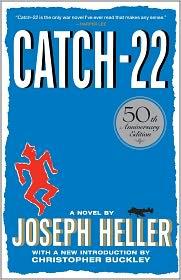
Compared to Catch-22's relentless comedy, Slaughterhouse-Five uses humor more sparingly and the grief is more visible. Which approach to representing war feels more honest to you?
- 9.
The novel was published in 1969 during Vietnam. How much of it is about World War II and how much is it talking about something happening in real time?
- 10.
Vonnegut was actually there, in that basement, when Dresden burned. How does knowing that change what you make of Billy Pilgrim's passivity?
- 11.
The book ends 'Poo-tee-weet?' — a bird call, the only appropriate response to what has happened. Is that resolution, or a refusal of resolution?
- 12.
If you had to describe the book to someone who had never heard of it in two sentences, what would you say? And is that description actually true to what reading it feels like?
Themes
Frequently asked questions
-
What is Slaughterhouse-Five about?
A World War II veteran named Billy Pilgrim who has become 'unstuck in time' and jumps involuntarily between moments in his life, including his experience surviving the firebombing of Dresden in 1945. It's a novel about trauma, war, and the impossibility of making sense of mass death.
-
Is Billy Pilgrim really a time traveler?
The novel doesn't resolve this. Billy may have been abducted by aliens and genuinely displaced in time, or he may be a traumatized veteran constructing an elaborate psychological escape from unbearable memories. Both readings are supported by the text.
-
Why does Vonnegut say 'So it goes' after every death?
It's a phrase used by the Tralfamadorians — aliens who see time as fixed and death as simply a bad moment in one of many. Vonnegut uses it ironically to show how people survive atrocity by numbing themselves, and as a protest against how America treated its war dead.
-
Is Slaughterhouse-Five hard to read?
Not difficult in terms of language — the prose is simple and the chapters are short. The challenge is structural: the timeline jumps constantly, and the novel resists the kind of emotional catharsis that straightforward war narratives provide.
-
Who shouldn't read Slaughterhouse-Five?
Readers who want a clear chronological story, defined characters, or any sense that the events lead somewhere will find it frustrating. The book's power comes from its refusal of exactly those things. If that refusal sounds like a problem, it will be one.