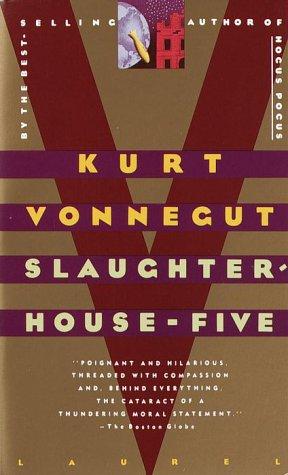
Talk to Slaughterhouse-Five like its author wrote you back.
Get the ideas that fit your life — not generic summaries.
- Chat with the book
- Audiobook-style main ideas
- Adapts to your life and goals
- Helps you take action
What it argues
Billy Pilgrim has become unstuck in time. A former American prisoner of war who survived the firebombing of Dresden in a slaughterhouse basement, Billy now jumps involuntarily between moments in his life — his boring optometry practice in upstate New York, his capture during the Battle of the Bulge, his years as a living exhibit on the planet Tralfamadore, his daughter's wedding. And then he travels back to Dresden. Slaughterhouse-Five, published in 1969, is Vonnegut's attempt to write about a war atrocity he survived and couldn't process through conventional narrative means. It's among the strangest and most effective antiwar novels ever written.
The book is overtly about the limits of story when applied to catastrophe. The first chapter is Vonnegut himself explaining that he tried for years to write about Dresden the normal way and couldn't — and so he invented Billy Pilgrim, who processes the unprocessable through time travel and alien abduction. The Tralfamadorians' view of time — all moments exist simultaneously, and death simply means the person is having a bad moment in one of them, so it goes — is both a coping mechanism and a satire of fatalism. Billy's "So it goes" after every death in the novel is devastatingly funny and devastatingly sad at once.
What it gets right
- 1.
The Tralfamadorian philosophy — all moments exist simultaneously, death is just a bad moment — is Vonnegut presenting a coping mechanism honestly: it helps, and it is also a way of avoiding responsibility and grief.
- 2.
'So it goes' appears after every death in the novel. The repetition does something to the reader that commentary can't: it performs the numbing that war produces.
- 3.
The firebombing of Dresden killed more civilians than Hiroshima and was barely discussed in postwar America. Vonnegut understood that the shape of memory is political.
What it covers
Who wrote it
Kurt Vonnegut (1922–2007) survived the firebombing of Dresden as an American prisoner of war, an experience that haunted him for two decades before becoming the subject of Slaughterhouse-Five. He worked as a journalist and writer for General Electric before publishing his first novel, Player Piano, in 1952. His major works include Cat's Cradle, Breakfast of Champions, and Mother Night. Known for his darkly comic voice, humanist politics, and the signature phrase "So it goes," Vonnegut became one of the most beloved American writers of the twentieth century, particularly during the Vietnam era.
