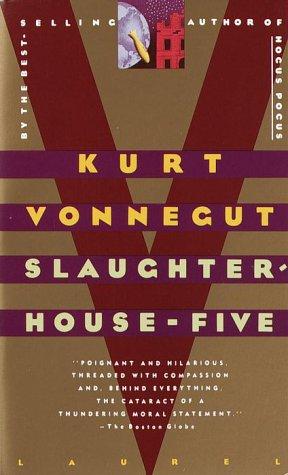
Talk to Slaughterhouse-Five like its author wrote you back.
Get the ideas that fit your life — not generic summaries.
- Chat with the book
- Audiobook-style main ideas
- Adapts to your life and goals
- Helps you take action
Slaughterhouse-Five, in detail
Billy Pilgrim has become unstuck in time. A former American prisoner of war who survived the firebombing of Dresden in a slaughterhouse basement, Billy now jumps involuntarily between moments in his life — his boring optometry practice in upstate New York, his capture during the Battle of the Bulge, his years as a living exhibit on the planet Tralfamadore, his daughter's wedding. And then he travels back to Dresden. Slaughterhouse-Five, published in 1969, is Vonnegut's attempt to write about a war atrocity he survived and couldn't process through conventional narrative means. It's among the strangest and most effective antiwar novels ever written.
The book is overtly about the limits of story when applied to catastrophe. The first chapter is Vonnegut himself explaining that he tried for years to write about Dresden the normal way and couldn't — and so he invented Billy Pilgrim, who processes the unprocessable through time travel and alien abduction. The Tralfamadorians' view of time — all moments exist simultaneously, and death simply means the person is having a bad moment in one of them, so it goes — is both a coping mechanism and a satire of fatalism. Billy's "So it goes" after every death in the novel is devastatingly funny and devastatingly sad at once.
Vonnegut's prose is conversational, flat, and deeply controlled. The short declarative sentences and chapter breaks feel almost childlike. They aren't. The simplicity is a way of reporting the unspeakable plainly, without inflation, which turns out to be more affecting than any conventional tragic register. The novel is also very funny, and it shouldn't be, and Vonnegut knows it shouldn't be, and the comedy and the horror refuse to separate.
Slaughterhouse-Five is short, unusual, and emotionally demanding in ways that aren't immediately obvious. Readers who want narrative tension or character development in the traditional sense will find it thin. What the book actually offers is something closer to a sustained mood — the texture of a survivor's mind, full of gaps and dark humor and the reflex to say "so it goes" because there's nothing else adequate to say. It has aged into one of the defining American novels, partly because the question of what to do with catastrophe — how to represent it, how to live with it — hasn't gotten easier.
The big ideas
- 1.
The Tralfamadorian philosophy — all moments exist simultaneously, death is just a bad moment — is Vonnegut presenting a coping mechanism honestly: it helps, and it is also a way of avoiding responsibility and grief.
- 2.
'So it goes' appears after every death in the novel. The repetition does something to the reader that commentary can't: it performs the numbing that war produces.
- 3.
The firebombing of Dresden killed more civilians than Hiroshima and was barely discussed in postwar America. Vonnegut understood that the shape of memory is political.
