Self-help · Book club
Slow Productivity book club questions
Here are 12 book club questions for Slow Productivity by Cal Newport, ordered to open easily and end somewhere worth arguing about. Copy them, print them, or bring them up one at a time.
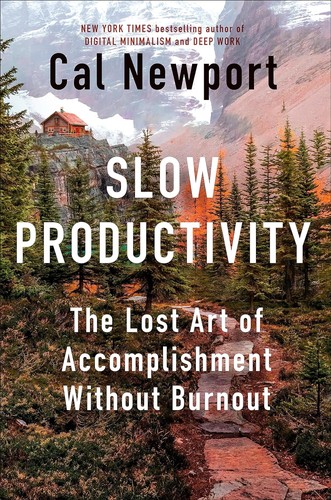
Slow Productivity is Cal Newport's argument that the dominant metric for productivity in knowledge work — visible busyness, inbox management, endless meeting attendance — is both exhausting and counterproductive, and that a more sustainable model exists.
Cal Newport · 2024 · 4h 15m
Full summary and key takeaways →The 12 questions
- 1.
Newport distinguishes pseudo-productivity from actual productivity. Where in your work life are you performing busyness rather than producing outcomes you care about?
- 2.
How many active projects do you currently have? If you cut that in half and spent the same total time on the remainder, what do you think the quality difference would be?
- 3.
What is your natural work rhythm like? Do you have high-output periods and low-output periods? Does your current work structure allow for that variation?
- 4.
Think of a piece of work you're genuinely proud of. What conditions made it possible? Were you overloaded or focused?
- 5.
Newport argues that visible busyness became the default productivity metric because knowledge work output is hard to measure. Do you see this pattern in your organization?
- 6.
What commitments could you decline or exit this month without significant long-term harm? What's stopping you?
- 7.
Newport profiles historical figures who produced significant bodies of work at a seemingly relaxed pace. Which examples did you find most compelling, and why?
- 8.
How do you currently decide whether to take on a new commitment? What criteria are you actually using, and are they the right ones?
- 9.
What would it look like to obsess over the quality of one thing in your work rather than managing the throughput of many things?
- 10.
Where in your life do you feel the most sustained, meaningful output happening? What's different about those conditions?
- 11.
Newport is a tenured professor with significant schedule control. How much of his advice is transferable to roles with less autonomy?
- 12.
What would 'slow productivity' look like as an explicit organizational culture, not just an individual practice?
How to run the discussion
- Pick six to eight, not all of them. An hour of real discussion covers fewer questions than anyone expects, and racing the list is what makes a book club feel like homework.
- Open with what people noticed, not what they concluded. Asking for a verdict first hardens opinions before anyone has heard each other.
- Let the disagreement run. The questions below that split a room are the ones worth the time; the ones everyone answers the same way can be skipped.
- Ask the quiet person a specific question. A direct, narrow question is far easier to answer than an open invitation to contribute.
Themes worth steering toward
If the conversation stalls, these are the threads that usually restart it.
Common questions
What are good book club questions for Slow Productivity?
Here are 12 book club questions for Slow Productivity by Cal Newport, ordered to open easily and end somewhere worth arguing about. The strongest openers ask what each reader noticed rather than what they concluded, and the discussion usually turns on productivity, knowledge work, focus.
How long should a book club discussion of Slow Productivity last?
Most groups run 60 to 90 minutes of actual discussion. That is roughly six to eight questions, not all of them, so pick the ones that suit your group rather than working down the list in order.
What are the main themes in Slow Productivity?
Productivity, Knowledge work, Focus, Work-life balance, Sustainable output. Those are the threads most likely to divide a room, which makes them the useful places to steer a discussion that has gone quiet.
Picking the next one? See books like Slow Productivity or questions for other book club picks.
