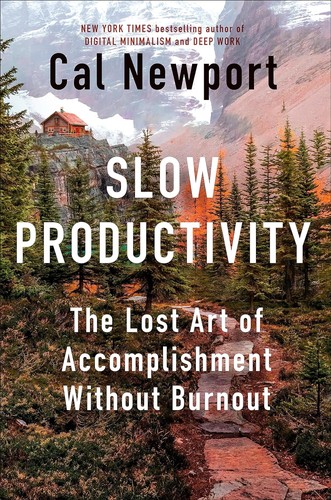
Slow Productivity by Cal Newport is a 2024 self-help book about productivity, knowledge work, focus. Pseudo-productivity — performing busyness through visible activity — is not the same as producing meaningful work. Most knowledge workers conflate them because actual output is hard to measure.
Summary
Slow Productivity is Cal Newport's argument that the dominant metric for productivity in knowledge work — visible busyness, inbox management, endless meeting attendance — is both exhausting and counterproductive, and that a more sustainable model exists. Newport draws on the working lives of historical figures: Charles Darwin, John Muir, Jewel, and others who produced significant bodies of work without being in a permanent state of frantic activity. The alternative he proposes isn't laziness; it's a deliberate reconfiguration of how work is structured and valued.
Newport organizes the book around three principles. The first is "do fewer things." Most knowledge workers carry far more active projects than they can attend to well. Newport argues that reducing the total number of concurrent commitments produces better output per project and less of the cognitive tax of switching between competing obligations. The second principle is "work at a natural pace," which draws on the contrast between the industrial-era ideal of uniform daily output and the more variable rhythms that most creative and intellectual work actually requires. The third principle is "obsess over quality." High-quality work produced at a sustainable pace tends to generate more meaningful career outcomes than high-volume work produced under constant pressure.
The book is partly cultural critique. Newport's diagnosis is that knowledge workers drifted into pseudo-productivity — the performance of busyness — because knowledge work lacks the clear output metrics that governed industrial labor, making visible effort the default proxy for value. He argues this default is both new and optional, not an inevitable feature of professional life.
Slow Productivity is Newport's most explicitly personal and philosophical book to date, and it reads differently from Deep Work and A World Without Email. Those books were structured around practical prescriptions; this one is closer to an extended argument about what work is for. It is most useful for people who feel productive by most conventional measures but somehow dissatisfied with the texture of their working life.
Talk to Slow Productivity like its author wrote you back.
Get the ideas that fit your life — not generic summaries.
- Chat with the book
- Audiobook-style main ideas
- Adapts to your life and goals
- Helps you take action
Key takeaways
- 1.
Pseudo-productivity — performing busyness through visible activity — is not the same as producing meaningful work. Most knowledge workers conflate them because actual output is hard to measure.
- 2.
Reducing the number of active commitments improves the quality of work on each one. A full plate doesn't signal ambition; it signals a missing filter.
- 3.
Creative and intellectual work naturally operates at variable intensity. Treating every day as peak output is unsustainable and produces inferior results compared to following the natural ebb and flow.
- 4.
Obsessing over the quality of a small number of outputs is a more reliable career strategy than maintaining high volume on many projects.
- 5.
Many of history's most productive creators worked in shorter, less frantic bursts than their output volumes suggest. The appearance of superhuman industry is often a retrospective illusion.
- 6.
Calendar and inbox management are admin tasks, not knowledge work. Optimizing them obsessively is a form of productive procrastination.
- 7.
Slow productivity requires saying no to commitments that don't deserve yes, which requires clear criteria for what deserves yes in the first place.
- 8.
The industrial model of uniform daily output was designed for assembly lines. Applying it to knowledge work produces workers who are busy all the time and excellent only occasionally.
Discussion questions
Use these on your own, with a book club, or as chat starters in Superbook. Book club version, ready to copy or print →
- 1.
Newport distinguishes pseudo-productivity from actual productivity. Where in your work life are you performing busyness rather than producing outcomes you care about?
- 2.
How many active projects do you currently have? If you cut that in half and spent the same total time on the remainder, what do you think the quality difference would be?
- 3.
What is your natural work rhythm like? Do you have high-output periods and low-output periods? Does your current work structure allow for that variation?
- 4.
Think of a piece of work you're genuinely proud of. What conditions made it possible? Were you overloaded or focused?
- 5.
Newport argues that visible busyness became the default productivity metric because knowledge work output is hard to measure. Do you see this pattern in your organization?
- 6.
What commitments could you decline or exit this month without significant long-term harm? What's stopping you?
- 7.
Newport profiles historical figures who produced significant bodies of work at a seemingly relaxed pace. Which examples did you find most compelling, and why?
- 8.
How do you currently decide whether to take on a new commitment? What criteria are you actually using, and are they the right ones?
- 9.
What would it look like to obsess over the quality of one thing in your work rather than managing the throughput of many things?
- 10.
Where in your life do you feel the most sustained, meaningful output happening? What's different about those conditions?
- 11.
Newport is a tenured professor with significant schedule control. How much of his advice is transferable to roles with less autonomy?
- 12.
What would 'slow productivity' look like as an explicit organizational culture, not just an individual practice?
Themes
Frequently asked questions
-
Is Slow Productivity worth reading if I've already read Deep Work?
Yes, but expect a different book. Deep Work is practical and tactical; Slow Productivity is more philosophical, arguing about what work is for rather than how to protect focus. The two books are complementary but don't substantially repeat each other.
-
Who is Slow Productivity for?
Knowledge workers who feel chronically overloaded and vaguely dissatisfied despite checking off tasks. The book is particularly useful for people who have optimized their productivity systems but still feel something is wrong with how they're spending their time.
-
What are the three principles of slow productivity?
Do fewer things, work at a natural pace, and obsess over quality. Each principle addresses a different pathology of modern knowledge work: overcommitment, the expectation of uniform daily output, and the preference for volume over quality.
-
Does Newport recommend literally working fewer hours?
Not exactly. The argument is about fewer concurrent commitments and a more variable natural rhythm, not a specific reduction in weekly hours. Some days might involve intense effort; others might involve less. The goal is sustainable high-quality output over years, not a shorter workweek.
-
How long does it take to read Slow Productivity?
About four hours. It is shorter and less densely footnoted than some of Newport's earlier books, and the argument moves quickly. The biographical examples are well-selected and readable, though some readers will want more tactical guidance than Newport provides here.
Similar books
Deep Work
Cal Newport
A World Without Email
Cal Newport
Essentialism: The Disciplined Pursuit of Less
Greg McKeown
Four Thousand Weeks: Time Management for Mortals
Oliver Burkeman
