Talk to Slow Productivity like its author wrote you back.
Get the ideas that fit your life — not generic summaries.
- Chat with the book
- Audiobook-style main ideas
- Adapts to your life and goals
- Helps you take action
What it argues
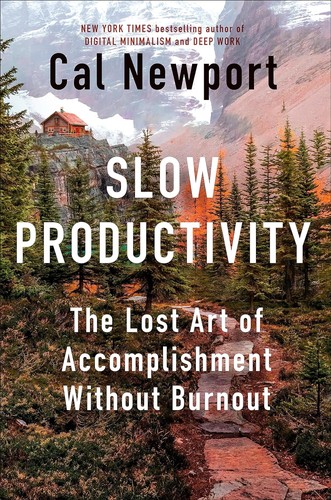
Slow Productivity is Cal Newport's argument that the dominant metric for productivity in knowledge work — visible busyness, inbox management, endless meeting attendance — is both exhausting and counterproductive, and that a more sustainable model exists. Newport draws on the working lives of historical figures: Charles Darwin, John Muir, Jewel, and others who produced significant bodies of work without being in a permanent state of frantic activity. The alternative he proposes isn't laziness; it's a deliberate reconfiguration of how work is structured and valued.
Newport organizes the book around three principles. The first is "do fewer things." Most knowledge workers carry far more active projects than they can attend to well. Newport argues that reducing the total number of concurrent commitments produces better output per project and less of the cognitive tax of switching between competing obligations. The second principle is "work at a natural pace," which draws on the contrast between the industrial-era ideal of uniform daily output and the more variable rhythms that most creative and intellectual work actually requires. The third principle is "obsess over quality." High-quality work produced at a sustainable pace tends to generate more meaningful career outcomes than high-volume work produced under constant pressure.
What it gets right
- 1.
Pseudo-productivity — performing busyness through visible activity — is not the same as producing meaningful work. Most knowledge workers conflate them because actual output is hard to measure.
- 2.
Reducing the number of active commitments improves the quality of work on each one. A full plate doesn't signal ambition; it signals a missing filter.
- 3.
Creative and intellectual work naturally operates at variable intensity. Treating every day as peak output is unsustainable and produces inferior results compared to following the natural ebb and flow.
What it covers
Who wrote it
Cal Newport is a computer science professor at Georgetown University and the author of seven books on focus, work, and career strategy, including Deep Work, Digital Minimalism, and A World Without Email. He avoids social media, writes regularly at calnewport.com, and hosts the Deep Questions podcast. Slow Productivity, published in 2024, is his most explicitly philosophical book, stepping back from specific techniques to argue about what sustainable, meaningful knowledge work looks like over a career.
