Fantasy · Book club
Small Gods book club questions
Here are 12 book club questions for Small Gods by Terry Pratchett, ordered to open easily and end somewhere worth arguing about. Copy them, print them, or bring them up one at a time.
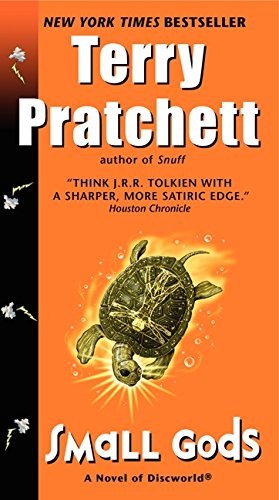
Small Gods is the thirteenth Discworld novel and the one most often cited as the best entry point into the series — and as the best argument that Pratchett was writing serious literature inside the clothing of comic fantasy.
Terry Pratchett · 1992 · 6h 0m
Full summary and key takeaways →The 12 questions
- 1.
Pratchett distinguishes between believing in Om and believing in the Church of Om. Do you think that distinction is coherent? Can you believe in an institution without believing in what it was founded to represent?
- 2.
Vorbis never doubts himself. The book presents that certainty as his defining moral failure. Is self-doubt a virtue, or is there a form of conviction that Pratchett would exempt from this critique?
- 3.
Om is forced to become humble by being reduced to a tortoise — dependent on a single believer, unable to command anything. How does that experience change him? Is what he becomes at the end of the book an improvement?
- 4.
Brutha cannot lie and cannot stop caring about people. Those qualities are presented as both a vulnerability and, ultimately, a kind of power. How does the book develop that argument?
- 5.
The Omnian Church uses torture and execution to enforce belief. The book is clear that this is wrong, but it is also clear that the people who run the Church are not monsters — they believe in what they are doing. What does Pratchett think is the difference between sincere evil and mere evil?
- 6.
The philosophers in the desert represent the intellectual life under persecution — people whose only offense is following arguments wherever they lead. What does Pratchett think we owe them?
- 7.
The ending of the book, in which Brutha is given a choice, is among the most emotionally powerful endings in the Discworld series. What does that choice reveal about what the book values?
- 8.
Small Gods is often described as a critique of organized religion. Is it fair to read it that way? Is Pratchett anti-religion, or is he making a more specific argument about the difference between faith and institution?
- 9.
Compare Vorbis to other literary portraits of sincere institutional evil — Grand Inquisitors in Dostoevsky, Umberto Eco's Jorge, O'Brien in 1984. What does Pratchett add to that tradition?
- 10.
The book is set in a culture clearly modeled on ancient Mediterranean civilizations. Does the historical analogy clarify the argument or does it let contemporary readers off the hook by treating the critique as historical?
- 11.
Pratchett was not a religious believer, but Small Gods is clearly not a simple atheist polemic. What does the book actually think about the existence of gods? Is the answer 'it depends on whether anyone believes in them' satisfying?
- 12.
Small Gods is recommended as the best introduction to Discworld. If this is your first Pratchett, what do you make of the series' reputation as primarily comedic? Does this book match that description?
How to run the discussion
- Pick six to eight, not all of them. An hour of real discussion covers fewer questions than anyone expects, and racing the list is what makes a book club feel like homework.
- Open with what people noticed, not what they concluded. Asking for a verdict first hardens opinions before anyone has heard each other.
- Let the disagreement run. The questions below that split a room are the ones worth the time; the ones everyone answers the same way can be skipped.
- Ask the quiet person a specific question. A direct, narrow question is far easier to answer than an open invitation to contribute.
Themes worth steering toward
If the conversation stalls, these are the threads that usually restart it.
Common questions
What are good book club questions for Small Gods?
Here are 12 book club questions for Small Gods by Terry Pratchett, ordered to open easily and end somewhere worth arguing about. The strongest openers ask what each reader noticed rather than what they concluded, and the discussion usually turns on religion and institutional power, faith versus belief, tyranny and truth.
How long should a book club discussion of Small Gods last?
Most groups run 60 to 90 minutes of actual discussion. That is roughly six to eight questions, not all of them, so pick the ones that suit your group rather than working down the list in order.
What are the main themes in Small Gods?
Religion and institutional power, Faith versus belief, Tyranny and truth, The individual against the system, Doubt as moral courage. Those are the threads most likely to divide a room, which makes them the useful places to steer a discussion that has gone quiet.
Picking the next one? See books like Small Gods or questions for other book club picks.
