Small Gods by Terry Pratchett is a 1992 fantasy book about religion and institutional power, faith versus belief, tyranny and truth. Pratchett's central distinction — between believing in a god and believing in an institution that claims to represent a god — is stated early and the entire book is its elaboration.
Summary
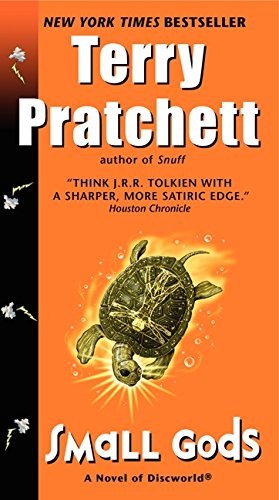
Small Gods is the thirteenth Discworld novel and the one most often cited as the best entry point into the series — and as the best argument that Pratchett was writing serious literature inside the clothing of comic fantasy. Published in 1992, it tells the story of Om, a god of an aggressive monotheistic religion, who manifests on Discworld as a small tortoise because almost no one in his own theocracy actually believes in him anymore — they believe in the Church of Om, which is a different and more comfortable thing. Only Brutha, a novice with a perfect memory and a complete inability to lie, genuinely believes. The plot follows their reluctant partnership across the desert and through a crisis that will determine whether Om survives or dwindles into nothing.
The book is Pratchett's most direct engagement with religion and institutional power. He is not writing an atheist polemic — he is writing about the difference between genuine faith and institutional religion, between what a god is and what a church becomes. The Omnian Church has the architecture, the hierarchy, the dungeons, and the exquisite instruments of torture; it has the power to reshape kingdoms and burn philosophers. What it lacks is actual divine presence, because actual divine presence requires people who believe, and belief cannot be compelled. Vorbis — the Deacon, the book's human antagonist — is one of Pratchett's great villains: terrifyingly competent, genuinely pious in his own way, and utterly convinced that cruelty in the service of truth is not cruelty at all.
What distinguishes Small Gods from Pratchett's other work is its emotional weight and its willingness to let the comedy take second place. There are jokes — Pratchett cannot help jokes — but the book is darker and more sustained in its seriousness than most Discworld novels. The scene in which Brutha confronts Vorbis at the end of the book is not funny at all, and Pratchett means it. The book's argument — that the gods need their believers as much as believers need their gods, and that institutions built around something sacred inevitably betray what they claim to serve — is stated plainly enough that Pratchett does not need to hide it in metaphor.
Small Gods stands completely alone and requires no prior knowledge of Discworld. It is the book to read if someone tells you Pratchett is merely a comedy writer. It is the book to give someone who loved The Name of the Rose or found Umberto Eco's argument about institutional religion interesting but wanted it funnier. It requires nothing from the reader except willingness to follow an argument delivered via a small tortoise and a naive boy walking through a desert.
Talk to Small Gods like its author wrote you back.
Get the ideas that fit your life — not generic summaries.
- Chat with the book
- Audiobook-style main ideas
- Adapts to your life and goals
- Helps you take action
Key takeaways
- 1.
Pratchett's central distinction — between believing in a god and believing in an institution that claims to represent a god — is stated early and the entire book is its elaboration.
- 2.
Vorbis is the most fully realized villain in the Discworld series: not cartoonishly evil but genuinely, terrifyingly righteous — a man who has never doubted himself and whose certainty is the most dangerous thing about him.
- 3.
Om's reduction to a small tortoise is the book's master metaphor: power depends on belief, belief cannot survive institutional coercion for long, and the gods who survive are those with genuine relationships to their followers.
- 4.
Brutha's perfect memory is used against him by the institution — and eventually for him, in a way the institution could not have predicted. Pratchett is precise about the difference between what institutions fear and what they should.
- 5.
The philosophers in the Omnian desert — tortured, burned, persecuted — are the book's clearest heroes. Pratchett has great affection for people who follow an argument wherever it leads even at cost to themselves.
- 6.
The book's treatment of death — Om's potential extinction, Brutha's eventual death, the choice offered at the end — is among the most moving things Pratchett wrote in any Discworld novel.
- 7.
Small Gods is an argument for doubt as a moral virtue. Certainty — especially religious certainty — is presented as the primary engine of atrocity in the book.
- 8.
Pratchett's voice is at its most controlled here: funnier than most novelists, yes, but the humor is precision-tooled to serve the argument rather than to entertain in place of one.
Discussion questions
Use these on your own, with a book club, or as chat starters in Superbook. Book club version, ready to copy or print →
- 1.
Pratchett distinguishes between believing in Om and believing in the Church of Om. Do you think that distinction is coherent? Can you believe in an institution without believing in what it was founded to represent?
- 2.
Vorbis never doubts himself. The book presents that certainty as his defining moral failure. Is self-doubt a virtue, or is there a form of conviction that Pratchett would exempt from this critique?
- 3.
Om is forced to become humble by being reduced to a tortoise — dependent on a single believer, unable to command anything. How does that experience change him? Is what he becomes at the end of the book an improvement?
- 4.
Brutha cannot lie and cannot stop caring about people. Those qualities are presented as both a vulnerability and, ultimately, a kind of power. How does the book develop that argument?
- 5.
The Omnian Church uses torture and execution to enforce belief. The book is clear that this is wrong, but it is also clear that the people who run the Church are not monsters — they believe in what they are doing. What does Pratchett think is the difference between sincere evil and mere evil?
- 6.
The philosophers in the desert represent the intellectual life under persecution — people whose only offense is following arguments wherever they lead. What does Pratchett think we owe them?
- 7.
The ending of the book, in which Brutha is given a choice, is among the most emotionally powerful endings in the Discworld series. What does that choice reveal about what the book values?
- 8.
Small Gods is often described as a critique of organized religion. Is it fair to read it that way? Is Pratchett anti-religion, or is he making a more specific argument about the difference between faith and institution?
- 9.
Compare Vorbis to other literary portraits of sincere institutional evil — Grand Inquisitors in Dostoevsky, Umberto Eco's Jorge, O'Brien in 1984. What does Pratchett add to that tradition?
- 10.
The book is set in a culture clearly modeled on ancient Mediterranean civilizations. Does the historical analogy clarify the argument or does it let contemporary readers off the hook by treating the critique as historical?
- 11.
Pratchett was not a religious believer, but Small Gods is clearly not a simple atheist polemic. What does the book actually think about the existence of gods? Is the answer 'it depends on whether anyone believes in them' satisfying?
- 12.
Small Gods is recommended as the best introduction to Discworld. If this is your first Pratchett, what do you make of the series' reputation as primarily comedic? Does this book match that description?
Themes
Frequently asked questions
-
Do I need to have read other Discworld books first?
No — Small Gods stands completely alone. It shares the Discworld cosmology but requires no prior knowledge. It is frequently recommended as the best place to start the series precisely because it works without context.
-
Is Small Gods funny?
Yes, but the humor is quieter and more purposeful than in earlier Discworld novels. This is not a comedy first; it is a serious argument about religion and institutional power that happens to be written by a very funny man. The tone shifts are deliberate.
-
What is the book actually arguing about religion?
It argues that institutional religion and genuine faith are different things, that institutions inevitably corrupt what they claim to protect, and that certainty — especially certainty in the name of the sacred — is the most dangerous human quality. It is not an argument that gods don't exist; it is an argument about what belief requires and what institutions cannot provide.
-
Why is Small Gods considered one of Pratchett's best?
Because it demonstrates that the comedy and the philosophy were never in conflict — that the funniness was always in service of an argument, not a substitute for one. Small Gods makes that argument clearly and at full emotional cost. It does not sacrifice its seriousness for a joke.
-
Who might find Small Gods disappointing?
Readers who want the pure comic momentum of the earlier Discworld books — the carnivalesque energy of The Color of Magic or Mort — may find Small Gods too focused and too serious. It earns its darkness, but readers who came for jokes may feel the book has other priorities.