Self-help · Book club
Smarter Faster Better book club questions
Here are 12 book club questions for Smarter Faster Better by Charles Duhigg, ordered to open easily and end somewhere worth arguing about. Copy them, print them, or bring them up one at a time.
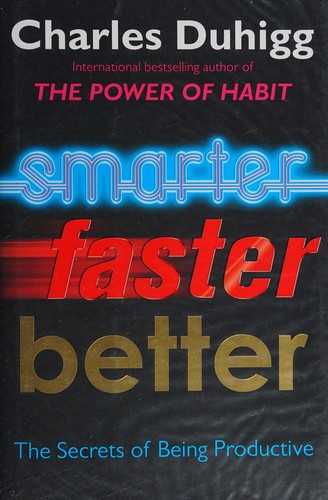
Smarter Faster Better is Duhigg's follow-up to The Power of Habit, turning from habitual behavior to the science of productive decision-making and sustained motivation.
Charles Duhigg · 2016 · 5h 20m
Full summary and key takeaways →The 12 questions
- 1.
Duhigg argues that motivation is built through agency, not praise. Where in your life could you reframe obligations to emphasize choice rather than compulsion?
- 2.
Google's Project Aristotle found that psychological safety was the primary predictor of team effectiveness. How safe is it to take interpersonal risks in your current team or organization?
- 3.
What is the stretch goal most important to you right now? What would the SMART goals that implement it look like?
- 4.
Have you ever built an explicit mental model before a complex decision — a scenario for what you expected to happen? How did reality compare?
- 5.
Where in your work are you currently reactive to incoming information rather than choosing what to focus on? What would choosing look like?
- 6.
Duhigg covers the story of the Cincinnati teacher who got students to engage with data by having them create it. What would it mean to create data actively about something you're trying to understand rather than just receiving it?
- 7.
The Marine training reform that used cognitive autonomy produced better soldiers than punishment-based training. What does that suggest about how you develop people around you?
- 8.
The innovation chapter describes people who cross communities as more likely to produce breakthroughs. How siloed is your current professional world? What community are you not currently part of that might offer new combinations?
- 9.
Probabilistic thinking requires explicitly acknowledging uncertainty. Where in your current work are you treating uncertain outcomes as binary when they're actually probabilistic?
- 10.
Duhigg's case studies involve disasters (plane crashes, data processing failures) as well as successes. What near-miss or small failure in your own work contains a lesson you haven't fully absorbed?
- 11.
Which of the eight concepts — motivation, teams, focus, goals, managing others, decisions, innovation, data — is the most critical gap in your current effectiveness?
- 12.
The book suggests that the practices of highly effective people are learnable, not innate. Which specific practice described in the book would most change your output if you implemented it consistently?
How to run the discussion
- Pick six to eight, not all of them. An hour of real discussion covers fewer questions than anyone expects, and racing the list is what makes a book club feel like homework.
- Open with what people noticed, not what they concluded. Asking for a verdict first hardens opinions before anyone has heard each other.
- Let the disagreement run. The questions below that split a room are the ones worth the time; the ones everyone answers the same way can be skipped.
- Ask the quiet person a specific question. A direct, narrow question is far easier to answer than an open invitation to contribute.
Themes worth steering toward
If the conversation stalls, these are the threads that usually restart it.
Common questions
What are good book club questions for Smarter Faster Better?
Here are 12 book club questions for Smarter Faster Better by Charles Duhigg, ordered to open easily and end somewhere worth arguing about. The strongest openers ask what each reader noticed rather than what they concluded, and the discussion usually turns on productivity, decision making, motivation.
How long should a book club discussion of Smarter Faster Better last?
Most groups run 60 to 90 minutes of actual discussion. That is roughly six to eight questions, not all of them, so pick the ones that suit your group rather than working down the list in order.
What are the main themes in Smarter Faster Better?
Productivity, Decision making, Motivation, Teams, Focus. Those are the threads most likely to divide a room, which makes them the useful places to steer a discussion that has gone quiet.
Picking the next one? See books like Smarter Faster Better or questions for other book club picks.
