Literary fiction · Book club
Solar Bones book club questions
Here are 11 book club questions for Solar Bones by Mike McCormack, ordered to open easily and end somewhere worth arguing about. Copy them, print them, or bring them up one at a time.
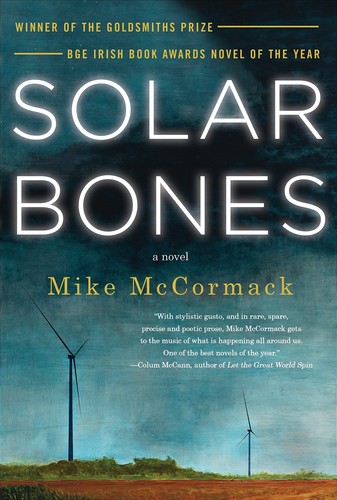
Marcus Conway, a civil engineer in rural County Mayo, Ireland, stands in his kitchen on All Souls' Day and narrates the events of the past year.
Mike McCormack · 2016 · 4h 45m
Full summary and key takeaways →The 11 questions
- 1.
McCormack's central formal choice — a single unbroken sentence — is an unusual commitment. Did it feel like an obstacle or did it work for you? At what point did you stop noticing it?
- 2.
Marcus is a civil engineer. Why do you think McCormack chose that profession specifically, and what is the novel saying about engineering as vocation?
- 3.
The water contamination story is based on a real public health scandal in Mayo. How does the specific political content sit alongside the personal narrative?
- 4.
The novel gradually reveals that Marcus is narrating from beyond death. Did you notice early, or was it a discovery? How does that revelation change earlier passages?
- 5.
Married life is depicted with unusual care and specificity. What does the novel seem to believe about long marriages?
- 6.
Marcus's adult children have their own crises and their own trajectories. How much does the novel belong to them as well as to him?
- 7.
The Irish Catholic framework — All Souls' Day, the dead returning — structures the novel's supernatural premise. Does the religious framing feel essential or incidental?
- 8.
Solar Bones is relatively short but formally demanding. Is there something appropriate about that — a life's span compressed into one long breath?
- 9.
The novel has been compared to Mrs Dalloway and Ulysses in terms of its single-day structure. Are those comparisons helpful or do they set the wrong expectations?
- 10.
What does the title mean to you, having read the novel?
- 11.
McCormack is dealing with grief — a family losing someone — but the narrator is the one who died. How does that inversion change how the grief lands?
How to run the discussion
- Pick six to eight, not all of them. An hour of real discussion covers fewer questions than anyone expects, and racing the list is what makes a book club feel like homework.
- Open with what people noticed, not what they concluded. Asking for a verdict first hardens opinions before anyone has heard each other.
- Let the disagreement run. The questions below that split a room are the ones worth the time; the ones everyone answers the same way can be skipped.
- Ask the quiet person a specific question. A direct, narrow question is far easier to answer than an open invitation to contribute.
Themes worth steering toward
If the conversation stalls, these are the threads that usually restart it.
Common questions
What are good book club questions for Solar Bones?
Here are 11 book club questions for Solar Bones by Mike McCormack, ordered to open easily and end somewhere worth arguing about. The strongest openers ask what each reader noticed rather than what they concluded, and the discussion usually turns on memory and mortality, family and ordinary life, ireland and history.
How long should a book club discussion of Solar Bones last?
Most groups run 60 to 90 minutes of actual discussion. That is roughly six to eight questions, not all of them, so pick the ones that suit your group rather than working down the list in order.
What are the main themes in Solar Bones?
Memory and mortality, Family and ordinary life, Ireland and history, Infrastructure and care, Grief and return. Those are the threads most likely to divide a room, which makes them the useful places to steer a discussion that has gone quiet.
Picking the next one? See books like Solar Bones or questions for other book club picks.
