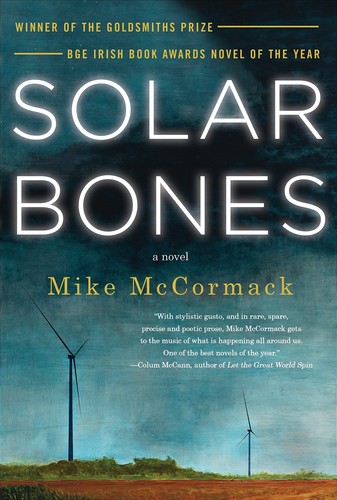
Solar Bones by Mike McCormack is a 2016 literary fiction book about memory and mortality, family and ordinary life, ireland and history. The single unbroken sentence enacts the way memory and consciousness actually work — associative, continuous, without the clean pauses that punctuation imposes.
Summary
Marcus Conway, a civil engineer in rural County Mayo, Ireland, stands in his kitchen on All Souls' Day and narrates the events of the past year. The novel is written as a single unbroken sentence — no full stops — and covers his marriage, his adult children, his work overseeing roads and bridges, a water contamination crisis that sickened his wife, and an increasingly clear sense of his own situation. Marcus is speaking from beyond the living world: he is dead, returned on the day the dead are remembered, and his narration is the only form of presence he has left.
The novel is about ordinary life taken seriously. McCormack is interested in what an engineer does — the unglamorous work of maintaining infrastructure, checking bridges, approving plans, signing off on drainage — as a form of care for a community. Marcus's work is treated with the same attention and dignity that fiction usually reserves for artists, philosophers, and saints. This is not incidental: the book is arguing that the maintenance of structures is a form of love, and that the people who do this work are doing something real and important and largely invisible.
The single-sentence form sounds more daunting than it is. McCormack's sentences breathe and pause; the lack of periods becomes a rhythm rather than an obstacle after the first thirty pages, and it enacts the specific quality of thought and memory the novel is about — the way consciousness moves without clean breaks, association to association, present to past. The prose is precise and often beautiful in an understated way that fits its subject.
Solar Bones won the Goldsmiths Prize and the International Dublin Literary Award and has been slowly gathering the readership it deserves since its initial publication by a small press. It is a short book that feels complete. Readers who want quiet intensity, a character observed with full intelligence, and a formal choice that serves its content will find it one of the best Irish novels of recent decades. Those expecting plot will wonder where it is.
Talk to Solar Bones like its author wrote you back.
Get the ideas that fit your life — not generic summaries.
- Chat with the book
- Audiobook-style main ideas
- Adapts to your life and goals
- Helps you take action
Key takeaways
- 1.
The single unbroken sentence enacts the way memory and consciousness actually work — associative, continuous, without the clean pauses that punctuation imposes.
- 2.
Marcus's work as a civil engineer is treated as a vocation rather than a job — maintenance and infrastructure are shown as forms of care and civic love.
- 3.
The water contamination crisis, based on a real event in Mayo, is the novel's political dimension: institutional failure with direct consequences for real bodies.
- 4.
The dead returning on All Souls' Day is both a traditional Catholic framework and something McCormack uses to say that the living remain present through memory and through the structures they leave behind.
- 5.
Ordinary married life is observed with more precision and affection than most novels manage — McCormack makes thirty years of partnership feel legible and specific.
- 6.
The formal choice supports the theme: a life without full stops is a life that does not pause to announce itself, that carries on until it simply doesn't.
- 7.
Ireland's recent history — the property boom, the crash, the church's decline, the small-town professional class — appears in peripheral detail that accumulates into a social portrait.
- 8.
The ending reveals what the novel has been from the beginning, and the revelation retroactively changes the quality of everything that preceded it.
Discussion questions
Use these on your own, with a book club, or as chat starters in Superbook. Book club version, ready to copy or print →
- 1.
McCormack's central formal choice — a single unbroken sentence — is an unusual commitment. Did it feel like an obstacle or did it work for you? At what point did you stop noticing it?
- 2.
Marcus is a civil engineer. Why do you think McCormack chose that profession specifically, and what is the novel saying about engineering as vocation?
- 3.
The water contamination story is based on a real public health scandal in Mayo. How does the specific political content sit alongside the personal narrative?
- 4.
The novel gradually reveals that Marcus is narrating from beyond death. Did you notice early, or was it a discovery? How does that revelation change earlier passages?
- 5.
Married life is depicted with unusual care and specificity. What does the novel seem to believe about long marriages?
- 6.
Marcus's adult children have their own crises and their own trajectories. How much does the novel belong to them as well as to him?
- 7.
The Irish Catholic framework — All Souls' Day, the dead returning — structures the novel's supernatural premise. Does the religious framing feel essential or incidental?
- 8.
Solar Bones is relatively short but formally demanding. Is there something appropriate about that — a life's span compressed into one long breath?
- 9.
The novel has been compared to Mrs Dalloway and Ulysses in terms of its single-day structure. Are those comparisons helpful or do they set the wrong expectations?
- 10.
What does the title mean to you, having read the novel?
- 11.
McCormack is dealing with grief — a family losing someone — but the narrator is the one who died. How does that inversion change how the grief lands?
Themes
Frequently asked questions
-
Is Solar Bones worth reading?
Yes. It is one of the most formally accomplished Irish novels of the past twenty years, and it does something formally unusual — the single sentence — in service of genuine emotional content rather than as a stunt. For readers willing to settle into its rhythm, it is quietly devastating.
-
Is the single-sentence structure really as hard as it sounds?
Less hard than it looks. The prose has internal rhythm and white space, and after 20-30 pages most readers report that it becomes a feature rather than an obstacle. It is not Joyce-level difficult. The bigger challenge is that very little happens in the conventional narrative sense.
-
What is Solar Bones about, without spoilers?
A middle-aged Irish civil engineer reflects on his life, his work, his family, and the community he has served. The novel's form — a single sentence on All Souls' Day — hints at his situation without making it explicit until late in the book.
-
Who shouldn't read this novel?
Readers who need plot and forward narrative momentum will find it frustrating. The novel is almost entirely retrospective — a man thinking back — and its pleasures are in prose and observation rather than in event.
-
Why is it called Solar Bones?
The title refers to the quality of light in the Irish west — bone-bright, as McCormack has described it — and to the way the dead are summoned: as structures, like bones, made visible in a particular light. It is also a phrase that captures the novel's interest in what endures after a body is gone.