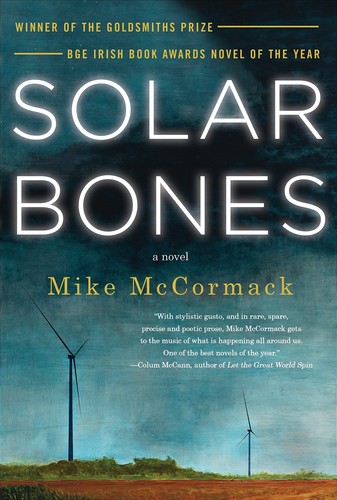
Talk to Solar Bones like its author wrote you back.
Get the ideas that fit your life — not generic summaries.
- Chat with the book
- Audiobook-style main ideas
- Adapts to your life and goals
- Helps you take action
What it argues
Marcus Conway, a civil engineer in rural County Mayo, Ireland, stands in his kitchen on All Souls' Day and narrates the events of the past year. The novel is written as a single unbroken sentence — no full stops — and covers his marriage, his adult children, his work overseeing roads and bridges, a water contamination crisis that sickened his wife, and an increasingly clear sense of his own situation. Marcus is speaking from beyond the living world: he is dead, returned on the day the dead are remembered, and his narration is the only form of presence he has left.
The novel is about ordinary life taken seriously. McCormack is interested in what an engineer does — the unglamorous work of maintaining infrastructure, checking bridges, approving plans, signing off on drainage — as a form of care for a community. Marcus's work is treated with the same attention and dignity that fiction usually reserves for artists, philosophers, and saints. This is not incidental: the book is arguing that the maintenance of structures is a form of love, and that the people who do this work are doing something real and important and largely invisible.
What it gets right
- 1.
The single unbroken sentence enacts the way memory and consciousness actually work — associative, continuous, without the clean pauses that punctuation imposes.
- 2.
Marcus's work as a civil engineer is treated as a vocation rather than a job — maintenance and infrastructure are shown as forms of care and civic love.
- 3.
The water contamination crisis, based on a real event in Mayo, is the novel's political dimension: institutional failure with direct consequences for real bodies.
What it covers
Who wrote it
Mike McCormack was born in London in 1965 and grew up in County Mayo, Ireland. He is the author of the story collection Getting It in the Head (1996), the novels Crowe's Requiem (1998), Notes from a Coma (2005), and Solar Bones (2016). Solar Bones won the Goldsmiths Prize and the International Dublin Literary Award, bringing McCormack wide recognition after two decades of quieter appreciation. He lives in Galway and teaches creative writing at the National University of Ireland, Galway.
