Science · Book club
Something Deeply Hidden: Quantum Worlds and the Emergence of Spacetime book club questions
Here are 12 book club questions for Something Deeply Hidden: Quantum Worlds and the Emergence of Spacetime by Sean Carroll, ordered to open easily and end somewhere worth arguing about. Copy them, print them, or bring them up one at a time.
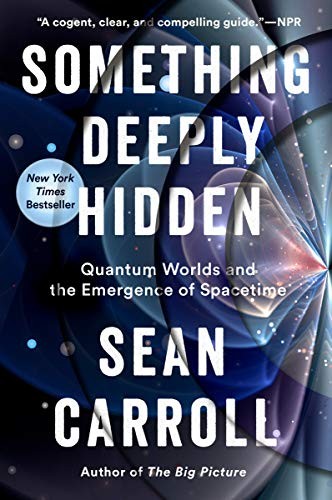
Something Deeply Hidden is Sean Carroll's case for the many-worlds interpretation of quantum mechanics — the view that when a quantum measurement occurs, the universe literally branches into multiple versions, each experiencing a different outcome.
Sean Carroll · 2019 · 6h 20m
Full summary and key takeaways →The 12 questions
- 1.
Carroll argues that the many-worlds interpretation is the most natural reading of quantum mechanics. What is the strongest objection to simply taking the math literally?
- 2.
The Copenhagen interpretation says 'shut up and calculate.' Is that a reasonable pragmatic stance, or does Carroll's charge of evasion feel justified to you?
- 3.
If the many-worlds interpretation is correct, there are versions of you that made different choices. Does that thought feel liberating, unsettling, or irrelevant to how you should live?
- 4.
Carroll distinguishes between what quantum mechanics predicts and what it means. In everyday reasoning, how often do you separate 'this works' from 'I understand why it works'?
- 5.
Decoherence explains why we don't see quantum superpositions in daily life without requiring a collapse. Does that seem like a satisfying explanation of why the world looks classical, or does it just hide the problem?
- 6.
Pilot wave theory reproduces all quantum predictions but requires non-local influences. How do you weigh explanatory elegance against the cost of adding non-locality to physics?
- 7.
Carroll argues that most physicists haven't taken many-worlds seriously due to cultural resistance rather than scientific reasons. How should you update when an expert claims their field has a collective blind spot?
- 8.
If spacetime emerges from quantum entanglement, what is more fundamental than space and time? What would it mean to investigate that?
- 9.
The book argues that the branching of worlds is not costly because the worlds don't take up extra space — they are just different parts of the wave function. Does that feel like an answer to the 'all those worlds' objection, or like sleight of hand?
- 10.
Carroll is candid about what is speculative versus established. How do you navigate a book where different chapters require very different levels of epistemic caution?
- 11.
What would it take to experimentally distinguish between many-worlds and Copenhagen? Is there any possible evidence, or is this purely a philosophical disagreement?
- 12.
The last section argues that space itself may not be fundamental. How does working backwards from our experience of a spatial world to a non-spatial quantum foundation feel as a research strategy?
How to run the discussion
- Pick six to eight, not all of them. An hour of real discussion covers fewer questions than anyone expects, and racing the list is what makes a book club feel like homework.
- Open with what people noticed, not what they concluded. Asking for a verdict first hardens opinions before anyone has heard each other.
- Let the disagreement run. The questions below that split a room are the ones worth the time; the ones everyone answers the same way can be skipped.
- Ask the quiet person a specific question. A direct, narrow question is far easier to answer than an open invitation to contribute.
Themes worth steering toward
If the conversation stalls, these are the threads that usually restart it.
Common questions
What are good book club questions for Something Deeply Hidden: Quantum Worlds and the Emergence of Spacetime?
Here are 12 book club questions for Something Deeply Hidden: Quantum Worlds and the Emergence of Spacetime by Sean Carroll, ordered to open easily and end somewhere worth arguing about. The strongest openers ask what each reader noticed rather than what they concluded, and the discussion usually turns on quantum mechanics, many-worlds interpretation, reality.
How long should a book club discussion of Something Deeply Hidden: Quantum Worlds and the Emergence of Spacetime last?
Most groups run 60 to 90 minutes of actual discussion. That is roughly six to eight questions, not all of them, so pick the ones that suit your group rather than working down the list in order.
What are the main themes in Something Deeply Hidden: Quantum Worlds and the Emergence of Spacetime?
Quantum mechanics, Many-worlds interpretation, Reality, Spacetime, Physics foundations. Those are the threads most likely to divide a room, which makes them the useful places to steer a discussion that has gone quiet.
Picking the next one? See books like Something Deeply Hidden: Quantum Worlds and the Emergence of Spacetime or questions for other book club picks.
