Philosophy · Book club
Sophie's World book club questions
Here are 12 book club questions for Sophie's World by Jostein Gaarder, ordered to open easily and end somewhere worth arguing about. Copy them, print them, or bring them up one at a time.
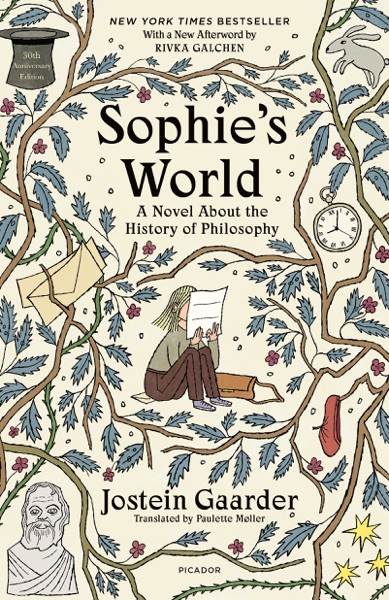
Sophie's World is Jostein Gaarder's novel about a fourteen-year-old Norwegian girl who begins receiving anonymous philosophy lessons — first as mysterious letters, then from a philosopher named Alberto Knox — that take her through the entire history of Western philosophy from the pre-Socratics to the present day.
Jostein Gaarder · 1991 · 10h 0m
Full summary and key takeaways →The 12 questions
- 1.
Gaarder chooses to teach philosophy through fiction rather than exposition. What does that format allow that a textbook doesn't, and what does it sacrifice?
- 2.
Which philosopher in Sophie's journey did you find most compelling or most alien, and what does your reaction say about your own assumptions?
- 3.
The meta-narrative asks: if Sophie is a fictional character who becomes aware of her fictional status, does she have a different kind of consciousness than one who doesn't? How does that apply to humans?
- 4.
Descartes concluded that the one thing he couldn't doubt was that he was thinking. Is that still a satisfying answer, or does it simply push the problem back a step?
- 5.
Kant argued that we can never know the thing-in-itself (the Ding an sich) — only the world as structured by our perception. Does that feel like a discovery or a defeat?
- 6.
The book covers enormous philosophical ground at speed. Where did you feel the presentation was too compressed to be useful?
- 7.
Gaarder's sympathies seem to lie with the continental European tradition. What gets left out by that emphasis?
- 8.
The novel form requires a protagonist with genuine curiosity. Does Sophie feel like a real person to you, or a device? Does it matter?
- 9.
Marx, Darwin, and Freud appear near the end as demolishers of comfortable assumptions about human nature and history. Which of the three still feels most unsettled in current culture?
- 10.
The book ends with a scene that deliberately collapses the boundary between fiction and reality. Did it work for you, or did the narrative trick undermine the philosophical substance?
- 11.
Sophie's World introduced many readers to philosophy who never pursued it further. What would you say to someone who has read this book and wants to go deeper into any one philosopher it covers?
- 12.
Gaarder wrote this primarily for Norwegian teenagers. Does it feel like that? What assumptions about the reader are visible in the text?
How to run the discussion
- Pick six to eight, not all of them. An hour of real discussion covers fewer questions than anyone expects, and racing the list is what makes a book club feel like homework.
- Open with what people noticed, not what they concluded. Asking for a verdict first hardens opinions before anyone has heard each other.
- Let the disagreement run. The questions below that split a room are the ones worth the time; the ones everyone answers the same way can be skipped.
- Ask the quiet person a specific question. A direct, narrow question is far easier to answer than an open invitation to contribute.
Themes worth steering toward
If the conversation stalls, these are the threads that usually restart it.
Common questions
What are good book club questions for Sophie's World?
Here are 12 book club questions for Sophie's World by Jostein Gaarder, ordered to open easily and end somewhere worth arguing about. The strongest openers ask what each reader noticed rather than what they concluded, and the discussion usually turns on history of philosophy, identity and consciousness, coming of age.
How long should a book club discussion of Sophie's World last?
Most groups run 60 to 90 minutes of actual discussion. That is roughly six to eight questions, not all of them, so pick the ones that suit your group rather than working down the list in order.
What are the main themes in Sophie's World?
History of philosophy, Identity and consciousness, Coming of age, Western thought, Metaphysics. Those are the threads most likely to divide a room, which makes them the useful places to steer a discussion that has gone quiet.
Picking the next one? See books like Sophie's World or questions for other book club picks.
